Textbook description of R##\ddot{\text o}##mer's light speed calculation

brotherbobby
Messages
793
Reaction score
175
TL;DR
A recent textbook (see below) has described the dutch astronomer R##\ddot{\text o}##mer's calculation of the velocity of light by alluding to the differences in the sighting of Jupiter's moon when the earth was ##\textit{moving away}## from the planet as against the earth ##\textit{moving towards}## the planet. I don't understand it. Why should light take longer or shorter times depending how the earth moved? I thought it was due to ##\textit{where}## the earth is, not how it was moving.
Statement of the problem : I copy and paste the clip from the text, underling in red the sentences where, in my opinion, the author(s) have gone wrong. I annonate to the right of the text in blue, assuming they are both readable. The text in question is titled Special and General Relativity (2026, Springer) by Boblest, Muller and Wunner.
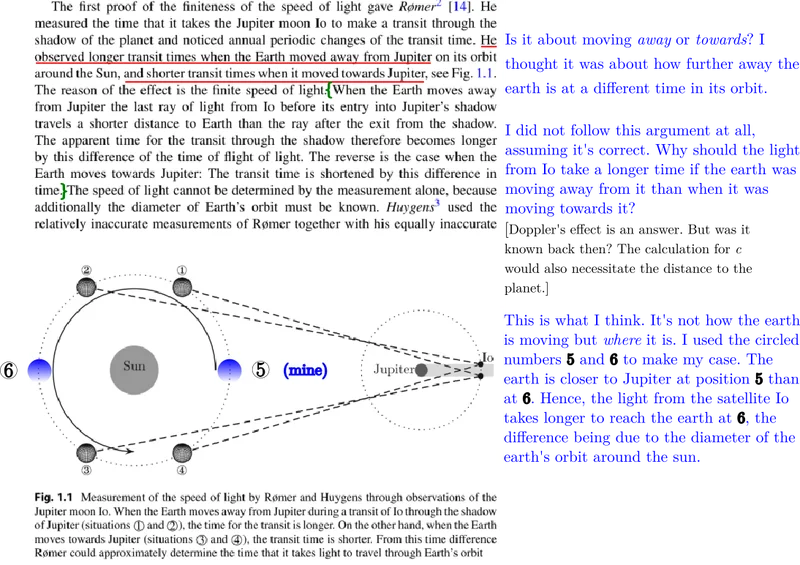
1780514038199.webp


I don't explain further, except for one point.

It is reported that R##\ddot{\text o}##mer found a time lag ##\Delta t = 22\;\text{minutes}\,## between the two sightings of the moon at different times of the year. Also, that he found the light's speed to measure to about ##\boxed{c = 220,000\;\text{km/s}}##.

I can use my reasoning as in the image to see if it fits. If indeed the time discrepancy takes place due to where the earth is relative to Jupiter, then the "culprit" should be the diameter of the earth's orbit. It is this extra distance that light has to travel that explains why it appears that the moon Io's stays a longer time eclipsed "behind" Jupiter.

This should help me calculate. We know the radius of the earth's orbit around the sun ##R_{\bigodot} = 1.5\times 10^8\;\text{km}##. The reported time lag ##\Delta t = 22\; \text{minutes}\, = 22\times 60\; \text{seconds}\, ##. Hence the speed of light ##c = \dfrac{2R_{\bigodot}}{\Delta t}= \dfrac{2\times 1.5 \times 10^8\;\text{km}}{22\times 60\;\text{s}} = \boxed{227272\;\text{km/s}}##, which is close to what was obtained.

Thanks for your time. If indeed I am mistaken and the authors are correct, I'd like to know of their reasoning and the calculation. The only way out I can see is if light is assumed to move through ether. Indeed, according to Doppler's effect, the speed of light (or sound) will change if the observer moved towards or away from the source. Is this the author's reasoning? Even if it was, I don't see how it leads to the result of light speed.
 
Last edited:
  • Like
Likes   Reactions: dextercioby and Dale
Physics news on Phys.org
I think the book's description is inadequate. This wikipedia entry has a better explanation.
 
  • Like
Likes   Reactions: Ibix
I think it would be fair on my part to carry out the calculation assuming the Doppler's effect, fair to the authors of the text that is. Let's assume the following was known at the time of R##\ddot{\text o}##mer.

Data : The distance to Jupiter from earth, ##d_J = 5.58\times 10^8\;\text{km}##. The velocity of the earth around the sun ##v_{\bigodot} = 10^5\;\text{km/h} \cong 30\;\text{km/s}##.
The time lag observed by the astronomer was ##\Delta t = 22\;\text{minutes}\; = 22\times 60\;\text{seconds}##
When the earth is moving towards Jupiter, the speed of light observed ##c_T = c+v_{\bigodot}## and when moving away, ##c_A = c-v_{\bigodot}##.

Hence the time lag ##\small{{\Delta t} = \dfrac{d_J}{c-v_{\bigodot}} - \dfrac{d_J}{c+v_{\bigodot} }=d_J\left( \dfrac{2v_{\bigodot}}{c^2-v^2_{\bigodot}}\right) = \dfrac{2v_{\bigodot}d_J}{c^2} \Rightarrow c = \left( \dfrac{2v_{\bigodot}d_J}{\Delta t} \right)^{\frac{1}{2}}},\;\text{since}\; c\gg v_{\bigodot}.##

This amounts to ##c = \left( \dfrac {2\times 30\times 5.58\times 10^8}{22\times 60} \right)^{\frac{1}{2}} \cong \boxed{5000\;\text{km/s}}##. This can't be right, assuming I haven't made calculation errors.
 
kuruman said:
I think the book's description is inadequate. This wikipedia entry has a better explanation.
To call it "inadequate" is putting it mildly.
My calculation above (post #3) shows that if the authors had Doppler's effect in mind for the differing speeds of light when the earth was moving towards and away from Jupiter, they are wrong in a big way.
It's not about how the earth is moving. Rather it's about where the earth is, or so it seems.
 
The Doppler effect is why the eclipse timings vary, because the distance to Jupiter changes between the beginning and end of the eclipse. You don't use the Doppler effect to calculate the speed of light though, not least because the radial velocity of Jupiter is zero at conjunction and opposition.

An idealised version of Rømer's experiment is to place a clock on Jupiter and watch it through a telescope. You observe that the clock takes 0.999s to tick 1s (numbers made up), from which you deduce that Jupiter is 0.001 light seconds closer now than it was 1s ago. You observe that the clock takes 0.998s to tick the next second, so Jupiter is 0.002 light seconds closer than 1s ago, 0.003 light seconds closer than two seconds ago. You keep cumulating the (signed!) time difference like this between opposition and conjunction to get a total time difference. You attribute this time to the extra distance, the diameter of Earth's orbit, and deduce that the diameter is 22 light minutes (or 16 light minutes, with more precise measurements).

Edit: note that here I'm using "light second" to mean the as-yet-unknown distance that light travels in one second, so all you get is the same as Rømer got, an observation that whatever distance light travels in a minute, Earth's orbit is 22 times larger. You need a separate measurement to calibrate this in feet or whatever Rømer would have used.
 
Last edited:
  • Like
Likes   Reactions: kuruman
brotherbobby said:
TL;DR: A recent textbook (see below) has described the dutch astronomer R##\ddot{\text o}##mer's calculation of the velocity of light by alluding to the differences in the sighting of Jupiter's moon when the earth was ##\textit{moving away}## from the planet as against the earth ##\textit{moving towards}## the planet. I don't understand it. Why should light take longer or shorter times depending how the earth moved? I thought it was due to ##\textit{where}## the earth is, not how it was moving.

Statement of the problem : I copy and paste the clip from the text, underling in red the sentences where, in my opinion, the author(s) have gone wrong. I annonate to the right of the text in blue, assuming they are both readable. The text in question is titled Special and General Relativity (2026, Springer) by Boblest, Muller and Wunner.

View attachment 372291

I don't explain further, except for one point.

It is reported that R##\ddot{\text o}##mer found a time lag ##\Delta t = 22\;\text{minutes}\,## between the two sightings of the moon at different times of the year. Also, that he found the light's speed to measure to about ##\boxed{c = 220,000\;\text{km/s}}##.

I can use my reasoning as in the image to see if it fits. If indeed the time discrepancy takes place due to where the earth is relative to Jupiter, then the "culprit" should be the diameter of the earth's orbit. It is this extra distance that light has to travel that explains why it appears that the moon Io's stays a longer time eclipsed "behind" Jupiter.

This should help me calculate. We know the radius of the earth's orbit around the sun ##R_{\bigodot} = 1.5\times 10^8\;\text{km}##. The reported time lag ##\Delta t = 22\; \text{minutes}\, = 22\times 60\; \text{seconds}\, ##. Hence the speed of light ##c = \dfrac{2R_{\bigodot}}{\Delta t}= \dfrac{2\times 1.5 \times 10^8\;\text{km}}{22\times 60\;\text{s}} = \boxed{227272\;\text{km/s}}##, which is close to what was obtained.

Thanks for your time. If indeed I am mistaken and the authors are correct, I'd like to know of their reasoning and the calculation. The only way out I can see is if light is assumed to move through ether. Indeed, according to Doppler's effect, the speed of light (or sound) will change if the observer moved towards or away from the source. Is this the author's reasoning? Even if it was, I don't see how it leads to the result of light speed.
The text is clarified somewhat by the caption on the figure: "When the Earth moves away from Jupiter during a transit." I.e. it’s not the speed of the movement but rather the extent of the movement over the interval.
 
haruspex said:
The text is clarified somewhat by the caption on the figure: "When the Earth moves away from Jupiter during a transit." I.e. it’s not the speed of the movement but rather the extent of the movement over the interval.
1780552517632.webp
No, see the diagram the authors have drawn. There is no position difference between the labelled points 1 (and 2) and that between 3 (and 4) far as distance from Jupiter goes. According to the authors' reasoning, at 1 and 2, the earth is moving away from Jupiter and at 3 and 4, it was moving towards it. Which is true, but doesn't account for the time delay (discrepancy) in the observation of Jupiter's moon after it reappears following the eclipse.
The authors, far as I can see, are mistaken.
 
brotherbobby said:
Which is true, but doesn't account for the time delay (discrepancy) in the observation of Jupiter's moon after it reappears following the eclipse.
Yes it does - light has extra distance to travel between Io and 2 compared to Io and 1, so the appearance of the emergence is delayed. And it has less distance to travel between Io and 4 than Io and 3 so this emergence is apparently early.

Note that the eclipses of Io don't last three months - the diagram is not remotely to scale.
 
Ibix said:
Yes it does - light has extra distance to travel between Io and 2 compared to Io and 1, so the appearance of the emergence is delayed. And it has less distance to travel between Io and 4 than Io and 3 so this emergence is apparently early.

Note that the eclipses of Io don't last three months - the diagram is not remotely to scale.
Are you saying it's the distance between 3 and 4 that matters? According to the authors, it's not the distance between 1 and 2, or between 3 and 4. They could be as close as you wish.
It's how the earth was moving at those points. Either towards or away from Jupiter.
 
  • #10
brotherbobby said:
It's how the earth was moving at those points. Either towards or away from Jupiter.
The direction determines whether you see a lengthened or shortened eclipse. The speed (times the more-or-less constant duration of an eclipse) determines the difference in distance which determines the magnitude of the change. All that is wrapped up in the relative velocity of Earth and Jupiter.
 
  • Like
Likes   Reactions: Sagittarius A-Star and Bandersnatch
  • #11
brotherbobby said:
View attachment 372293No, see the diagram the authors have drawn. There is no position difference between the labelled points 1 (and 2) and that between 3 (and 4) far as distance from Jupiter goes. According to the authors' reasoning, at 1 and 2, the earth is moving away from Jupiter and at 3 and 4, it was moving towards it. Which is true, but doesn't account for the time delay (discrepancy) in the observation of Jupiter's moon after it reappears following the eclipse.
The authors, far as I can see, are mistaken.

The following shows, that Roemer measured a Doppler-effect.


Roemer.webp

Source:
https://www.mathpages.com/home/kmath203/kmath203.htm
 
  • Like
Likes   Reactions: Ibix
  • #12
brotherbobby said:
The only way out I can see is if light is assumed to move through ether. Indeed, according to Doppler's effect, the speed of light (or sound) will change if the observer moved towards or away from the source.
brotherbobby said:
When the earth is moving towards Jupiter, the speed of light observed ##c_T = c+v_{\bigodot}## and when moving away, ##c_A = c-v_{\bigodot}##.

The Doppler effect does not require an ether. According to special relativity, the speed of light in vacuum is exactly ##c## in each inertial reference frame:
##c_T=c_A=c##

Source:
https://en.wikipedia.org/wiki/Relativistic_Doppler_effect
 
Last edited:
  • #13
brotherbobby said:
According to the authors, it's not the distance between 1 and 2, or between 3 and 4. It's how the earth was moving at those points. Either towards or away from Jupiter.
The Earth's motion direction affects the distances between the points, so I don't understand where you see a contradiction here.
brotherbobby said:
They could be as close as you wish.
The distances between the points are determined the times of observed eclipse begin and end, so they are not a free parameter.
 
  • #14
Ibix said:
The direction determines whether you see a lengthened or shortened eclipse. The speed (times the more-or-less constant duration of an eclipse) determines the difference in distance which determines the magnitude of the change. All that is wrapped up in the relative velocity of Earth and Jupiter.
1780575466140.webp
Let's have the image again.
It might be obvious from the picture, but let me state it all the same.
In 1 and 2, the object it moving away from Jupiter, while in 3 and 4, it is moving towards.
In 1 and 3, the moon Io is seen by the earth to be sliding out of the eclipse, while in 2 and 4 it is seen to be sliding into it.
Let's call the duration for the ellipse from ##1\rightarrow 2=\Delta t_{\text{A}}## (A for Away) and from ##3\rightarrow 4=\Delta t_{\text{T}}## (T for towards).
Are you saying that ##\Delta t_{\text A}>\Delta t_{\text T}##? And why? (Sorry I didn't follow your reasoning in the two posts above, at all).

Please correct me as I answer the question I raise myself.

If the speed of light is deemed constant irrespective of how the earth moves, we should have ##\Delta t_{\text A} = \Delta t_{\text T}##, for all four positions, and their means, are located at equal distances from Jupiter.

Thanks for your interest.
 
  • #15
A.T. said:
The distances between the points are determined the times of observed eclipse begin and end, so they are not a free parameter.
Yes sorry about that. I agree.

A.T. said:
The Earth's motion direction affects the distances between the points, so I don't understand where you see a contradiction here.
I am sorry I don't see how that is - the earth's motion, whether towards or away, affecting when the earth sees the moon disappear and reappear. I am sure it won't be easy for you to draw a diagram for it. Do you have a text with a diagram to which I can refer?
1780576404651.webp


This is a diagram from the text. Imagine the earth was moving clockwise, instead of the anti-clockwise way it is in the picture. At 2 the moon Io slides into the eclipse and at 1 it slides out of it. How does this change the time period of the ellipse from what it was before, when the earth was rotating the other way?
 
  • #16
brotherbobby said:
Are you saying that ΔtA>ΔtT? And why?
Consider a 1D case with simple numbers:

Emitter at rest sends two signals 1s apart, which travel at 2m/s.
Receiver A moves away from the emitter at 1m/s.
Receiver T moves towards the emitter at 1m/s.
Assume for simplicity that A and T are colocated when they both simultaneously receive the first signal.

What are the time intervals between the receiving of the signals for A and T?
What are the distances traveled by A and T between receiving of the signals?

It should be obvious that ΔtA>ΔtT, because A is running away from the second signal, while T moves towards it.

To make it more obvious, consider the limiting case:
What happens, when the receiver speeds approach the signal speed?
 
Last edited:
  • #17
brotherbobby said:
If the speed of light is deemed constant irrespective of how the earth moves, we should have ##\Delta t_{\text A} = \Delta t_{\text T}##, for all four positions, and their means, are located at equal distances from Jupiter.
No. The distance between points ##1## and ##2## maybe called ##\Delta x##. Then, because light needs ##\Delta x / c## more time to point ##2## than to point ##1##:

##\Delta t_A = \Delta t + \Delta x / c = \Delta t + v\Delta t / c##

##\Delta t_A / \Delta t = 1+v/c##.

This is the Doppler-formula, when the relativistic time-dilation factor ##\gamma## is neglected and the signal speed in each frame is ##c##.
You get the same Doppler formula if you draw a picture in which the Earth is at rest and Jupiter is moving.

Analog:

The distance between points ##3## and ##4## maybe called ##\Delta w##. Then, because light needs ##\Delta w / c## less time to point ##4## than to point ##3##:

##\Delta t_T = \Delta t - \Delta w / c = \Delta t - v\Delta t / c##

##\Delta t_T / \Delta t = 1-v/c##.
 
Last edited:
  • #18
brotherbobby said:
Are you saying that ##\Delta t_{\text A}>\Delta t_{\text T}##? And why? (Sorry I didn't follow your reasoning in the two posts above, at all).
Yes, that is the case. Hang in there while I prepare the necessary diagrams and algebraic proof in LaTeX. It is strictly geometrical, there is no Doppler effect.

On first edit
Roemer.webp
OK, here it is. The figure on the right is essentially a reproduction of the original figure. Subscripted distances ##L_i## denote the Earth-Jupiter distances assuming that Jupiter doesn't move. The fact that it actually moves with a period of about 12 years is irrelevant to the argument. Distance ##L_0## is the (fixed) Sun-Jupiter distance.

The dashed circle of radius ##R## is the orbit of the Earth around the Sun. We apply the Law of Cosines to the red triangle and get $$L_1=\sqrt{L_0^2+R^2-2RL_0\cos\varphi}.$$ Note that when ##\varphi=0##, ##L_1=L_0-R~## and when ##\varphi=\pi##, ##L_1=L_0+R~## as expected.

If ##\Delta t_1## is the time needed for light to travel from Jupiter to point 1, we have
##c~\Delta t_1=L_1=\sqrt{L_0^2+R^2-2RL_0\cos\varphi_1}.## Likewise,
##c~\Delta t_2=L_2=\sqrt{L_0^2+R^2-2RL_0\cos\varphi_2}.##
The difference between the two time intervals is
$$\Delta t_2-\Delta t_1=\frac{1}{c}\left(\sqrt{L_0^2+R^2-2RL_0\cos\varphi_2}-\sqrt{L_0^2+R^2-2RL_0\cos\varphi_1}\right).\tag{1}$$ Likewise for points 3 and 4, $$\Delta t_4-\Delta t_3=\frac{1}{c}\left(\sqrt{L_0^2+R^2-2RL_0\cos\varphi_4}-\sqrt{L_0^2+R^2-2RL_0\cos\varphi_3}\right).$$ From the diagram, $$\cos\varphi_4=\cos(\pi+\varphi_2)=-\cos\varphi_2~;~~\cos\varphi_3=\cos(\pi+\varphi_1)=-\cos\varphi_1$$so that $$\Delta t_4-\Delta t_3=\frac{1}{c}\left(\sqrt{L_0^2+R^2+2RL_0\cos\varphi_2}-\sqrt{L_0^2+R^2+2RL_0\cos\varphi_3}\right).\tag{2}$$If you compare equations (1) and (2), you see that the time differences when the Earth is receding and when is approaching are not the same because of the relative sign changes under the radicals.

On second edit
Roemer Plot.webp
And here is a plot of ##c(\Delta t_{i+1}-\Delta t_i)~## as a function of ##\varphi## over a complete revolution of the Earth. To generate the plot, I used ##L_0=5.2~##A.U. and ##R=1~##A.U.
 
Last edited:
  • #19
Maybe it would be helpful to produce an imaginary data set. Let Io make one complete orbit in a nice round number, say 1 day or one week (as measured at closest approach) and when Earth and Jupeter are at closest approach, emergence occurs at exactly midnight? What is important is the data set collected over a year and not one day?
 
  • #20
Spinnor said:
Maybe it would be helpful to produce an imaginary data set. Let Io make one complete orbit in a nice round number, say 1 day or one week (as measured at closest approach) . . .
Io's period around Jupiter is 1.77 days. It can be rounded to 2 days. I don't think that it depends on where the Earth is.

If I had to make the measurements today, I would
1. Measure ##\Delta t## and look up ##\varphi## on the web. It must be referred to the most recent line of closest approach between Earth and Jupiter.
2. Repeat monthly over a year to get 12 measurements.
3. Take all the possible ratios, $$R_{ij}=\frac{\left(\sqrt{L_0^2+R^2+2RL_0\cos\varphi_i}-\sqrt{L_0^2+R^2+2RL_0\cos\varphi_j}\right)}{\Delta t_i-\Delta t_j}$$ for ##i\neq j##. There are 122 -12 = 132 such ratios.
4. Take the average value and see how close it is to the speed of light.

For better accuracy one may also look up the Sun-Jupiter distance and use $$R_{ij}=\frac{\left(\sqrt{L_{0,i}^2+R^2+2RL_{0,i}\cos\varphi_i}-\sqrt{L_{0,j}^2+R^2+2RL_{0,j}\cos\varphi_j}\right)}{\Delta t_i-\Delta t_j}.$$
 
Last edited:
  • #21
Let the period be 2 days and take measurements for half a year. In that time Jupiter moved roughly 1/24 an orbit so in the half year we let Jupiter be approximately stationary. If the closest emergence was at midnight then a half a year later the Earth would be approximately the Earth's orbital diameter further from Jupiter so emergence would be later by t = D/c 3E11/3E8 = 1000 seconds after midnight? It would take a half year for emergence to lag by 1000 seconds?
 

Similar threads

  • · Replies 2 ·
Replies
2
Views
1K
  • · Replies 2 ·
Replies
2
Views
3K
  • · Replies 1 ·
Replies
1
Views
4K
Replies
8
Views
21K
  • · Replies 1 ·
Replies
1
Views
3K
Replies
6
Views
7K
  • · Replies 1 ·
Replies
1
Views
6K
  • · Replies 15 ·
Replies
15
Views
9K
Replies
5
Views
3K