The Alpine Fault, upper South Is., New Zealand

  • Thread starter Thread starter davenn
  • Start date Start date
  • Tags Tags
    Fault
Click For Summary

Discussion Overview

The discussion centers on the Alpine Fault in New Zealand, particularly focusing on its geological features, historical significance, and recent research regarding earthquake probabilities. Participants share personal experiences related to the fault, as well as insights from recent scientific studies, exploring both the physical characteristics of the fault and the implications for seismic activity.

Discussion Character

  • Exploratory
  • Technical explanation
  • Debate/contested

Main Points Raised

  • One participant describes a concrete wall built across the Alpine Fault trace in 1964, intended to observe future fault movement, noting that no rupture has occurred since its construction.
  • Another participant shares images and coordinates of the fault trace and the wall, highlighting the vertical offset observed along the trace.
  • A later post references a 2021 study that significantly increased the estimated probability of an earthquake on the Alpine Fault to 75% within the next 50 years, compared to previous estimates of 29%.
  • The study discusses evidence from sediment analysis in West Coast lakes, indicating that strong shaking during earthquakes has historically caused deformation and underwater landslides.
  • Further details from the study suggest that minor geometric changes along the fault may influence earthquake rupture behavior, potentially leading to different modes of earthquake activity.

Areas of Agreement / Disagreement

Participants express interest in the geological features and recent research findings, but there is no consensus on the implications of the study's findings or the likelihood of future earthquakes, as the discussion includes varying interpretations of the data.

Contextual Notes

The discussion includes references to specific geological studies and their methodologies, but participants do not fully explore the implications of these findings or the assumptions underlying the research.

davenn
Science Advisor
Gold Member
Messages
9,715
Reaction score
11,761
Following on from my last post about stream offsets along active faults. This post is a little more about the Alpine Fault in particular. This is more about a place of interest, rather than about the science of tectonics

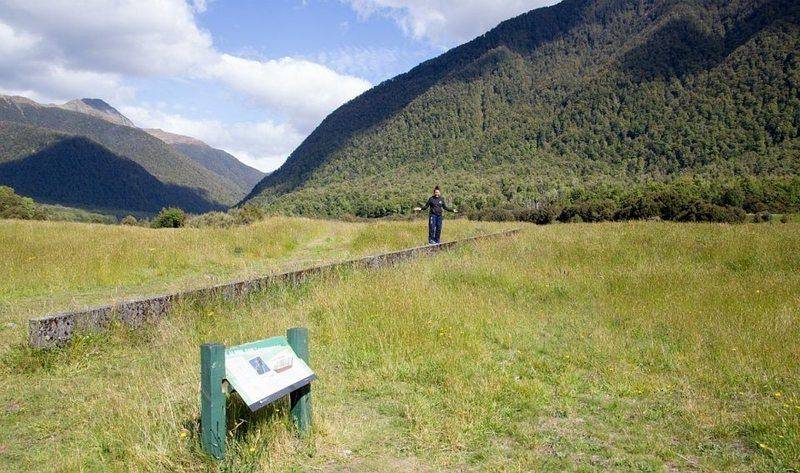
Just off State Highway 7 ( the Lewis Pass Rd) that connects the east and west coasts of the upper South Island, is an interesting landmark. In 1964, Frank Evison and his colleagues built a concrete wall across the Alpine Fault trace, in the hope that one day there will be a rupture on the fault and the wall will get split in two. ( hasn't happened yet !). I had last visited this site some 18 years ago but didn't have a photographic record. So during the Christmas period of 2016 and being in the general region, I decided to revisit the site.

The wall is 24m long and 1.4m high ( most of which is buried)

Image 1
My wife, Cindy, is standing on the wall directly above the fault trace which bisects the wall.
2016_12_29_6860sm.jpg


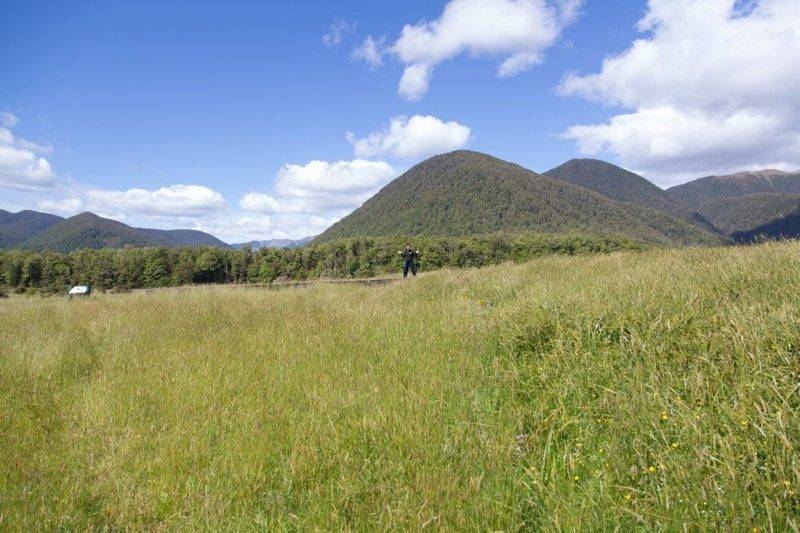
Image2
In this image, I am standing on the fault and looking north east along the trace towards the wall.
Even with the long grass, the vertical offset on the trace can be seen to the right side of the pic. ~ 1.5 - 2 metres.
The trace continues onwards into the pic., across a river, through that line of trees, across the left hand base of that large hill (mound) and up the distant valley.
2016_12_29_6863sm.jpg


Dave
 
Last edited:
  • Like
Likes   Reactions: 1oldman2 and fresh_42
Earth sciences news on Phys.org
Image3
This image is from Google Earth. I have annotated the key points.
The fault trace, the wall and the tectonic plates

Alpine Fault Trace with wall 01sm.jpg


Image4
and a zoomed out view of the region
Alpine Fault Trace with wall 02sm.jpg
Again, for anyone who would like to Google Earth the location ...

42.349176 S 172.224816 ERegards
Dave
 
  • Like
Likes   Reactions: 1oldman2 and fresh_42
Muy interessant. Thank you. :oldwink:
 
  • Like
Likes   Reactions: davenn
A new study published in April 2021 puts the probability of an earthquake on the central section of the fault at 75% in the next 50 years. This is a massive jump in percentage as previous studies placed the probability of an earthquake around 29%. Scientists believe that such an earthquake will be of magnitude 8 or higher.
https://www.thevintagenews.com/2021/07/09/new-zealand-earthquake-preparation/
The team of researchers from Victoria University of Wellington, the University of Otago, GNS Science, the University of California, and the United States Geological Survey studied evidence of 20 previous Alpine Fault earthquakes over a 4000-year period.
The evidence was recorded in the sediment of four West Coast lakes (Lakes Kaniere, Mapourika, Paringa, and Ellery) and two swamps. The results of this study were some of the most complete earthquake records of its kind in the world.

To obtain their data, the research team drilled down six meters and extracted a cross-section of the lake bed, which revealed a literal line-by-line snapshot of its history.

The strong shaking during earthquakes deformed layers of sediment, causing them to collapse and blend together. The vibration also weakened material at the edge of the lake, which caused underwater landslides.

https://www.nature.com/articles/s41561-021-00721-4 (subscription or purchase required)

Abstract: Minor changes in geometry along the length of mature strike-slip faults may act as conditional barriers to earthquake rupture, terminating some and allowing others to pass. This hypothesis remains largely untested because palaeoearthquake data that constrain spatial and temporal patterns of fault rupture are generally imprecise. Here we develop palaeoearthquake event data that encompass the last 20 major-to-great earthquakes along approximately 320 km of the Alpine Fault in New Zealand with sufficient temporal resolution and spatial coverage to reveal along-strike patterns of rupture extent. The palaeoearthquake record shows that earthquake terminations tend to cluster in time near minor along-strike changes in geometry. These terminations limit the length to which rupture can grow and produce two modes of earthquake behaviour characterized by phases of major (Mw 7–8) and great (Mw > 8) earthquakes. Physics-based simulations of seismic cycles closely resemble our observations when parameterized with realistic fault geometry. Switching between the rupture modes emerges due to heterogeneous stress states that evolve over multiple seismic cycles in response to along-strike differences in geometry. These geometric complexities exert a first-order control on rupture behaviour that is not currently accounted for in fault-source models for seismic hazard.
 

Similar threads

  • · Replies 27 ·
Replies
27
Views
7K
  • · Replies 2 ·
Replies
2
Views
3K
  • · Replies 7 ·
Replies
7
Views
8K
  • · Replies 4 ·
Replies
4
Views
3K
  • · Replies 1 ·
Replies
1
Views
4K