The average Asian aging process

Click For Summary

Discussion Overview

The discussion revolves around the aging process of Asian women compared to Western women, particularly in relation to menopause and physical appearance. Participants explore cultural differences, stereotypes, and the potential biological factors influencing these perceptions, while referencing various sources and personal observations.

Discussion Character

  • Debate/contested
  • Exploratory
  • Conceptual clarification

Main Points Raised

  • Some participants suggest that Asian women, particularly Japanese and Chinese, may reach menopause later than Western women, with a hypothesized link to fertility and aging.
  • Others argue that aging and changes in appearance occur universally across all demographics, challenging the notion that Asian women do not show physical changes as they age.
  • A participant requests links to research papers to support claims made about menopause and aging differences.
  • Another participant notes that while some sources claim a two-year difference in menopause onset, this may not be significant and questions the validity of the cartoon's portrayal.
  • Some express admiration for Asian beauty and hygiene practices, suggesting these may contribute to perceptions of aging.
  • One participant proposes that Olympic athlete data could provide insights into physical aging across different nationalities and ethnicities.

Areas of Agreement / Disagreement

Participants do not reach a consensus on the existence or significance of differences in aging between Asian and Western women. Multiple competing views remain regarding the validity of stereotypes and the influence of cultural practices on aging.

Contextual Notes

Limitations include a lack of empirical studies directly addressing the claims made, reliance on anecdotal evidence, and the potential for stereotypes to oversimplify complex biological and cultural factors.

mark!
Messages
150
Reaction score
13
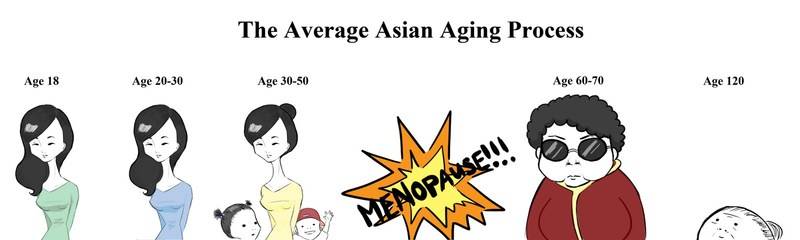
You might have seen this cartoon on the web. Is this just for laughs, or is there actually some truth to it?
273c5db0ceb59df8c59eddc21425bbdb.jpg


After a bit of research I've found out that Asian women, particularly Japanese and Chinese, indeed tend to reach menopause at a later age. Moreover, western women show more complications and problems regarding the menopause process (like hot flashes), in contrast to Asian women. The hypothesised explanation for the physical differences (that seem to occur during menopause in all women) is that female fertility isn't necessary at a higher age.

Still, the question remains why this cultural difference exists, if it even exists, because I couldn't find any paper on this phenomenon that describes how many percent of Asian women actually show this physical transformation, and why western women don't seem to undergo this process at all.
 

Attachments

  • 273c5db0ceb59df8c59eddc21425bbdb.jpg
    273c5db0ceb59df8c59eddc21425bbdb.jpg
    23.2 KB · Views: 75,800
Biology news on Phys.org
mark! said:
Still, the question remains why this cultural difference exists, if it even exists, because I couldn't find any paper on this phenomenon that describes how many percent of Asian women actually show this physical transformation, and why western women don't seem to undergo this process at all.

What process? Suddenly appearing to go "downhill" in their 50's and 60's? That happens in women everywhere to some degree. And men too. It's just a natural part of aging. The exact change in the appearance of the person varies tremendously. My mother is in her late 50's and unlike the woman in the picture above, is still very thin, like she's always been. But she's always been very active outside and watches her weight, so I wouldn't expect a drastic change. Still, she most definitely looks her age. Silvering hair. Wrinkles starting to appear. Etc.

Do note that the diagram's suggestion that asian women do not change in their appearance from their 20's to their 40's is entirely wrong. Everyone changes as they age.
 
  • Like
Likes   Reactions: Evo
mark! said:
After a bit of research
Can you post links to some of the papers you read in your research? That is how we start threads like this here at the PF...
 
As I've already said I couldn't find papers on the matter @berkeman, only on the web were several sources that claimed that Asians went "later" in menopause. However, in this health book it is determined to only 2 years later. If this is indeed true, I guess the comic image is just for laughs. But 2 years is not a big of a deal.

But I saw the image and I thought that it would be very interesting if indeed Asian women indeed would stay physically younger for a longer period of time than Caucasian women. That's why I wanted to find out more about this. Of course, I knew beforehand that a statement like this could never account for ALL Asian women, but still, if a great part of older Asian women would show this characteristic, unlike older women in the west, it would still be interesting to me.

Check this out by the way, a 63 year old mom with her 41, 40 And 36 year old daughters. (Without anything to support otherwise, I'm going to label this as an exception).

Still, the question remains why this misleading cartoon was made?
 
Last edited:
mark! said:
If this is indeed true, I guess the comic image is just for laughs. But 2 years is not a big of a deal.

I can assure you that the comic was indeed meant to be just for laughs.

mark! said:
Still, the question remains why this misleading cartoon was made?

Other than to tell you that it's a stereotype, I don't know what to say. Most stereotypes have some basis in reality, but I couldn't begin to estimate how accurate this stereotype is.
 
Hmmm... maybe the doctors have something after-all; keep BMI down and exercise up.
 
Asian women are my idols for facial and body care! They have the methods down tight. I have noticed beauty and hygiene is usually approached in a step-like fashion that takes care of the whole. Effective.
 
Probably the best data sets for determining physical age and capability by nationality/ethnicity/race would be among Olympic athletes. Those who aged slower, or maintained capability longer, would be competing effectively in the Olympics at a greater age than others. Just off hand, I can't recall any athletes in the same sports with a significantly wider range of competitive ages.
 
  • Like
Likes   Reactions: jim mcnamara
Dr_Zinj said:
Probably the best data sets for determining physical age and capability by nationality/ethnicity/race would be among Olympic athletes. Those who aged slower, or maintained capability longer, would be competing effectively in the Olympics at a greater age than others. Just off hand, I can't recall any athletes in the same sports with a significantly wider range of competitive ages.

Sort of relevant...

Could you be an athlete? Olympics 2012 by age, weight and height (incl. by country)
See the results of the first comprehensive analysis of the 11,000 contestants at London 2012

Old Olympians Ride Horses; Young Ones Do Flips
 

Similar threads

  • · Replies 7 ·
Replies
7
Views
4K
  • · Replies 6 ·
Replies
6
Views
4K
  • · Replies 1 ·
Replies
1
Views
4K
  • · Replies 2 ·
Replies
2
Views
4K
  • · Replies 13 ·
Replies
13
Views
5K
Replies
98
Views
21K
  • · Replies 9 ·
Replies
9
Views
7K
  • · Replies 1 ·
Replies
1
Views
10K
Replies
5
Views
5K
Replies
7
Views
7K