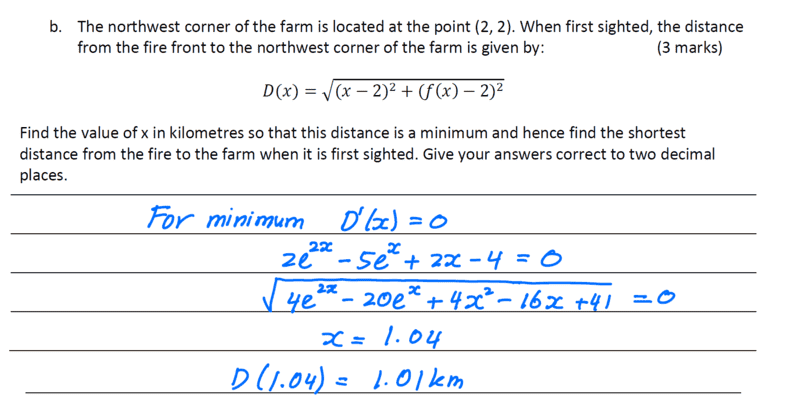
The below solution seems to assume that 1/0 = 0

  • Thread starter Thread starter Darkmisc
  • Start date Start date
  • Tags Tags
    Chain rule
Darkmisc
Messages
222
Reaction score
31
Homework Statement
The below question seems to assume that 1/0 = 0. Have I misunderstood something?
Relevant Equations
Chain rule
Hi everyone

In the below problem, I understand that the chain rule is being used. The derivative is then equated to zero. Since the derivative is composed of dy/du and du/dx, the derivative will equal zero if either dy/du or du/dx equals zero.

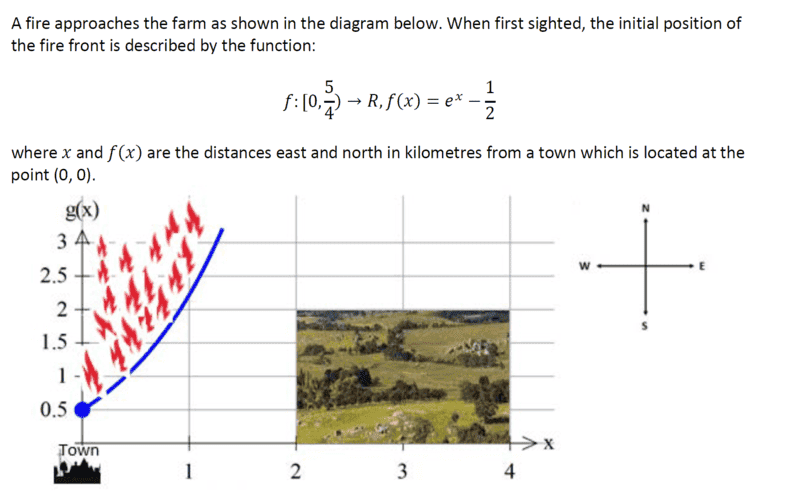
However, u would be everything under the square root sign, so dy/du would be 1/(2u^0.5). If u is equated to zero, dy/du should be undefined.

Is it a mistake for the below solutions to consider dy/du=0, or have I missed something?

Thanks
1659059283216.png
1659059331033.png
 
Physics news on Phys.org
What is u that you are wondering ? I do not find the formula.
 
anuttarasammyak said:
What is u that you are wondering ? I do not find the formula.
1659068534936.png
 
Darkmisc said:
so dy/du would be 1/(2u^0.5).
… which is non-zero so du/dx needs to be zero for dy/dx to be zero.
 
  • Like
Likes   Reactions: Darkmisc
[tex]\frac{dy}{dx}=\frac{dy}{du}\frac{du}{dx}=\frac{2x-4+2e^{2x}-5e^x}{2\sqrt{u}}[/tex]

1659074444797.png

Obviously
[tex]u=(x-2)^2+(e^x-\frac{5}{2})^2 >0[/tex]

1659077435600.png
 
Last edited:
  • Like
Likes   Reactions: jim mcnamara, Darkmisc and malawi_glenn
It is pretty easy to show that ##u= (x-2)^2 + (e^x - \frac{5}{2})^2## can not be zero.
Remember, this is Pythagoras theorem basically. So the only way u can be zero is if both terms are equal to zero individually. This means x1 = 2 and x2 = ln(5/2). But 5/2 < e so x2 < 1. So there is no x that can make u = 0.
 
  • Like
Likes   Reactions: jim mcnamara and Darkmisc
The issue only occurs if [itex]u(x) = 0[/itex] somewhere; but then [itex]\min\sqrt{u(x)} = 0[/itex], and we don't need to look at the derivative of [itex]\sqrt{u(x)}[/itex] (at a point where it doesn't exist) to tell us that. Also, it is enough to look for a minimum of [itex]u(x) \geq 0[/itex], rather than [itex]\sqrt{u(x)}[/itex].
 
  • Like
Likes   Reactions: Darkmisc and malawi_glenn
pasmith said:
Also, it is enough to look for a minimum of u(x)≥0, rather than u(x).
Also note that this is true for any monotonically increasing function ##f## (such as the square root on the non-negative numbers).
 

Similar threads

  • · Replies 12 ·
Replies
12
Views
3K
  • · Replies 4 ·
Replies
4
Views
2K
  • · Replies 1 ·
Replies
1
Views
2K
  • · Replies 18 ·
Replies
18
Views
4K
  • · Replies 10 ·
Replies
10
Views
2K
  • · Replies 1 ·
Replies
1
Views
3K
  • · Replies 7 ·
Replies
7
Views
2K
  • · Replies 7 ·
Replies
7
Views
3K
Replies
4
Views
2K
  • · Replies 3 ·
Replies
3
Views
3K