The cauchy problem and the equations

  • Thread starter Thread starter shadi_s10
  • Start date Start date
  • Tags Tags
    Cauchy
Click For Summary
SUMMARY

The discussion centers on the Cauchy problem in the context of general relativity, specifically referencing equations 13.12 to 13.14 and 13.18 from a textbook. Participants highlight the use of the Riemannian tensor R_abcd and the transformation of the metric tensor g_ab to g_ab prime as critical steps in deriving these equations. The Ricci tensor R_ab is defined and its computation is discussed, emphasizing the importance of understanding tensor calculus and geodesic coordinates for successful derivation.

PREREQUISITES
  • Understanding of Riemannian geometry and tensors
  • Familiarity with the Ricci tensor and its properties
  • Knowledge of metric transformations in general relativity
  • Proficiency in tensor calculus and geodesic coordinates
NEXT STEPS
  • Study the derivation of the Ricci tensor R_ab using the definition R_{ab}=g^{dc}R_{cabd}
  • Learn about geodesic coordinates and their application in tensor calculus
  • Explore the implications of the Cauchy problem in general relativity
  • Practice using LaTeX for typesetting complex equations in mathematical discussions
USEFUL FOR

Students and researchers in theoretical physics, particularly those focusing on general relativity, tensor calculus, and the mathematical foundations of the Cauchy problem.

shadi_s10
Messages
87
Reaction score
0
Hi everyone!
again d'inverno!
to tell the truth I don't really understand what is going on in the cauchy problem!

1)
in section 13.5 "the cauchy problem", it is said that the field equations can be written as the forms in 13.12 to 13.14
can anyone tell me how?

actually I tried to use the riemannian tensor : R_abcd
then I tried to contract indices a and c
but there are some gamma terms which I don not know what to do with.

2)
moreover it is said that if you use the equation that transforms g_ab to g_ab prime (at the end of page 175) , you can get to 13.18

I do not understand how is this one possible:
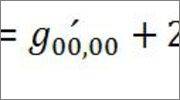
1L8kOS.jpg
 
Physics news on Phys.org
please somebody help me with it!
 
shadi_s10 said:
Hi everyone!
again d'inverno!
to tell the truth I don't really understand what is going on in the cauchy problem!

1)
in section 13.5 "the cauchy problem", it is said that the field equations can be written as the forms in 13.12 to 13.14
can anyone tell me how?

actually I tried to use the riemannian tensor : R_abcd
then I tried to contract indices a and c
but there are some gamma terms which I don not know what to do with.

These equations can be simply verified. Show us what you've done so far so we could be able to help you out! Please use Latex to typeset equations and if you don't know how to do it, use this picture stuff for a quick understanding.

Your approach is good.

2)
moreover it is said that if you use the equation that transforms g_ab to g_ab prime (at the end of page 175) , you can get to 13.18

I do not understand how is this one possible:

1L8kOS.jpg

Catching the glimpse of metric indices carefully, plug (13.17) into the transformation formula to get those equations.

AB
AB
 
Hi again!
you are right. the second one was so easy. I derived it correctly.
but about the first one,I mean equations (13.12)-(13.14) here is what I've done:

1ObIM0.jpg


I know that one can do the rest by using gamma definition which is based on the metric.
but isn't it too long?!
I feel there is something wrong with my solution as first it had derived the rimannian tensors and then the metric and the derivatives. (13.18)
so maybe I should do something else...
 
shadi_s10 said:
Hi again!
you are right. the second one was so easy. I derived it correctly.
but about the first one,I mean equations (13.12)-(13.14) here is what I've done:

1ObIM0.jpg


I know that one can do the rest by using gamma definition which is based on the metric.
but isn't it too long?!
I feel there is something wrong with my solution as first it had derived the rimannian tensors and then the metric and the derivatives. (13.18)
so maybe I should do something else...

I think you have serious problems with the understanding of tensor calculus!

First off, the Ricci tensor R_{ab} is given by

R_{ab}=R^{c}_{abc}=\Gamma_{ab}^{c}_{,c}-\Gamma_{ac}^{c}_{,b}+\Gamma_{ab}^{c}\Gamma_{cd}^{d}-\Gamma_{ad}^{c}\Gamma_{bc}^{d}.

Secondly, you can get the Ricci tensor from the following definition:

R_{ab}=g^{dc}R_{cabd}, (1)

where R_{cabd}=g_{ck}R^{k}_{abd} is the covariant Riemann tensor. Do you know anything about the geodesic coordinates? If yes, split R_{cabd} into two categories of terms, one containg all terms of second order and the other including in all terms of first order. So spending 10 minutes of your time on the expansion of terms after bringing into consideration the geodesic coordinates (for the sake of convenience, as this is not necessary) you'll end up getting a straightforward expression for R_{cabd}, only consisting of second derivatives of metric tensor. Then turn to computing the Ricci tensor using (1) which will give you all those equations that you are after by a componential analysis.

AB
 
Last edited:

Similar threads

  • · Replies 6 ·
Replies
6
Views
2K
  • · Replies 23 ·
Replies
23
Views
3K
Replies
7
Views
2K
Replies
8
Views
1K
Replies
2
Views
2K
  • · Replies 7 ·
Replies
7
Views
2K
Replies
2
Views
2K
  • · Replies 4 ·
Replies
4
Views
2K
  • · Replies 7 ·
Replies
7
Views
3K
  • · Replies 1 ·
Replies
1
Views
2K