The Double Helix - Hydrogen bonding and stability

Click For Summary
SUMMARY

The stability of DNA base pairs is determined by the number of hydrogen bonds formed between them. The cytosine-guanine (C-G) pair, which forms three hydrogen bonds, is more stable than the thymine-adenine (A-T) pair, which forms two hydrogen bonds. Therefore, the ranking from most to least stable is C-G, A-T, and cytosine-adenine (C-A) as the least stable pairing. Understanding the bond energy associated with these hydrogen bonds is crucial for determining stability.

PREREQUISITES
  • Basic understanding of DNA structure and base pairing
  • Knowledge of hydrogen bonding and its role in molecular stability
  • Familiarity with bond energy concepts
  • Understanding of molecular interactions in biochemistry
NEXT STEPS
  • Research the role of hydrogen bonds in DNA stability
  • Learn about the significance of bond energy in molecular interactions
  • Explore the implications of base pair stability on DNA replication and mutation
  • Investigate the effects of environmental factors on hydrogen bonding in DNA
USEFUL FOR

Students and professionals in biochemistry, molecular biology, and genetics who are interested in understanding DNA stability and the mechanisms of base pairing.

Vivianian
Messages
3
Reaction score
0
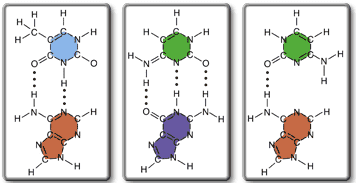
Rank the following base pairs according to their stability.
Rank from most to least stable. To rank items as equivalent, overlap them.
1zlyt8p.png


-------------
I have found out that the first one is thymine-adenine pair and the second one is a cytosine-guanine pair. The third one is cytosine paired with adenine, which doesn't make sense, so it must be the least stable. Now how do I go about determining if the A-T pair or C-G pair is more stable? It has something to do with the number of bonds, maybe?
 
Physics news on Phys.org
Vivianian said:
It has something to do with the number of bonds, maybe?

I think that is a safe assumption. Now just ask yourself which pair would require the most energy to break the hydrogen bonds; G-C with three H-bonds, or A-T with two H-bonds? This will be the most stable pairing.
 
I know that the larger the bond energy, the more energy is needed to break the bond. If the more energy is needed to break the bond, that means the bond is stronger and more stable. Is this correct?
 
Vivianian said:
I know that the larger the bond energy, the more energy is needed to break the bond. If the more energy is needed to break the bond, that means the bond is stronger and more stable. Is this correct?

Yep. Then just follow mplayer's advice and you should get the answer. I imagine them as being sticky: the more points (bonds) that can stick togeather, the more sticky the molecules are and the harder they are to pull apart!
 
nobahar said:
I imagine them as being sticky: the more points (bonds) that can stick togeather, the more sticky the molecules are and the harder they are to pull apart!

That's a nice trick. Thanks for the advice! :)
 

Similar threads

  • · Replies 1 ·
Replies
1
Views
2K
  • · Replies 2 ·
Replies
2
Views
20K
  • · Replies 2 ·
Replies
2
Views
3K
  • · Replies 3 ·
Replies
3
Views
4K
  • · Replies 1 ·
Replies
1
Views
7K
  • · Replies 4 ·
Replies
4
Views
3K
  • · Replies 10 ·
Replies
10
Views
3K
  • · Replies 3 ·
Replies
3
Views
15K
  • · Replies 5 ·
Replies
5
Views
4K
Replies
2
Views
3K