The Eigenfunction of a 2-electron system

Click For Summary
The discussion revolves around demonstrating that the wave function of a two-electron system is an eigenfunction of the Hamiltonian when the electrons do not interact. The user is struggling with the calculations, particularly in substituting the two-electron wave function into the Hamiltonian and confirming that the energy is constant and independent of the radial coordinate. Despite knowing that Z = 2, the user is unable to derive the expected energy value, indicating a potential misstep in factoring out the kinetic energy term. A suggestion from another participant ultimately helps the user resolve the issue. The conversation highlights the importance of correctly applying the Hamiltonian to multi-electron systems in quantum mechanics.
Settho
Messages
4
Reaction score
0
Homework Statement
Show that the wave function is an eigenfunction of the hamiltonian.
Relevant Equations
Hamiltonian, wave function, energy and Born radius
Hello!

I am stuck at the following question:
Show that the wave function is an eigenfunction of the Hamiltonian if the two electrons do not interact, where the Hamiltonian is given as;

Schermafbeelding 2019-04-28 om 20.33.57.png


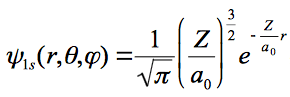
the wave function and given as;
Schermafbeelding 2019-04-28 om 20.34.45.png


and the energy and Born radius are given as:

Schermafbeelding 2019-04-28 om 20.51.31.png


and I used this for ∇ squared:
Schermafbeelding 2019-04-28 om 20.50.07.png


I am stuck at the end of the calculation. I know Z = 2, but somehow I don't end up with the energy, which you need to show that it is indeed an eigenfunction. This is what I get and where I am stuck at:
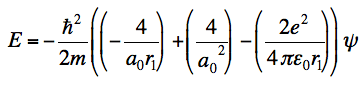
Schermafbeelding 2019-04-28 om 20.46.42.png


and even when I substitute a0 in this formula, I don't get the energy value. I honestly don't know where it did go wrong.
If someone is able to help, that would be great.
 
Physics news on Phys.org
You need to substitute the two-electron wavefunction$$\psi(r_1,r_2)=\psi(r_1)\psi(r_2)=\frac{1}{\sqrt{\pi}}\left( \frac{Z}{a_0}\right)^{3/2}e^{-\frac{Z}{a_0}r_1}\frac{1}{\sqrt{\pi}}\left( \frac{Z}{a_0}\right)^{3/2}e^{-\frac{Z}{a_0}r_2}$$in your Hamiltonian. The energy is a constant and should have no ##r## dependence.
 
Last edited:
But isn't it just the idea to split the Hamiltonian in electron 1 and electron 2 instead of the two-electron wave function?
 
Settho said:
I am stuck at the end of the calculation. I know Z = 2, but somehow I don't end up with the energy, which you need to show that it is indeed an eigenfunction. This is what I get and where I am stuck at:
View attachment 242595
The ##-\hbar^2 / 2m## term doesn't factor out of all terms.
 
DrClaude said:
The ##-\hbar^2 / 2m## term doesn't factor out of all terms.

Your simple suggestion made me solve the problem. Thank you so much!
 

Similar threads

  • · Replies 1 ·
Replies
1
Views
2K
Replies
6
Views
2K
  • · Replies 14 ·
Replies
14
Views
3K
Replies
4
Views
2K
  • · Replies 2 ·
Replies
2
Views
2K
Replies
46
Views
2K
  • · Replies 8 ·
Replies
8
Views
3K
  • · Replies 11 ·
Replies
11
Views
6K
  • · Replies 1 ·
Replies
1
Views
1K
  • · Replies 6 ·
Replies
6
Views
2K