The electric field of a piecewise uniform 1D charge distribution

Click For Summary

Homework Help Overview

The discussion revolves around understanding the electric field of a piecewise uniform one-dimensional charge distribution, particularly in the context of a diode's space charge layer. Participants explore the implications of applying Gauss's law in this scenario and the behavior of electric fields produced by different charge configurations.

Discussion Character

  • Exploratory, Conceptual clarification, Assumption checking

Approaches and Questions Raised

  • Participants discuss the nature of the electric field in relation to a line of charge and question the assumptions about charge distributions, including whether to treat them as lines or slabs. There is also exploration of why a positive charge placed near the boundary of a positive region does not experience the expected repulsion.

Discussion Status

The discussion is active, with participants providing insights into the electric field behavior near charged slabs and questioning the consistency of interpretations regarding the electric field's constancy and direction. Some participants suggest reconsidering the nature of the electric field produced by individual sheets of charge.

Contextual Notes

There are ongoing debates about the interpretation of charge distributions as either lines or slabs, and how this affects the electric field calculations. Participants are also grappling with the implications of distance on electric field strength and direction.

sudera
Messages
25
Reaction score
0
Homework Statement
Find the electric field of a line of charge on the x-axis, with charge density ##\lambda_1## (negative) between ##x=-a## and ##x=0## and charge density ##\lambda_2## (positive) between ##x=0## and ##x = b##.
Relevant Equations
##\dfrac{dE}{dx} = \dfrac{\lambda}{\epsilon_0}##
This is not really homework, but I'm having trouble understanding it intuitively. I came across this when learning about the space charge layer of a diode. The solution I know simply uses the 1D form of Gauss's law: ##\vec{\nabla} \cdot \vec{E}## = ##\dfrac{\rho}{\epsilon_0}## becomes ##\dfrac{dE}{dx} = \dfrac{\lambda}{\epsilon_0}##.
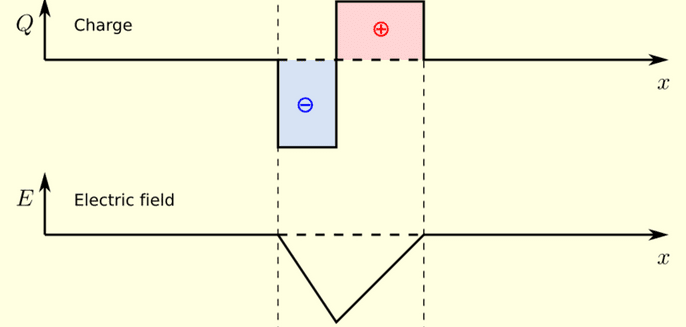
The integral of the left part is an integral of a negative constant, thus will give a declining line. The integral from 0 to the right will give an inclining line (picture below). The electric field is negative everywhere, thus points to the left everywhere. This means that when you placed a positive charge anywhere between ##-a## and ##b##, it would accelerate to the left. But my actual questions is this: what if you place it at ##x=b-\epsilon##, where ##\epsilon## is a small number? It's much closer to all the positive charges than it is to the negative ones so why doesn't it get repelled to the right?

Thanks in advance.
ff.PNG
 
Physics news on Phys.org
The solution is one-dimensional, i.e., it corresponds to infinitely extended charges in the y and z directions. In this scenario, the electric field does not decrease with distance (cf, the electric field of an infinite flat surface with constant charge density).
 
Orodruin said:
The solution is one-dimensional, i.e., it corresponds to infinitely extended charges in the y and z directions. In this scenario, the electric field does not decrease with distance (cf, the electric field of an infinite flat surface with constant charge density).
But in case of an infinite surface, the electric field is constant perpendicular to the surface, whereas here it is declining. So I don't really understand what you mean.
 
sudera said:
whereas here it is declining
No it is not. It is constant. It just is constantly zero since the positive and negative charges are equal and thus contribute with the same magnitude field (but opposite sign).
 
Orodruin said:
No it is not. It is constant. It just is constantly zero since the positive and negative charges are equal and thus contribute with the same magnitude field (but opposite sign).

What about the electric field "triangle" in the picture then? Perhaps I am interpreting it wrong.
 
Orodruin said:
The solution is one-dimensional, i.e., it corresponds to infinitely extended charges in the y and z directions. In this scenario, the electric field does not decrease with distance (cf, the electric field of an infinite flat surface with constant charge density).
I think I understand what you meant now. But the question here is the electric field IN or ALONG the line of charge, not perpendicular to it.
 
Orodruin said:
The solution is one-dimensional, i.e., it corresponds to infinitely extended charges in the y and z directions. In this scenario, the electric field does not decrease with distance (cf, the electric field of an infinite flat surface with constant charge density).
As we get closer to the wire we should consider it as an infinite plane, not an infinite line?
 
sudera said:
Homework Statement:: Find the electric field of a line of charge on the x-axis, with charge density ##\lambda_1## (negative) between ##x=-a## and ##x=0## and charge density ##\lambda_2## (positive) between ##x=0## and ##x = b##.

I came across this when learning about the space charge layer of a diode.
Are you sure you are dealing with a line of charge? It seems to me that the space charge would be modeled as negative and positively charged slabs. Then, the ##\lambda##'s would be volume charge densities.

1576520902175.png
 
TSny said:
Are you sure you are dealing with a line of charge? It seems to me that the space charge would be modeled as negative and positively charged slabs. Then, the ##\lambda##'s would be volume charge densities.

View attachment 254211

Well, I came across this when learning about diodes, so a slab would be more accurate. However, my textbook solves for the electric field using the equation ##\dfrac{dE}{dx} = \dfrac{\lambda}{\epsilon_0}##, and so does this site in section 4.3.3: https://ecee.colorado.edu/~bart/book/book/chapter4/ch4_3.htm
I understand the calculation, but like I said, I don't know why it makes sense intuitively that placing a positive charge at the right border of the positive region wouldn't be repelled to the right by all the positive charges in its proximity to the left.
 
  • #10
sudera said:
Well, I came across this when learning about diodes, so a slab would be more accurate. However, my textbook solves for the electric field using the equation ##\dfrac{dE}{dx} = \dfrac{\lambda}{\epsilon_0}##, and so does this site in section 4.3.3: https://ecee.colorado.edu/~bart/book/book/chapter4/ch4_3.htm
I understand the calculation, but like I said, I don't know why it makes sense intuitively that placing a positive charge at the right border of the positive region wouldn't be repelled to the right by all the positive charges in its proximity to the left.
The slabs of charge can be thought of as made of many thin sheets of charge. So you should consider the nature of the electric field produced by a single thin sheet of charge. I think this is what @Orodruin was alluding to. If a sheet can be approximated as infinite in area, then the E field that it produces does not depend on the distance from the sheet. The magnitude of the force that the sheet would produce on a point charge would be independent of the distance of the point charge from the sheet.
 
  • #11
TSny said:
The slabs of charge can be thought of as made of many thin sheets of charge. So you should consider the nature of the electric field produced by a single thin sheet of charge. I think this is what @Orodruin was alluding to. If a sheet can be approximated as infinite in area, then the E field that it produces does not depend on the distance from the sheet. The magnitude of the force that the sheet would produce on a point charge would be independent of the distance of the point charge from the sheet.
If it's independent of the distance, then why is the electric field not constant? @Orodruin said it was, in fact, constant and zero, but the electric field in the link I shared and in the picture of the original post isn't zero in the "triangle".
 
  • #12
sudera said:
If it's independent of the distance, then why is the electric field not constant? @Orodruin said it was, in fact, constant and zero, but the electric field in the link I shared and in the picture of the original post isn't zero in the "triangle".
It is not zero there because the total charge on either side is not zero.
 
  • #13
sudera said:
If it's independent of the distance, then why is the electric field not constant? @Orodruin said it was, in fact, constant and zero, but the electric field in the link I shared and in the picture of the original post isn't zero in the "triangle".
Think of the positive slab of charge as made of many individual sheets, like a deck of cards where each card is a sheet. The magnitude of the field of any particular sheet does not depend on the distance from the sheet. But the direction of the field changes to the opposite direction when you go from one side of the sheet to the other side of the sheet.

Imagine boring a little ways into the deck of cards. The field produced at your location by the cards that you have passed through points oppositely to the field produced by the cards that you have not passed through. So, there's some cancellation of the fields of the cards in the positive slab. The net field of the positive slab no longer cancels the field of the negative slab. So, overall, the field at your location will point in the negative direction.
 
  • Like
Likes   Reactions: sudera
  • #14
TSny said:
Think of the positive slab of charge as made of many individual sheets, like a deck of cards where each card is a sheet. The magnitude of the field of any particular sheet does not depend on the distance from the sheet. But the direction of the field changes to the opposite direction when you go from one side of the sheet to the other side of the sheet.

Imagine boring a little ways into the deck of cards. The field produced at your location by the cards that you have passed through points oppositely to the field produced by the cards that you have not passed through. So, there's some cancellation of the fields of the cards in the positive slab. The net field of the positive slab no longer cancels the field of the negative slab. So, overall, the field at your location will point in the negative direction.
Oh, this makes a lot of sense, I get it now. Thanks a lot for elaborating on the analogy!
 

Similar threads

Replies
23
Views
5K
Replies
4
Views
4K
  • · Replies 1 ·
Replies
1
Views
2K
Replies
9
Views
1K
Replies
4
Views
5K
Replies
11
Views
4K
Replies
11
Views
2K
  • · Replies 11 ·
Replies
11
Views
3K
  • · Replies 2 ·
Replies
2
Views
3K
Replies
9
Views
2K