The experiment for testing the CHSH inequalities

Click For Summary

Discussion Overview

The discussion centers around the experimental testing of the CHSH inequalities, a key aspect of Bell's theorem in quantum mechanics. Participants explore the differences in descriptions of the experiment found in Wikipedia and a popular science book, particularly regarding the use of waveplates and the angles at which they are set. The conversation includes inquiries about the nature of the experiment, the significance of the angles mentioned, and recommendations for clearer sources on the topic.

Discussion Character

  • Exploratory
  • Debate/contested
  • Technical explanation

Main Points Raised

  • One participant expresses confusion over the differing descriptions of the CHSH experiment in Wikipedia and a popular book, particularly regarding the role of waveplates and the significance of specific angles.
  • Another participant suggests that popular science books may not adequately convey the mathematical aspects necessary to understand the experiment, implying that a university-level understanding is required.
  • A participant notes that there are multiple types of experiments testing the CHSH inequalities, referencing four "loophole-free" experiments conducted in 2015 with different setups involving photons and electron spins.
  • One contributor emphasizes that the violation of Bell's inequalities can be demonstrated using a polarization-singlet state of photons, discussing the importance of relative angles between polarization filters.
  • Another participant asserts that popular sources are not valid references for this level of discussion and recommends looking at textbooks or peer-reviewed papers instead.
  • A later reply clarifies that the differences in diagrams from Wikipedia and the book stem from simplifications made by different scientists, explaining the function of waveplates in the context of the experiment.

Areas of Agreement / Disagreement

Participants express differing views on the adequacy of popular science sources for understanding the CHSH inequalities. There is no consensus on the best resources for learning about the experiment, and multiple interpretations of the experimental setup are presented.

Contextual Notes

Participants highlight limitations in the clarity of popular sources and the need for mathematical understanding to fully grasp the concepts involved in the CHSH inequalities. There are unresolved questions regarding the specific experimental setups and the implications of the angles used in the tests.

Spathi
Gold Member
Messages
102
Reaction score
10
TL;DR
The description of the experiment for testing the CHSH inequalities is diffrent in Wikipedia and a popular book I read.
I want to understand how an experiment is carried out to test violations of the CHSH inequalities. I have read Wikipedia and one popular book on quantum mechanics. The Wikipedia article is too short and incomprehensible to me; in addition, the description from Wikipedia and from the book is different.

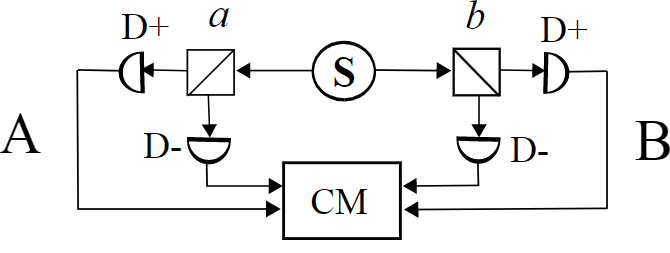
Wikipedia shows the following figure:
IlSOI.png


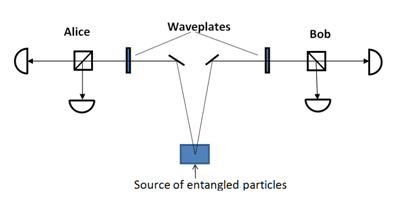
The figure in the book is the following:
gwTxB.png

In the book, the picture shows the waveplates in front of each PBS, and it says “these plates are set at angles 0, Pi/8, Pi/4 and 3Pi/8”. Wikipedia says “Four separate subexperiments are conducted, corresponding to the four terms E(a, b) in the test statistic S (2, above). The settings a, a′, b and b′ are generally in practice chosen to be 0, 45°, 22.5° and 67.5° respectively — the "Bell test angles" — these being the ones for which the quantum mechanical formula gives the greatest violation of the inequality”.

Thus, Wikipedia does not explain what are these angles 0, 45 °, etc., but the book says that these are the angles at which the waveplates are installed (and Wikipedia does not mention waveplates). So my question is, whether the waveplates are used in this experiment, and what do the angles at which they are installed mean?

I tried to read the original work of Clauser et al, there are no pictures and everything is not clear to me too. I ask you to advise popular sources that clearly describe the essence of the CHSH inequalities and the experiment to test them.
 
Physics news on Phys.org
I think the problem is to use popular-science books to understand a phenomenon you can adequately talk about only using math. You labelled this thread with "A". So that assumes that you are familiar with the subject at the university level, with help of which it would be pretty easy to explain though both Wikipedia and what you provide as information from some popular-science book (which one?) lack sufficient information to really explain it (i.e., which Bell state is used). With the adequate math, which boils down to pretty simple calculations with photon-polarization states. Does the book state which experiment it is referring to, i.e., does it cite the paper it's referring too. In this topic usually the scientific papers are easy to understand, while the popularized versions are incomprehensible, because they cannot use the adequate language to explain the issue ;-)).
 
There is not one kind of experiment. In 2015 there were four "loophole-free experiments". Two of them had photons speeding from a central location to distant measurement locations. One of them had electron spins associated with a defect in a diamond, at two distant locations. Both spins were zapped with a laser and emitted photons which interfered at a distant intermediate location. A fourth used Rubydium atoms, if I remember correctly. I must say, I too don't know what is a good book or website which gives a decent introduction. The general Wikipedia pages on these topics are badly outdated. I would recommend you start by reading the book of collected papers by John S. Bell "Speakable and Unspeakable". It's pretty old now but it is still a mine of information. And the scheme he discusses in a chapter called "Bertlmann's socks and the nature of reality" was the model for the 2015 experiments.
 
  • Like
Likes   Reactions: Lord Jestocost and vanhees71
The fundamental point of the violation of Bell's inequalities is not so dependent on the specific realization by an experiment. I found the most simple example is that using photons in the polarization-singlet state,
$$|\Psi \rangle=\frac{1}{\sqrt{2}} (|H,V \rangle-|V,H \rangle),$$
where ##V## and ##H## refer to vetrically and horizontally polarized wrt. an arbitrary direction perpendicular to the wave vectors ##\pm \vec{k}## of the photons.

To demonstrate the violation of Bell's inequality (or the CHSH version) you put a polarization filter in front of each particle's way and you make coincidence measurements for different relative angles between the filter orientation (the counting statistics is only dependent on the relative angle, because the polarization-singlet state is rotation invariant). Using the four settings described in the OP, you get a maximal violation of Bell's inequality.

The most clear treatment can be found (using the spin-singlet state of two spin-1/2 particles, which is analogous to the polarization case for photons) in Sakurai's, Modern Quantum Mechanics or (even better) Weinberg's Lectures on Quantum Mechanics.
 
Spathi said:
I ask you to advise popular sources
Popular sources are not valid references, particularly not in an "A" level discussion. You need to look at actual textbooks (@vanhees71 referenced two of them) or peer-reviewed papers. There is a quite voluminous literature on the subject at this point; one is certainly not restricted to the original papers by Clauser and others from several decades ago (some of which may indeed be hard to read, since the subject was only just starting to be investigated then).
 
  • Like
Likes   Reactions: vanhees71
Actually, the two pictures in the original post are really the same. Different scientists simplified something pretty complicated in a different way. The Wikipedia drawing has merged the waveplates and the polarizing beam splitter. The idea is that by rotating the plate you rotate the polarization of the photon. Then you let it enter the polarizing beam splitter. That's a bit easier than rotating a polarizing beam splitter. The Wikipedia diagram also merges the source and the two mirrors of the picture in the book. Put it all into one box, so to speak. The Wikipedia diagram on the other hand gives a lot more detail about what happens after the photons have made the detectors click. It corresponds to very old experiments in which you had no control at all over the emission of photon pairs. They were created in a continuous stream and moreover a lot of single photons were also created and moreover, anyway, lots of photons get lost "en route". So in the oldest experiments, you registered the times of clicks at any of those four detectors and if two of them, one on each side, were close enough in time to one another, you treated them as the detections of two photons which had been emitted together.
 
  • Like
Likes   Reactions: gentzen, DrChinese, Lord Jestocost and 2 others
Spathi said:
Summary:: The description of the experiment for testing the CHSH inequalities is diffrent in Wikipedia and a popular book I read.

I want to understand how an experiment is carried out to test violations of the CHSH inequalities. I have read Wikipedia and one popular book on quantum mechanics. The Wikipedia article is too short and incomprehensible to me; in addition, the description from Wikipedia and from the book is different.

Wikipedia shows the following figure:
View attachment 291054

The figure in the book is the following:

View attachment 291055
In the book, the picture shows the waveplates in front of each PBS, and it says “these plates are set at angles 0, Pi/8, Pi/4 and 3Pi/8”. Wikipedia says “Four separate subexperiments are conducted, corresponding to the four terms E(a, b) in the test statistic S (2, above). The settings a, a′, b and b′ are generally in practice chosen to be 0, 45°, 22.5° and 67.5° respectively — the "Bell test angles" — these being the ones for which the quantum mechanical formula gives the greatest violation of the inequality”.

Thus, Wikipedia does not explain what are these angles 0, 45 °, etc., but the book says that these are the angles at which the waveplates are installed (and Wikipedia does not mention waveplates). So my question is, whether the waveplates are used in this experiment, and what do the angles at which they are installed mean?

I tried to read the original work of Clauser et al, there are no pictures and everything is not clear to me too. I ask you to advise popular sources that clearly describe the essence of the CHSH inequalities and the experiment to test them.
There are three aspects to this.

1) Bell's theorem/inequality. This is a general result for correlation of data in classical probability theory. Ironically, there is nothing specific to QM, but it can be used to put a limit on how much correlation any local hidden variable theory can achieve in terms of entanglement.

The first step is to understand this inequality - which is classical probability theory and not QM at all.

2) Apply Bell's theorem for photon/electron entanglement. This is where the angles come in. Bell's theorem has three parameters, so we need at least three angles. We propose that particle entanglement is controlled by local hidden variables and we use Bell's theorem to predict a limit on correlations (inequality) for entangled photon polarisations (experimentally practical) or electron spin (not so easy to test).

In short, we do a classical probability calculation and come up with a predicted inequality for our experimental data.

3) Quantum Mechanics and quantum entanglement. We do an alternative calculation using QM (which does not use local hidden variables or classical probability theory). This QM calculation, critically, produces a result that does not agree with the above inequality. In one sense QM can "do better" than anything local hidden variables can do.

In short, QM gives us a different prediction that violates the above equality.

Therefore, this experiment gives us a key test of QM - in the sense that only "quantumness" can produce the observed results.

PS All of the above three items including the proposed experiment for electron spin is neatly covered in Modern Quantum Mechanics, by J.J. Sakurai (pages 226-232). I don't believe it can be done more simply and attempts to recast the problem simply confuse the issue, IMO.
 
  • Like
Likes   Reactions: vanhees71
As I said above, I think Weinberg in "Lectures on Quantum Mechanics" got the very same discussion even more easy to grasp.
 
vanhees71 said:
I think the problem is to use popular-science books to understand a phenomenon you can adequately talk about only using math. You labelled this thread with "A". So that assumes that you are familiar with the subject at the university level, with help of which it would be pretty easy to explain though both Wikipedia and what you provide as information from some popular-science book (which one?)
I am a newbie at this forum, and not yet sure whether I should label my threads with "A" or "I".

gill1109 said:
I would recommend you start by reading the book of collected papers by John S. Bell "Speakable and Unspeakable". It's pretty old now but it is still a mine of information. And the scheme he discusses in a chapter called "Bertlmann's socks and the nature of reality" was the model for the 2015 experiments.
I started reading this chapter and was puzzled by the analogy between socks and particles. In the book, Bell mixes degrees as a measure of angle (for particles) and degrees as a measure of temperature (for socks). Maybe this is not quite correct? I hope I will be able to find the simplest and most understandable description of Bell's theory.

vanhees71 said:
As I said above, I think Weinberg in "Lectures on Quantum Mechanics" got the very same discussion even more easy to grasp.
Can you suggest where can I freely download this book? Or such suggestions are not allowed on this forum? Sorry for my ignorance, but I live in Russia and may meet difficulties with buying this book.
 
  • #10
Bell likes to make jokes. He is very serious about the analogy between socks and particles, but his whole point is that according to quantum mechanical predictions, socks aren't like "quantum particles" at all.
 
Last edited by a moderator:
  • Like
Likes   Reactions: DrChinese
  • #11
I don't think that Bell's writings are the best to start with. It's hard to find a no-nonsense approach when it comes to these issues. The best introductory ones I know are the corresponding chapters in J. J. Sakurai, Modern Quantum Mechanics and S. Weinberg, Lectures on Quantum Theory (though I don't agree with Weinberg's conclusion in the chapter on interpretation that there are open questions, but that's another story).
 
  • #12
vanhees71 said:
I don't think that Bell's writings are the best to start with. It's hard to find a no-nonsense approach when it comes to these issues. The best introductory ones I know are the corresponding chapters in J. J. Sakurai, Modern Quantum Mechanics and S. Weinberg, Lectures on Quantum Theory (though I don't agree with Weinberg's conclusion in the chapter on interpretation that there are open questions, but that's another story).
Whether or not there are open questions, is clearly an open question.
 
  • Like
  • Haha
Likes   Reactions: gentzen, Nugatory and vanhees71

Similar threads

  • · Replies 4 ·
Replies
4
Views
2K
  • · Replies 61 ·
3
Replies
61
Views
5K
  • · Replies 7 ·
Replies
7
Views
2K
  • · Replies 71 ·
3
Replies
71
Views
6K
  • · Replies 1 ·
Replies
1
Views
1K
  • · Replies 5 ·
Replies
5
Views
2K
  • · Replies 16 ·
Replies
16
Views
3K
  • · Replies 6 ·
Replies
6
Views
3K
  • · Replies 49 ·
2
Replies
49
Views
6K
  • · Replies 1 ·
Replies
1
Views
2K