The inelastic collision between a disk and a rotating platform

Click For Summary
In an inelastic collision between a disk and a rotating platform, angular momentum is conserved, but kinetic energy is not. The equation for angular momentum shows that the final angular velocity of the system differs from the initial kinetic energy of the platform. The energy is dissipated primarily through kinetic friction, which converts mechanical energy into thermal energy. The work done by friction accounts for the change in mechanical energy, indicating that while energy is conserved overall, kinetic energy is lost. Thus, the interaction between the disk and platform results in a decrease in the platform's angular speed as the disk accelerates.
Leo Liu
Messages
353
Reaction score
156
Homework Statement
A FR question in 2019 AP Physics C Exam (Version 2)
Relevant Equations
Rotational Kinetic Energy, Conservation of Angular Momentum
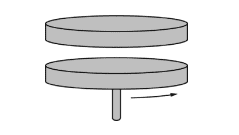
A disk is dropped on a platform rotating at a constant angular speed ##\omega_i## as shown below.
1588882549551.png

The question asks whether the final kinetic energy of the platform is conserved. I understand the angular momentum is always conserved provided that the net torque is 0, so I wrote the following equation:
$$I_{platform} \omega_i = (I_{platform}+I_{disk}) \omega_f$$
From this I inferred that ##\frac 1 2 I_{platform} {\omega_i}^2 \neq \frac 1 2 (I_{platform}+I_{disk}) {\omega_f}^2##.

My questions are as follows: Why is the energy not conserved in the collision, and how is the energy dissipated?

Thank you in advance.
 

Attachments

  • 1588882478810.png
    1588882478810.png
    14.5 KB · Views: 176
  • 1588883047773.png
    1588883047773.png
    19.3 KB · Views: 143
Last edited:
Physics news on Phys.org
What force must act between the platform and the disk in order to equalise their angular velocities? Does this force dissipate mechanical energy into anything else?
 
etotheipi said:
What force must act between the platform and the disk in order to equalise their angular velocities? Does this force dissipate mechanical energy into anything else?
I think it's kinetic friction because the angular speed of the platform decreases as the rotation of the disk speeds up. Am I right?
 
Leo Liu said:
I think it's kinetic friction because the angular speed of the platform decreases as the rotation of the disk speeds up. Am I right?

Yes that's right.

And friction dissipates mechanical energy into thermal energy. Actually, the total work done by friction at the interface, ##W##, is the change in mechanical energy of the system. The change in thermal energy of the system is ##-W##. Energy is conserved... just not KE!
 
  • Like
Likes Leo Liu
The book claims the answer is that all the magnitudes are the same because "the gravitational force on the penguin is the same". I'm having trouble understanding this. I thought the buoyant force was equal to the weight of the fluid displaced. Weight depends on mass which depends on density. Therefore, due to the differing densities the buoyant force will be different in each case? Is this incorrect?

Similar threads

Replies
26
Views
1K
Replies
3
Views
2K
  • · Replies 11 ·
Replies
11
Views
1K
Replies
30
Views
3K
Replies
9
Views
2K
  • · Replies 31 ·
2
Replies
31
Views
4K
  • · Replies 1 ·
Replies
1
Views
2K
Replies
10
Views
3K
  • · Replies 6 ·
Replies
6
Views
2K