Leo Liu
- 353
- 156
- Homework Statement
- A FR question in 2019 AP Physics C Exam (Version 2)
- Relevant Equations
- Rotational Kinetic Energy, Conservation of Angular Momentum
A disk is dropped on a platform rotating at a constant angular speed ##\omega_i## as shown below.
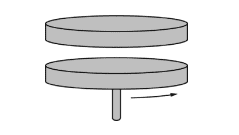
The question asks whether the final kinetic energy of the platform is conserved. I understand the angular momentum is always conserved provided that the net torque is 0, so I wrote the following equation:
$$I_{platform} \omega_i = (I_{platform}+I_{disk}) \omega_f$$
From this I inferred that ##\frac 1 2 I_{platform} {\omega_i}^2 \neq \frac 1 2 (I_{platform}+I_{disk}) {\omega_f}^2##.
My questions are as follows: Why is the energy not conserved in the collision, and how is the energy dissipated?
Thank you in advance.
The question asks whether the final kinetic energy of the platform is conserved. I understand the angular momentum is always conserved provided that the net torque is 0, so I wrote the following equation:
$$I_{platform} \omega_i = (I_{platform}+I_{disk}) \omega_f$$
From this I inferred that ##\frac 1 2 I_{platform} {\omega_i}^2 \neq \frac 1 2 (I_{platform}+I_{disk}) {\omega_f}^2##.
My questions are as follows: Why is the energy not conserved in the collision, and how is the energy dissipated?
Thank you in advance.
Attachments


Last edited: