The Inertia Tensor .... Determining Components of Angular Momentum ....

Click For Summary
SUMMARY

The discussion centers on deriving the components of Angular Momentum (L) and the Inertia Tensor from the equations presented in "Tensor Calculus for Physics" by Dwight E. Neuenschwander. Specifically, participants analyze the transition from equation 2.9 to equation 2.11, focusing on the mathematical manipulation of vector components. The key takeaway is that the ith component of L can be expressed as Li = ∫[r2δij - xixjj dm, utilizing the properties of the Kronecker delta and the summation convention.

PREREQUISITES
  • Understanding of Tensor Calculus
  • Familiarity with Angular Momentum concepts
  • Knowledge of vector notation and summation conventions
  • Basic principles of mechanics and rigid body dynamics
NEXT STEPS
  • Study the derivation of the Inertia Tensor in rigid body dynamics
  • Learn about the properties of the Kronecker delta in tensor equations
  • Explore the implications of Angular Momentum conservation in physics
  • Review advanced topics in Tensor Calculus for deeper insights
USEFUL FOR

Students and professionals in physics, particularly those focusing on mechanics and tensor calculus, as well as anyone seeking to understand the mathematical foundations of Angular Momentum and the Inertia Tensor.

Math Amateur
Gold Member
MHB
Messages
3,920
Reaction score
48
TL;DR
I am having trouble following Neuenschwander's logic in deriving the components of angular momentum ... as he proceed to derive the components of the inertia tensor
I am reading Tensor Calculus for Physics by Dwight E. Neuenschwander and am having difficulties in following his logic regarding proceeding to derive the components of Angular Momentum and from there the components of the Inertia Tensor ...

On page 36 we read the following:
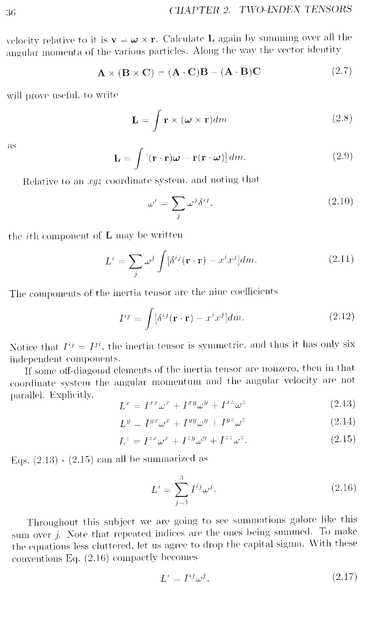
Neuenschwander ... Section 2,2 page 36.png


In the above text by Neuenschwander we read the following:

" ... ... ## L = \int [ ( r \bullet r ) \omega - r ( r \bullet \omega ) ] dm ## ... ... ... (2.9)

Relative to an xyz coordinate system and noting that

## \omega^i = \sum_j \omega^j \delta^{ij} ## ... ... ... (2.10)

the ith component of L may be written

## L^i =\sum_j \omega^j \ \int [ \delta^{ij} ( r \bullet r ) - x^i x^j] dm ## ... ... ... (2.11) ... ... ... "Can some please (... preferably in some detail) show me how Neuenschwander derives the expression for ## L^i ### (that is equation 2.11 from the equations above 2.11 ...Help will be much appreciated ...
Now I think it will be helpful for readers of the above post to have access to the start of Section 2.2 so i am providing this ... as follows:
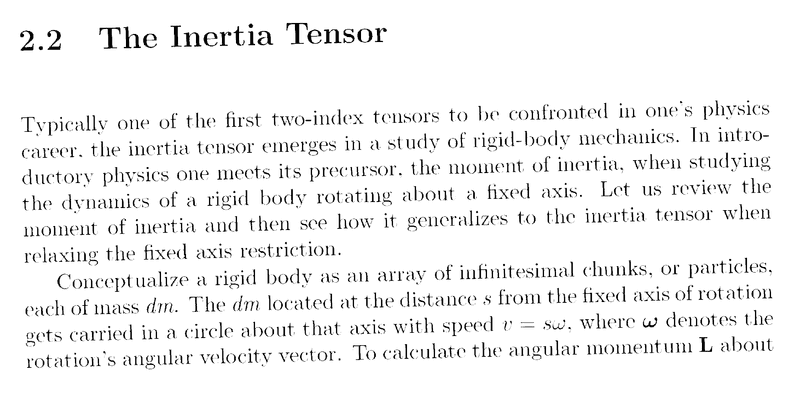
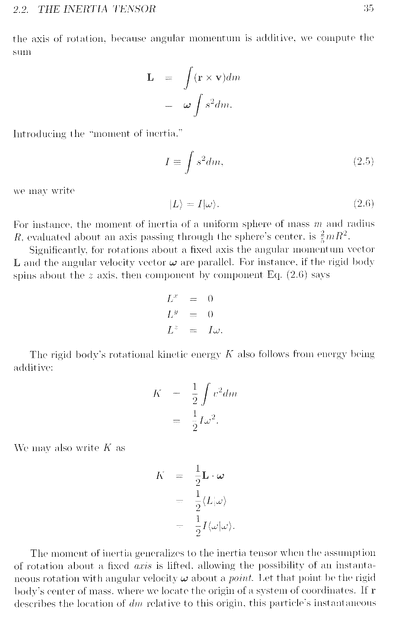
Neuenschwander ... section 2.2 Page 34 .png


Neuenschwander ... Section 2,2 Page 35.png


'
Hope that helps

Peter
 
Last edited:
Physics news on Phys.org
There is not much to be shown as it is just writing equation 2.9 on index form while keeping 2.10 in mind.
 
Thanks for the reply Orodruin ... Given that it should be straight forward i had another shot at demonstrating the Neuenschwander Equation 2.9 leads to (the compact and rather non-intuitive IMO) equation 2.11 ... I think my demonstration is OK ... but not completely sure ... details follow ...

Peter
... 2.11 follows from 2.9 ... Page 1.png
... 2.11 follows from 2.9 ... Page  2 .png
... 2.11 follows from 2.9 ... Page  3 ... .png
Hope that is OK ...

Peter
 
You are way overcomplicating things by writing out all the terms explicitly. The ith component of any vector ##\vec v## is given by ##v_i = \vec e_i \cdot \vec v## and therefore
$$
L_i = \vec e_i\cdot \vec L
= \int [r^2 \vec e_i\cdot\vec\omega - (\vec e_i\cdot \vec x)(\vec x\cdot \vec \omega)] dm
= \int [r^2 \omega_i - x_i (\vec x\cdot \vec \omega)] dm.
$$
Now use that ##\omega_i = \delta_{ij}\omega_j## and ##\vec x \cdot \vec \omega = x_j \omega_j## (implicit sums over j due to the summation convention) and you obtain
$$
L_i
= \int [r^2 \delta_{ij}- x_i x_j]\omega_j dm
$$
where ##\omega_j## is constant and can be moved out of the integral.
 
Last edited:
  • Like
Likes   Reactions: Math Amateur
Thanks Orodruin … most helpful …

Appreciate your help …

Peter
 

Similar threads

  • · Replies 4 ·
Replies
4
Views
2K
  • · Replies 16 ·
Replies
16
Views
3K
  • · Replies 1 ·
Replies
1
Views
3K
  • · Replies 30 ·
2
Replies
30
Views
3K
  • · Replies 1 ·
Replies
1
Views
2K
  • · Replies 17 ·
Replies
17
Views
982
  • · Replies 3 ·
Replies
3
Views
2K
  • · Replies 5 ·
Replies
5
Views
3K
  • · Replies 1 ·
Replies
1
Views
1K
  • · Replies 6 ·
Replies
6
Views
765