The James Webb Space Telescope
- Thread starter valenumr
- Start date
Join the discussion
Registration is free. Ask a follow-up in this thread, or start your own.
546 replies · 78K views
Astronomy news on Phys.org
Science Advisor
Homework Helper
- 30,613
- 7,551
Yes. And the positioning is so precise that they can get back accurately to the starting point.
Much harder when they are looking at an interference pattern of multiple beams.
Much harder when they are looking at an interference pattern of multiple beams.
- 11,327
- 8,758
The topic of this video is the mirror actuator mechanism that allows such precise adjustments. Very clever mechanical engineering. The video producer 3D printed a replica to test and demonstrate which IMO is also very clever.
Oldman too
- 259
- 489
Science Advisor
Homework Helper
- 30,613
- 7,551
JWST power supply; any left over?
The life of the vehicle is said to be limited by the amount of fuel available. Also, they have been ultra careful with the navigation so much less fuel was used and its estimated life is now double what was expected.
My question is, though, why didn't they use an electrical propulsion system, powered by PV panels, for station keeping? The potential surface it sits on has a very gentle slope so the energy needed would be very little, at anyone time. A few m2 of PV panels (or less?) could provide an endless electrical supply for an Ion Drive, for instance.
Perhaps the project started so long ago that the decision to use a rocket engine was made with 'older' technology in mind.
On the same sort of topic, how much power does the refrigeration system use? I heard that it only works at all because the passive system keeps the refrigerant cold enough already. Other low noise imagers on other missions have needed to take fuel with them to achieve the same cooling facility.
The life of the vehicle is said to be limited by the amount of fuel available. Also, they have been ultra careful with the navigation so much less fuel was used and its estimated life is now double what was expected.
My question is, though, why didn't they use an electrical propulsion system, powered by PV panels, for station keeping? The potential surface it sits on has a very gentle slope so the energy needed would be very little, at anyone time. A few m2 of PV panels (or less?) could provide an endless electrical supply for an Ion Drive, for instance.
Perhaps the project started so long ago that the decision to use a rocket engine was made with 'older' technology in mind.
On the same sort of topic, how much power does the refrigeration system use? I heard that it only works at all because the passive system keeps the refrigerant cold enough already. Other low noise imagers on other missions have needed to take fuel with them to achieve the same cooling facility.
- 11,327
- 8,758
There are too many factors for us to speculate on the optimum choice. Mass, simplicity, reliability, contamination (as @hutchphd suggests), plus more I can't think of.sophiecentaur said:My question is, though, why didn't they use an electrical propulsion system, powered by PV panels, for station keeping?
But the pressure to make JWST last a long time is deprecated by these four additional projects coming "soon" that may surpass JWST's capabilities.
https://www.physicsforums.com/threa...es-webb-space-telescope.1008536/#post-6558722
Science Advisor
Homework Helper
- 30,613
- 7,551
Yikes - I never thought of that - however, the ions would be traveling much faster than rocket ejecta so would they not disperse more?hutchphd said:My guess: ions would condense out on mirror. Just a guess.
Oldman too
- 259
- 489
Curiosity led me to look into the Ion drive as far as issues of compatibility with JWST. Its all way over my head but this link seems to have an abundance of info on Ion drive development as well as pro vs. con points. Perhaps someone more academically inclined may get something useful from it. I believe the attitude is controlled mainly with reaction wheels rather than boosters, I could be wrong about this but it seems this is the the way I remember it.
https://aip.scitation.org/doi/10.1063/5.0010134
An update, it seems reaction wheels as well as boosters are used.
https://jwst-docs.stsci.edu/jwst-ob...acecraft -bus/jwst-attitude-control-subsystem
https://jwst-docs.stsci.edu/jwst-observatory-hardware/jwst- spacecraft -bus/jwst-propulsion
https://aip.scitation.org/doi/10.1063/5.0010134
An update, it seems reaction wheels as well as boosters are used.
https://jwst-docs.stsci.edu/jwst-ob...acecraft -bus/jwst-attitude-control-subsystem
https://jwst-docs.stsci.edu/jwst-observatory-hardware/jwst- spacecraft -bus/jwst-propulsion
Last edited:
valenumr
- 469
- 193
If I understand correctly, mostly they just adjust the telescope's pointing, not so much the mirrors to get the initial state. I could be wrong, but it is a reasonable proposition that none of the primary mirrors have the same aim prior to alignment. It only took a handful of captures to identify which mirror corresponded to which target. Don't be so pessimistic.sophiecentaur said:They must be able to identify each mirror without 'turning off' the others. Wobbling it a bit is the only way I could think of. No wonder it's all taking a long time. It's going to be even more of a problem when all the images are in one place; wobbling will have a much more subtle effect when an image is in amongst all the others. A very painstaking system and (yet again) very impressive. Unlike Apollo, there is no room for any seat of the pants stuff here.
Science Advisor
Homework Helper
- 30,613
- 7,551
Not “pessimistic”, just saying that it’s easier to spot one image moving about on its own and one image moving amongst 17 others when they are all on the same basic spot. Wouldn’t you also expect an interference pattern?valenumr said:If I understand correctly, mostly they just adjust the telescope's pointing, not so much the mirrors to get the initial state. I could be wrong, but it is a reasonable proposition that none of the primary mirrors have the same aim prior to alignment. It only took a handful of captures to identify which mirror corresponded to which target. Don't be so pessimistic.
Science Advisor
Homework Helper
- 6,962
- 6,042
The alignment of each optical axis seems almost "easy". If fact at first cosideration the most difficult part if this design would seem to me to get the distance to the center of each mirror exactly adjusted. Each of those (d~1m) mirrors will produce a Rayleigh limit $$\theta =1.22\frac \lambda d$$ but for the coherently adjusted group of 18 where $$D\approx 4d$$ then the diffraction spot gets smaller by 4. How do they get that distance correct?sophiecentaur said:Wouldn’t you also expect an interference pattern?
Science Advisor
Homework Helper
- 3,448
- 3,767
berkeman said:I dunno, seems like a pretty hard problem to me unless you can cover up individual mirrors somehow (which they can't). Anybody know how often they plan to re-calibrate the alignments? Once a "day", once a year, etc.?
According to the article below, they'll do a check every few days, it seems.
hutchphd said:The alignment of each optical axis seems almost "easy". If fact at first cosideration the most difficult part if this design would seem to me to get the distance to the center of each mirror exactly adjusted. Each of those (d~1m) mirrors will produce a Rayleigh limit $$\theta =1.22\frac \lambda d$$ but for the coherently adjusted group of 18 where $$D\approx 4d$$ then the diffraction spot gets smaller by 4. How do they get that distance correct?
This article might shine some light:
https://svs.gsfc.nasa.gov/12753
During coarse phasing, engineers point the telescope toward a bright star and use NIRCam to find any large offsets between the mirror segments (though “large” is relative, and in this case it means mere millimeters). NIRCam has a special filter wheel that can select, or filter, specific optical elements that are used during the coarse phasing process. While Webb looks at the bright star, grisms in the filter wheel will spread the white light of the star out on a detector. Grisms, also called grating prisms, are used to separate light of different wavelengths. To an observer, these different wavelengths appear as parallel line segments on a detector.
[...]
During fine phasing, engineers will again focus the telescope on a bright star. This time, they will use NIRCam to take 18 out-of-focus images of that star — one from each mirror segment. The engineers then use computer algorithms to determine the overall shape of the primary mirror from those individual images, and to determine how they must move the mirrors to align them. These algorithms were previously tested and verified on a 1/6th scale model of Webb’s optics, and the real telescope experienced this process inside the cryogenic, airless environment of Chamber A at NASA’s Johnson Space Center in Houston. Engineers will go through multiple fine-phasing sessions until those 18 separate, out-of-focus images become a single, clear image.
[...]
The entire alignment process is expected to take several months, and once Webb begins making observations, its mirrors will need to be checked every few days to ensure they are still aligned
Motore
- 220
- 222
Everything about alignment is described here:
https://blogs.nasa.gov/webb/2022/02/03/photons-incoming-webb-team-begins-aligning-the-telescope/
This site (the Webb blog) was referred here several times already, so if you are interested I would advise you to look it up every once in a while.
https://blogs.nasa.gov/webb/2022/02/03/photons-incoming-webb-team-begins-aligning-the-telescope/
This site (the Webb blog) was referred here several times already, so if you are interested I would advise you to look it up every once in a while.
Science Advisor
Homework Helper
- 6,962
- 6,042
Well now I know and that is indeed a very nicely presented synopsis. I'm pleased I was asking the right questions: it makes the answers more satisfying ! First time I've seen the term "piston difference" which is very descriptive.Motore said:This site (the Webb blog) was referred here several times already, so if you are interested I would advise you to look it up every once in a while.
valenumr
- 469
- 193
Science Advisor
Homework Helper
- 3,448
- 3,767
hutchphd said:First time I've seen the term "piston difference" which is very descriptive.
If you're interested in the actuators' engineering, here is a good video with a working, 3D-printed replica of the actuators:
Mentor
- 37,555
- 14,432
The 18 mirror images are now in the same spot
It's still 18 largely independent images, the mirrors are not aligned to interference yet.
It's still 18 largely independent images, the mirrors are not aligned to interference yet.
Oldman too
- 259
- 489
It just keeps getting better!
https://www.nasa.gov/press-release/...ignment-milestone-optics-working-successfully
https://www.nasa.gov/press-release/...ignment-milestone-optics-working-successfully
Attachments
pinball1970
Gold Member
2025 Award
- 3,892
- 6,219
Great news ! I posted on TIL regarding cooling. EDIT, also..Oldman too said:It just keeps getting better!
https://www.nasa.gov/press-release/...ignment-milestone-optics-working-successfully
Last edited:
Mentor
- 37,555
- 14,432
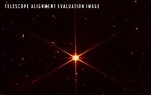
Casual observations of some extremely far away galaxies taken while still aligning the telescope.
That star is magnitude 11, so even amateur telescopes can see it - it's extremely bright compared to typical JWST targets. You can see three pairs of diffraction spikes from the mirror borders and smaller horizontal diffraction spikes from the support of the secondary mirror (the other spikes from that are merged with the mirror segment spikes). These things will be far less prominent in science exposures, as it's obvious from the background galaxies.
That star is magnitude 11, so even amateur telescopes can see it - it's extremely bright compared to typical JWST targets. You can see three pairs of diffraction spikes from the mirror borders and smaller horizontal diffraction spikes from the support of the secondary mirror (the other spikes from that are merged with the mirror segment spikes). These things will be far less prominent in science exposures, as it's obvious from the background galaxies.
- 20,819
- 28,467
pinball1970
Gold Member
2025 Award
- 3,892
- 6,219
Which bit is what here?fresh_42 said:
Circled the whole image conventional? On the right, same area with Webb?
- 20,819
- 28,467
It was said to be the first sharp image from Webb in the article.pinball1970 said:Which bit is what here?
Circled the whole image conventional? On the right, same area with Webb?
Oldman too
- 259
- 489
On "killing time" while awaiting commissioning... about that commissioning,
https://ntrs.nasa.gov/citations/20205010662
After looking at the last image posted (the background was a nice bonus), I decided to look into some of the instrument details to get an idea of what's in store when the science begins.Reading through this site, https://webbtelescope.org/resource-gallery/articles/pagecontent/filter-articles/how-does-webb-see-the-universe.html
it links me to, https://sci.esa.int/web/jwst/-/45694-nirspec-the-near-infrared-spectrograph
This is a truly amazing instrument, https://jwst.nasa.gov/content/about/innovations/microshutters.htm
"Capable of measuring the spectra of up to 200 objects simultaneously in a 3.4 arcminute × 3.6 arcminute field of view."Looking into Webb's connectivity, it's better than I thought.
"Webb can downlink at least 57.2 gigabytes of recorded science data each day, with a maximum data rate of 28 megabits per second."This video explains its title nicely.
"Webb's Field of Regard"
It's also worth noting that someone must have learned a thing or two from the Hubble primary mirror issue, this looks like a contingency plan should there be a problem with optics on JWST.
https://jwst.nasa.gov/content/about/innovations/wavefront.html
And a couple of random upcoming science proposals.
https://arxiv.org/abs/2111.14865
https://arxiv.org/abs/2109.03829
Cheers, Scott
https://ntrs.nasa.gov/citations/20205010662
After looking at the last image posted (the background was a nice bonus), I decided to look into some of the instrument details to get an idea of what's in store when the science begins.Reading through this site, https://webbtelescope.org/resource-gallery/articles/pagecontent/filter-articles/how-does-webb-see-the-universe.html
it links me to, https://sci.esa.int/web/jwst/-/45694-nirspec-the-near-infrared-spectrograph
This is a truly amazing instrument, https://jwst.nasa.gov/content/about/innovations/microshutters.htm
"Capable of measuring the spectra of up to 200 objects simultaneously in a 3.4 arcminute × 3.6 arcminute field of view."Looking into Webb's connectivity, it's better than I thought.
"Webb can downlink at least 57.2 gigabytes of recorded science data each day, with a maximum data rate of 28 megabits per second."This video explains its title nicely.
"Webb's Field of Regard"
It's also worth noting that someone must have learned a thing or two from the Hubble primary mirror issue, this looks like a contingency plan should there be a problem with optics on JWST.
https://jwst.nasa.gov/content/about/innovations/wavefront.html
And a couple of random upcoming science proposals.
https://arxiv.org/abs/2111.14865
https://arxiv.org/abs/2109.03829
Cheers, Scott
Last edited:
valenumr
- 469
- 193
This a pretty cool comparison of the same shot from spitzer:
Mentor
- 37,555
- 14,432
Not the image you posted. That's Gaia taking a picture of JWST. Note the different diffraction pattern: JWST has 6+2 spikes, not 4.fresh_42 said:It was said to be the first sharp image from Webb in the article.
Here it's in an article
Overview which feature of JWST leads to which diffraction pattern.
Similar threads
- James Demers
- · Replies 2 ·
- Astronomy, Astrophysics, Cosmology
- Replies
- 2
High School
Nervous about James Webb Space Telescope?
- Maximum7
- · Replies 23 ·
- Astronomy, Astrophysics, Cosmology
- Replies
- 23
- neilparker62
- · Replies 15 ·
- Astronomy, Astrophysics, Cosmology
- Replies
- 15
- Julian_M
- · Replies 9 ·
- Other Physics Topics
- Replies
- 9
High School
Why is the Webb Space Telescope placed at L2?
- brajesh
- · Replies 13 ·
- Astronomy, Astrophysics, Cosmology
- Replies
- 13
Stargazing
The James Webb Space Telescope construction
- davenn
- · Replies 31 ·
- Astronomy, Astrophysics, Cosmology
- Replies
- 31
- anorlunda
- · Replies 7 ·
- Aerospace Engineering
- Replies
- 7
- brajesh
- · Replies 25 ·
- Astronomy, Astrophysics, Cosmology
- Replies
- 25
- tesselate
- · Replies 5 ·
- Beyond the Standard Models
- Replies
- 5
- signerror
- · Replies 38 ·
- Astronomy, Astrophysics, Cosmology
- Replies
- 38