The magnetic field within cylindrical hollow conductor

Click For Summary

Discussion Overview

The discussion revolves around the behavior of the magnetic field within a cylindrical hollow conductor, particularly in the context of coaxial cables. Participants explore the boundary conditions of the magnetic field at the interface between a dielectric and a perfect conductor, questioning the assumptions made about the magnetic field inside the conductor.

Discussion Character

  • Debate/contested
  • Technical explanation

Main Points Raised

  • One participant asserts that inside a perfect conductor, both the tangential and normal components of the magnetic field (Ht and Hn) are zero.
  • Another participant challenges this claim, asking for justification and referencing literature that discusses boundary conditions at the dielectric-perfect conductor interface.
  • Some participants argue that the literature states the magnetic field inside a perfect conductor is zero, while others suggest that if the conductor is not perfect, the field can penetrate to a certain depth (skin depth).
  • A participant cites a specific source (Engineering Electromagnetics by Nathan Ida) to support their claim about the magnetic field conditions in perfect conductors.
  • There is a suggestion that the discussion may relate to the Meissner-Ochsenfeld effect in superconductivity, prompting a reference to Wikipedia for further information.

Areas of Agreement / Disagreement

Participants do not reach a consensus on the behavior of the magnetic field inside a perfect conductor. There are competing views regarding the interpretation of literature and boundary conditions, leading to an unresolved debate.

Contextual Notes

Participants reference various sources and literature, but there are differing interpretations of the boundary conditions and the behavior of the magnetic field in perfect versus imperfect conductors. The discussion highlights the complexity of electromagnetic theory and the nuances in definitions and assumptions.

nabil25
Messages
6
Reaction score
0
Hi,
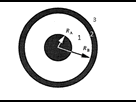
While studying the coaxial cable, i noticed that the magnetic field of the inner conductor can pass through the hollow conductor (can be calculated in the region 3). However, the boundary condition of the magnetic field at the surface (between dielectric and perfect conductor) of a perfect conductor is known as the tangential component of H (Ht = Js surface current density) and the normal component is Hn = 0. Inside the perfect conductor, we have Ht = 0 and Hn = 0.

So why do we superpose the magnetic field of the inner conductor and the hollow conductor when calculating the magnetic field in the region 3 ?

In this case we suppose that the current flowing in the inner conductor is i1 and in the hollow conductor is i2 (not like the coax,here i2 is not equal to -i1).
1477345339-capture.png


Thank you in advance.
 
Physics news on Phys.org
nabil25 said:
Inside the perfect conductor, we have Ht = 0 and Hn = 0.
What makes you say this?
 
kuruman said:
What makes you say this?
According to the literature, it's the boundary condition of the magnetic field at the interface of dielectric-perfect conductor.
 
The literature does not say that the H-field is zero inside the conductor. What does the literature say?
 
kuruman said:
The literature does not say that the H-field is zero inside the conductor. What does the literature say?
The litterature say that the magnetic field inside a perfect conductor is equal to zero. If it's not a perfect conductor, the magnetic field will penetrate until the skin depth.
 
nabil25 said:
The litterature say that the magnetic field inside a perfect conductor is equal to zero. If it's not a perfect conductor, the magnetic field will penetrate until the skin depth.
"The second type of interface discussed here is that between a perfect dielectric and a perfect conductor. In this case, the
overriding condition is that of the conductor, that is, that all fields in the perfect conductor must be zero. Assuming material
(2) is the perfect conductor, E2t, H2t, D2n, and B2n are zero"
 
nabil25 said:
"The second type of interface discussed here is that between a perfect dielectric and a perfect conductor. In this case, the
overriding condition is that of the conductor, that is, that all fields in the perfect conductor must be zero. Assuming material
(2) is the perfect conductor, E2t, H2t, D2n, and B2n are zero"
Can you reference where that comes from? One would expect it would be explained somehow there.
 
DarkBabylon said:
Can you reference where that comes from? One would expect it would be explained somehow there.
ebook (Engineering electromagnetics) Nathan Ida. third edition. page 581. there is a lot of references that say the same thing.
 
Well, at this page are only the usual boundary conditions for the electromagnetic field components but no such claim. Perhaps you are referring to the Meissner-Ochsenfeld effect in superconductivity? Then have a look at Wikipedia

https://en.wikipedia.org/wiki/Meissner_effect
 

Similar threads

  • · Replies 2 ·
Replies
2
Views
2K
  • · Replies 9 ·
Replies
9
Views
2K
Replies
48
Views
5K
  • · Replies 6 ·
Replies
6
Views
2K
  • · Replies 4 ·
Replies
4
Views
3K
  • · Replies 2 ·
Replies
2
Views
2K
  • · Replies 11 ·
Replies
11
Views
4K
  • · Replies 2 ·
Replies
2
Views
2K
  • · Replies 4 ·
Replies
4
Views
1K
  • · Replies 1 ·
Replies
1
Views
4K