Finding the Electric Field of a Hollow Cylindrical Conductor

Click For Summary
SUMMARY

The discussion focuses on calculating the electric field of a hollow, open-ended, thin-walled cylindrical conductor with a net charge. It is established that the electric field within the cylinder is not zero, particularly near the open boundaries. The analysis involves integrating over the cylindrical charge distribution, and while the net electric field is zero at specific points, it is generally non-zero at other locations along the axis. The conclusion emphasizes that the resultant electric field strength vector is non-zero for any point inside the finite hollow cylinder, except potentially at the midpoint of the axis.

PREREQUISITES
  • Understanding of electric fields and conductors
  • Familiarity with integral calculus and numerical methods
  • Knowledge of elliptic integrals of the first kind
  • Basic principles of electrostatics
NEXT STEPS
  • Study the application of numerical integration techniques, such as trapezoidal integration, for electric field calculations
  • Explore the properties of electric fields in conductors, particularly in cylindrical geometries
  • Research the behavior of electric fields near open boundaries of conductors
  • Investigate the use of elliptic integrals in solving electrostatic problems
USEFUL FOR

Students and professionals in physics, electrical engineering, and anyone interested in understanding the behavior of electric fields in cylindrical conductors.

tade
Messages
720
Reaction score
26
I am trying to find the electric field of a hollow, open-ended, thin-walled cylindrical conductor.

I am trying to solve something regarding LINACs:
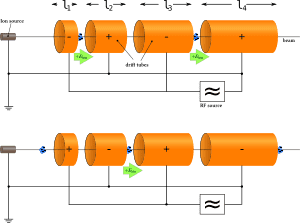
300px-Lineaer_accelerator_en.svg.png


Assume we have an isolated, hollow, open-ended, thin-walled cylindrical conductor, with a net charge.

The net electric field within the cylinder is ostensibly zero, but since it isn't a closed surface, is there a net electric field near the open boundaries of the cylinder?

I tried to solve it using integral methods, but I ended up having to integrate over a function involving elliptic integrals of the first kind, which is hard, and I'm stupid. :confused:
 
Physics news on Phys.org
Cool problem. If you're interesting in a numerical solution why not do it numerically. Use some integration like trapezoidal integration over the charges.
 
tade said:
The net electric field within the cylinder is ostensibly zero
no it can never be zero for a finite hollow cylinder,(except on points lying on mid plane (normal to axis) of cylinder which i doubt may also be nonzero but at midpoint of axis)
suppose take a point P on axis of cylinder at a distance 't' from one base of cylinder (t < (h/2)) where h is height of cylinder
field at P due to portion of cylinder below P (ie of height 't') has some non zero projection along axis = E1
now take portion of cylinder above P, divide it into 2 parts , 1st part which is symmetric(about P) to portion of cylinder below P, rest part is 2nd part
field at P due to 1st part (ie of height 't') has some non zero projection along axis which cancels E1 (since vertical component of force is in opposite dir)
field at P due to 2nd part (ie of height 'h-2t') has some non zero projection along axis
so there is net non-zero vertical projection of field at any point on axis inside finite hollow cylinder (except at midpoint of axis)
so resultant field strength vector must be nonzero in magnitude for any point inside finite hollow cylinder
(
except on points lying on mid plane (normal to axis) of cylinder which i doubt may also be nonzero but at midpoint of axis)
 

Similar threads

Replies
48
Views
5K
  • · Replies 5 ·
Replies
5
Views
1K
  • · Replies 14 ·
Replies
14
Views
3K
  • · Replies 7 ·
Replies
7
Views
1K
  • · Replies 4 ·
Replies
4
Views
2K
  • · Replies 3 ·
Replies
3
Views
2K
  • · Replies 3 ·
Replies
3
Views
2K
  • · Replies 4 ·
Replies
4
Views
4K
  • · Replies 9 ·
Replies
9
Views
4K
  • · Replies 11 ·
Replies
11
Views
4K