The maximum reversible work in thermodynamics

  • Thread starter Thread starter tracker890 Source h
  • Start date Start date
  • Tags Tags
    Thermal dynamics
Click For Summary
SUMMARY

The discussion centers on the calculation of maximum reversible work in thermodynamics, specifically through the analysis of equations related to exergy balance and entropy generation. The key equation presented, W_{rev} = \sum{(1 - \frac{T_0}{T_k}) Q_k} - \Delta U_{sys} + T_0 \Delta S_{sys} - P_0(V_2 - V_1), was scrutinized for accuracy, leading to corrections in the calculations. Participants emphasized the importance of understanding entropy generation to grasp the concept of available energy, referencing textbooks by Yunus A. Çengel and Claus Borgnakke & Richard E. Sonntag for deeper insights.

PREREQUISITES
  • Understanding of thermodynamic principles, particularly exergy and entropy generation.
  • Familiarity with the equations of state and energy balance in thermodynamics.
  • Knowledge of the Carnot cycle and reversible processes.
  • Ability to interpret and manipulate thermodynamic equations and variables.
NEXT STEPS
  • Study the concept of "available energy" as outlined in Yunus A. Çengel's textbooks.
  • Learn about entropy generation and its role in thermodynamic processes.
  • Review the derivations in "Fundamentals of Engineering Thermodynamics" by Moran et al., focusing on section 7.4.
  • Explore practical applications of reversible processes in engineering systems.
USEFUL FOR

Students and professionals in thermodynamics, mechanical engineers, and anyone involved in energy systems analysis and optimization will benefit from this discussion.

tracker890 Source h
Messages
90
Reaction score
11
Homework Statement
Using different methods to solve for the 'maximum reversible work,' the self-solution and the answer differ, and it is unclear where the error lies.
Relevant Equations
Exergy balance
Energy balance
Entropy balance
Q: The maximum reversible work, self-solved, is as follows: Only when equation (5) equals zero will it match the textbook solution; kindly indicate any errors in the self-solution.
reference. : sol.; exergy balance; CMS.; wrev.
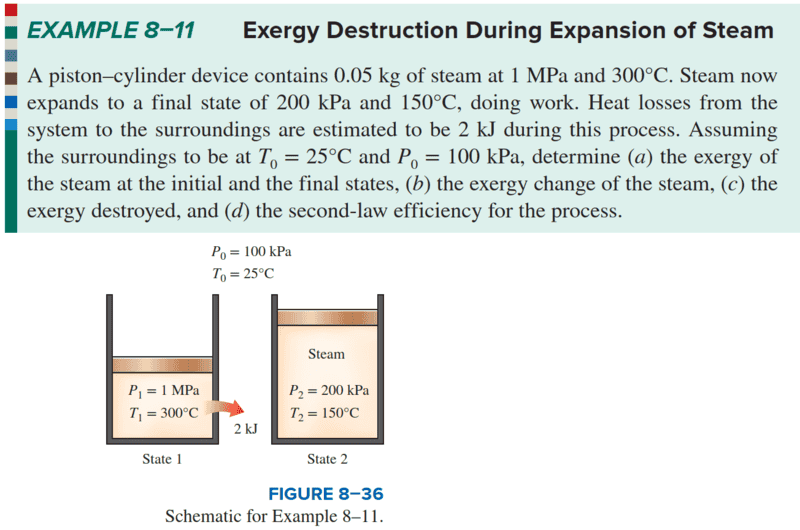
1712335459613.png

Q:
The maximum reversible work, self-solved, is as follows:
Only when equation (5) equals zero will it match the answer; please kindly point out any errors.
$$
W_{rev}=\left( W-W_{surr}^{\nearrow ^{P_0\left( V_2-V_1 \right)}} \right) +T_0Sgen\cdots \cdots \cdots \left( 1 \right)
$$
$$
eneger\ balance:\ \ Q_{in,net}^{\nearrow ^{\sum{Q_k}}}-W_{out,net}^{\nearrow ^W}=\bigtriangleup U_{sys}\cdots \cdots \cdots \left( 2 \right)
$$
$$
entropy\ balance:\ \bigtriangleup S_{sys}=\sum{\frac{Q_k}{T_k}}+\cancel{\left( \sum{m_is_i-}\sum{m_es_e} \right) }+Sgen\cdots \cdots \cdots \left( 3 \right)
$$
$$
ref.\left( 2 \right) :\ \ W=\sum{Q_k}-\bigtriangleup U_{sys}
$$
$$
ref.\left( 3 \right) :\ \ T_0Sgen=\ T_0\bigtriangleup S_{sys}-\sum{\frac{\ T_0}{T_k}}Q_k
$$
$$
\therefore W_{rev}=\sum{\left( 1-\frac{\ T_0}{T_k} \right) Q_k}-\bigtriangleup U_{sys}+T_0\bigtriangleup S_{sys}-P_0\left( V_2-V_1 \right)
$$
$$
=\sum{\left( 1-\frac{\ T_0}{T_k} \right) Q_k}+m\left[ \left( u_1-u_2 \right) -T_0\left( s_1-s_2 \right) +P_0\left( v_1-v_2 \right) \right] \cdots \cdots \cdots \left( Ans.\ W_{rev} \right)
$$
Supplement:
##m\left[ \left( u_1-u_2 \right) -T_0\left( s_1-s_2 \right) +P_0\left( v_1-v_2 \right) \right] ## same as the solution in textbook ##X_1-X_2##solution.
$$
\sum{\left( 1-\frac{\ T_0}{T_k} \right) Q_k}=Q_k^{\nearrow 2KJ}\left[ \left( 1-\frac{\ T_0^{\nearrow 298}}{T_1^{\nearrow ^{573}}} \right) +\left( 1-\frac{\ T_0^{\nearrow 298}}{T_2^{\nearrow ^{423}}} \right) \right] =0.77544^{KJ}\ne 0\cdots \cdots \cdots \left( 5 \right)
$$
 
Last edited:
  • Like
Likes   Reactions: berkeman
Physics news on Phys.org
Review your rendering of the equations. I don't see any equation 5.
 
Chestermiller said:
Review your rendering of the equations. I don't see any equation 5.
There is an equation labeled (5) at the very bottom of the post under "Supplement". There is no equation (4), though.
 
Please describe the process you envision to go from the initial state to the final state of the system.
 
Chestermiller said:
Please describe the process you envision to go from the initial state to the final state of the system.
1. Regarding equation (5), the calculation error has been corrected to:
$$
\sum{\left( 1-\frac{\ T_0}{T_k} \right) Q_k}=Q_k^{\nearrow -2KJ}\left[ \left( 1-\frac{\ T_0^{\nearrow 298}}{T_1^{\nearrow ^{573}}} \right) +\left( 1-\frac{\ T_0^{\nearrow 298}}{T_2^{\nearrow ^{423}}} \right) \right] =-1.5509^{KJ}\ne 0\cdots \cdots \cdots \left( 5 \right)
$$
2. The new idea is as follows, unsure if it is correct:
$$
ref.\left( 2 \right) :\ \ W=\sum{Q_k}-\bigtriangleup U_{sys}=\sum{-Q_R}-\bigtriangleup U_{sys}
$$
$$
ref.\left( 3 \right) :\ \ T_0Sgen=\ T_0\bigtriangleup S_{sys}-\sum{\frac{\ T_0}{T_k}}Q_k=T_0\bigtriangleup S_{sys}-\sum{\frac{\ T_0}{T_R^{\nearrow T_0}}}\left( -Q_R \right) =T_0\bigtriangleup S_{sys}+\sum{Q_R}
$$
##
\therefore W_{rev}=-\bigtriangleup U_{sys}+T_0\bigtriangleup S_{sys}-P_0\left( V_2-V_1 \right) =m\left[ \left( u_1-u_2 \right) -T_0\left( s_1-s_2 \right) +P_0\left( v_1-v_2 \right) \right]
##........(same as the solution in textbook solution)
 
This is not the process that the system experienced. It is the equations you used. What’s the detailed process that these equations correspond to?
 
Chestermiller said:
This is not the process that the system experienced. It is the equations you used. What’s the detailed process that these equations correspond to?
Imagine a system in a quasi-static state, with a thermodynamic process occurring from state 1 to state 2.
 
How do you know that this was the proces that brought about the change?
 
Chestermiller said:
How do you know that this was the proces that brought about the change?
I referenced the following two thermodynamics textbooks for your consideration.
reference
 
  • #10
I'm sorry, I just don't follow what you are trying to do. I'm guessing, you have been trying to devise a reversible process between the initial state and final state of the system, and comparing the work done by the system in that process (over and above work to push back the surroundings) with the decrease in exergy of the system. Is that correct?
 
  • #11
Chestermiller said:
I'm sorry, I just don't follow what you are trying to do. I'm guessing, you have been trying to devise a reversible process between the initial state and final state of the system, and comparing the work done by the system in that process (over and above work to push back the surroundings) with the decrease in exergy of the system. Is that correct?
What you said is correct.
 
  • #12
tracker890 Source h said:
What you said is correct.
OK. And what is the mismatch algebraically?
 
  • #13
Chestermiller said:
OK. And what is the mismatch algebraically?
Why is equation (5) not zero?
reference
 
Last edited:
  • #14
Did all the heat in your reversible process on the system get transferred to the surroundings reversibly at T0? That reference you cited makes sense to me. You need to maintain the same original system and surroundings.
 
  • #15
If I were going to analyze a reversible process for the system to go from the initial state to the final state under the constraint of constant total volume of system and surroundings, and no heat transfer from this combined microsystem, I would do the following:

1. Adiabatic reversible expansion of the steam to the final volume

2. At constant volume of system, reversibly transferring heat through a Carnot engine setup with the gas as the high temperature reservoir (with temperature decreasing) and the surroundings at T0 as the low temperature reservoir.

The combined system work from both these steps (for the combined macros system of system plus surroundings) should equal the decrease in exergy of the system between the initial and final state.
 
  • #16
Here is the analysis I alluded to in my previous post.

The initial state of the system is: ##T_1=300\ C##,##P_1=10\ bars##, ##u_1=2793\ kJ/kg##, ##s_1=7.121\ kJ/kgK##, ##v_1=0.2579\ m^3/kg##
 
  • #17
Chestermiller said:
If I were going to analyze a reversible process for the system to go from the initial state to the final state under the constraint of constant total volume of system and surroundings, and no heat transfer from this combined microsystem, I would do the following:
1. Adiabatic reversible expansion of the steam to the final volume
2. At constant volume of system, reversibly transferring heat through a Carnot engine setup with the gas as the high temperature reservoir (with temperature decreasing) and the surroundings at T0 as the low temperature reservoir.

The combined system work from both these steps (for the combined macros system of system plus surroundings) should equal the decrease in exergy of the system between the initial and final state.
To avoid confusion, I'll use the precise term "available energy" from the textbook.
  1. The method you described is the approach by the author Yunus A. Çengel: assuming the process is entirely reversible to determine the available energy.
  2. Another approach is from the authors CLAUS BORGNAKKE and RICHARD E. SONNTAG: preserving the original irreversible thermodynamic process, subtracting the irreversible part, to obtain the method for a reversible process, and then determining the available energy.
  3. I am preparing another example to discuss with everyone, aiming to clarify the correct concept of "available energy."
 
Last edited:
  • #18
tracker890 Source h said:
To avoid confusion, I'll use the precise term "available energy" from the textbook.
  1. The method you described is the approach by the author Yunus A. Çengel: assuming the process is entirely reversible to determine the available energy.
  2. Another approach is from the authors CLAUS BORGNAKKE and RICHARD E. SONNTAG: preserving the original irreversible thermodynamic process, subtracting the irreversible part, to obtain the method for a reversible process, and then determining the available energy.
To do this, don't you need to know the amount of entropy generation?
 
  • #19
Chestermiller said:
To do this, don't you need to know the amount of entropy generation?
Thank you very much. You've mentioned the most important key point. However, explaining this part in words is quite difficult. I can only say that one must first learn about "entropy generation" in order to understand exergy.
 
  • #20
tracker890 Source h said:
Thank you very much. You've mentioned the most important key point. However, explaining this part in words is quite difficult. I can only say that one must first learn about "entropy generation" in order to understand exergy.
I don’t think so. As long as you use a reversible process, the exergy decrease will be equal to the maximum work you can derive from the combination of system and surroundings.
 
  • #21
Chestermiller said:
I don’t think so. As long as you use a reversible process, the exergy decrease will be equal to the maximum work you can derive from the combination of system and surroundings.
Perhaps my level is not as high, but the few sentences you mentioned seem simple, yet they are insights I've obtained after about a week of research and repeatedly deriving them. Additionally, I have uploaded a new example, hoping to receive your corrections.
 
  • #22
tracker890 Source h said:
Perhaps my level is not as high, but the few sentences you mentioned seem simple, yet they are insights I've obtained after about a week of research and repeatedly deriving them. Additionally, I have uploaded a new example, hoping to receive your corrections.
Have you seen the derivations in Fundamentals of Engineering Thermodynamics by Moran, et al? See especially section 7.4.
 
  • #23
Chestermiller said:
Have you seen the derivations in Fundamentals of Engineering Thermodynamics by Moran, et al? See especially section 7.4.
Thank you for your suggestion. I also managed to find the book successfully. After studying some of the material, I've gained inspiration and different perspectives to ponder on.
 
  • Like
Likes   Reactions: Chestermiller

Similar threads

  • · Replies 1 ·
Replies
1
Views
824
Replies
9
Views
1K
  • · Replies 2 ·
Replies
2
Views
1K
  • · Replies 11 ·
Replies
11
Views
3K
  • · Replies 3 ·
Replies
3
Views
2K
  • · Replies 1 ·
Replies
1
Views
2K
  • · Replies 2 ·
Replies
2
Views
1K
  • · Replies 1 ·
Replies
1
Views
2K