The Normal Zeeman Effect and Hydrogen States

Click For Summary

Homework Help Overview

The discussion revolves around the Normal Zeeman Effect and its implications for the hydrogen atom's energy states. Participants explore the relationship between energy levels and angular momentum, particularly in the context of time evolution of quantum states.

Discussion Character

  • Exploratory, Conceptual clarification, Mathematical reasoning

Approaches and Questions Raised

  • Participants discuss avoiding perturbation theory and express concerns about the simplicity of their derived energy expressions. Questions arise regarding the time evolution of wavefunctions and the implications for specific quantum states, particularly the |2 1 0> state.

Discussion Status

Some participants have provided guidance on the mathematical expressions for probability amplitudes and the normalization of wavefunctions. There is ongoing exploration of how to interpret these amplitudes and their implications for probabilities over time, with no explicit consensus reached on the final interpretations.

Contextual Notes

Participants are navigating complex quantum mechanical concepts, including the normalization of states and the behavior of probability amplitudes under time evolution. There are mentions of specific conditions and assumptions that may affect the outcomes, such as the treatment of angular momentum quantum numbers.

mrjohns
Messages
13
Reaction score
0
I'm studying the hydrogen atom and have this question. Apparently it can be solved without perturbation theory, however I'm having trouble justifying it.
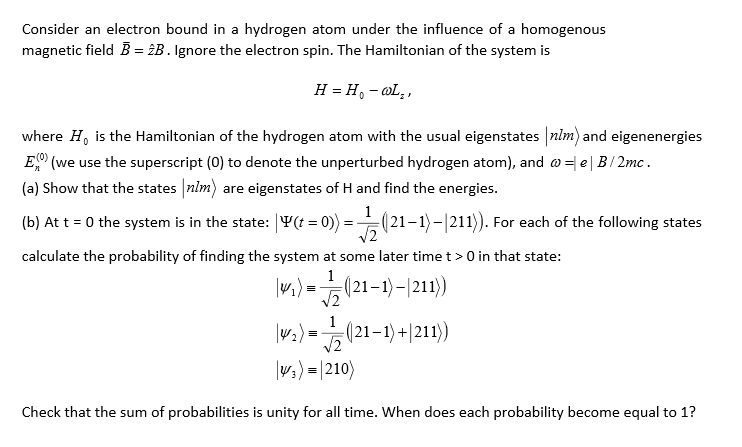
Homework Statement


153wwgi.png


2. The attempt at a solution

Avoiding perturbation theory I simply get:

E = E(n) - constant*(mh) where m is the angular momentum number not mass

Which seems a little too easy.

For the second part I can see the initial t=0 wavefunction is normalised no problem, but when I apply the time evolution operator e^(iEt)/h things get messy.

Am I right in thinking the probability for the third state | 2 1 0 > is just zero for all time?
 
Physics news on Phys.org
Hello mrjohns. Welcome to PF!

mrjohns said:
Avoiding perturbation theory I simply get:

E = E(n) - constant*(mh) where m is the angular momentum number not mass

Which seems a little too easy.

That looks good.

For the second part I can see the initial t=0 wavefunction is normalised no problem, but when I apply the time evolution operator e^(iEt)/h things get messy.
Can you show a little more detail. It shouldn't be messy.

Am I right in thinking the probability for the third state | 2 1 0 > is just zero for all time?
Yes.
 
Thanks for the reply.

If I say the energies are E=E(n)-E(b)*mh I get by time evolution:

|psi(t)> = 1/sqr(2) [ e^-i(E(n)+E(b))t | 2 1 -1 > - e^-i(E(n)-E(b))t | 2 1 1 > ]

Which by Eulers formula:

=1/sqrt(2) { [ cos[(-E(n)-E(b))t] + isin[(-E(n)-E(b))t] ] | 2 1 -1 > - [ cos[(-E(n)+E(b))t] + isin[(-E(n)+E(b))t] ] | 2 1 1 > }

Which is normalised for all time, since (cos(x)+isin(x))(cos(x)-isin(x))=1

Now obviously it can never get to the |psi(3)>=|210> state of |nlm> since this evolution doesn't change the value of m.

But I can't see how it can evolve to the |psi(2)> state. Should I have left in m, rather than substituted 1 and -1 in for it?
 
You have |ψ(t)> = 1/√2 [e-iω1t | 2 1 -1 > - e-iω2t | 2 1 1 > ] where ω1 = E(n)+E(b) and ω2 = E(n)-E(b)

Note that the phase factors in front of | 2 1 -1 > and | 2 1 1 > oscillate with different frequencies. So, there will be instants of time when the phase factors are equal (which gives |ψ1>) and instants of time when the phase factors are exactly out of phase with each other (which gives |ψ2>).

Now that you have an expression for |ψ(t)>, how would you get the probability amplitude for this state to be measured as |ψ1>?
 
Using matrix multiplication and putting bras to kets i get:

Prob amp for |ψ1> = 1/2 [e^-iω1t + e^-iω2t] => Probability is one when e^-iω1t = e^-iω2t = 1

Prob amp for |ψ2> = 1/2 [e^-iω1t - e^-iω2t] => Probability is one when e^-iω1t = -e^-iω2t = 1

Prob amp for |ψ3> = 0 for all time

Now these probability amplitudes for |ψ1>,|ψ2>,|ψ3> sum to e^-iω1t which does not equal one. Is this correct?

Or am I reading the question wrong, and is it simply asking whether <ψ(t)|ψ(t)> = 1 for all time? (Which it does.)

[Edit-And I've also got the added condition for the phases e^-iω1t = e^-iω2t = 1 rather than when they're just equal, and e^-iω1t = -e^-iω2t = 1 rather than when they're just out of phase.

I know I want to do <ψ1|ψ(t)> to find the probability amplitude for ψ1

Do I want <ψ1| = 1/√2 [< 2 1 -1 | - < 2 1 1 |] or am I missing something?]
 
Last edited:
mrjohns said:
Using matrix multiplication and putting bras to kets i get:

Prob amp for |ψ1> = 1/2 [e^-iω1t + e^-iω2t] => Probability is one when e^-iω1t = e^-iω2t = 1

Prob amp for |ψ2> = 1/2 [e^-iω1t - e^-iω2t] => Probability is one when e^-iω1t = -e^-iω2t = 1

Prob amp for |ψ3> = 0 for all time

Now these probability amplitudes for |ψ1>,|ψ2>,|ψ3> sum to e^-iω1t which does not equal one. Is this correct?

Or am I reading the question wrong, and is it simply asking whether <ψ(t)|ψ(t)> = 1 for all time? (Which it does.)

A probability amplitude is a product of a bra with a ket. So, I'm not following your statements above. But you are correct in what you state below:

I know I want to do <ψ1|ψ(t)> to find the probability amplitude for ψ1

Do I want <ψ1| = 1/√2 [< 2 1 -1 | - < 2 1 1 |] or am I missing something?]

Yes this is all you need to do, find <ψ1|ψ(t)>

where <ψ1| = 1/√2 [< 2 1 -1 | - < 2 1 1 |] and |ψ(t)> = 1/√2 [e-1t | 2 1 -1 > - e-iω2t | 2 1 1 > ]
 
So does the methodology here look right?

<ψ1|ψ(t)> = {1/√2 [< 2 1 -1 | - < 2 1 1 |]}{1/√2 [e-iω1t | 2 1 -1 > - e-iω2t | 2 1 1 > ] }
<ψ1|ψ(t)> = 1/2 [< 2 1 -1 | e-iω1t | 2 1 -1 > + < 2 1 1 | e-iω2t | 2 1 1 >]
<ψ1|ψ(t)> = 1/2 [e^-iω1t + e^-iω2t] by orthonormality

And similarly:

<ψ2|ψ(t)> = 1/2 [e^-iω1t - e^-iω2t] by orthonormality

<ψ3|ψ(t)> = 0

To get the probability density I need to square by complex conjugate, so get:

Prob:(ψ1) = 1/4 [e^-iω1t + e^-iω2t][e^+iω1t + e^+iω2t]
Prob:(ψ1) = 1/4 [2+2e^(-i^2)ω1ω2(t^2)]
Prob:(ψ1) = 1/2 [1+e^ω1ω2(t^2)]

And similarly:

Prob:(ψ2) = 1/2 [1-e^ω1ω2(t^2)]

Thus Prob:(ψ1) + Prob:(ψ2) + Prob:(ψ3) = 1/2 [1+e^ω1ω2(t^2)] + 1/2 [1-e^ω1ω2(t^2)] = 1 for all time.

And we get:

Prob:(ψ1)=1 if e^ω1ω2(t^2)=1
Prob:(ψ2)=1 if e^ω1ω2(t^2)=-1

Does this seem ok? One part that's bugging me is e^ω1ω2(t^2) - how do I know it is bound between -1 and 1 in order for the probability density equations to make sense?
 
Last edited:
mrjohns said:
To get the probability [STRIKE]density[/STRIKE] I need to square by complex conjugate, so get:

Prob:(ψ1) = 1/4 [e^-iω1t + e^-iω2t][e^+iω1t + e^+iω2t]
Prob:(ψ1) = 1/4 [2+2e^(-i^2)ω1ω2(t^2)]

Good up to the blue line. Rethink the product e-iω1te+iω2t
 
Whoops, so I should have typed:

Prob:(ψ1) = 1/4 [e^-iω1t + e^-iω2t][e^+iω1t + e^+iω2t]
Prob:(ψ1) = 1/4 [1+e^-i(ω1-ω2)t+e^-i(ω2-ω1)t+1]
Prob:(ψ1) = 1/4 [2+e^-i(ω1-ω2)t+e^-i(ω2-ω1)t]

And similarly:

Prob:(ψ2) = 1/4 [2-e^-i(ω1-ω2)t-e^-i(ω2-ω1)t]

Thus Prob:(ψ1) + Prob:(ψ2) + Prob:(ψ3) = 1/4 [2+e^-i(ω1-ω2)t+e^-i(ω2-ω1)t] + 1/4 [2-e^-i(ω1-ω2)t-e^-i(ω2-ω1)t] = 1 for all time.

And we get:

Prob:(ψ1)=1 if e^-i(ω1-ω2)t+e^-i(ω2-ω1)t=2
Prob:(ψ2)=1 if e^-i(ω1-ω2)t+e^-i(ω2-ω1)t=-2

So now I need | e^-i(ω1-ω2)t+e^-i(ω2-ω1)t | <= 2 - how do I know it is bound in this way? And isn't the complex part an issue?
 
Last edited:
  • #10
mrjohns said:
Whoops, so I should have typed:

Prob:(ψ1) = 1/4 [e^-iω1t + e^-iω2t][e^+iω1t + e^+iω2t]
Prob:(ψ1) = 1/4 [1+e^-i(ω1-ω2)t+e^-i(ω2-ω1)t+1]
Prob:(ψ1) = 1/4 [2+e^-i(ω1-ω2)t+e^-i(ω2-ω1)t]

Use the identity eix + e-ix = 2cos(x)
 
  • #11
Ah, so:

Prob:(ψ1) = 1/4 [2+e^-i(ω1-ω2)t+e^+i(ω1-ω2)t]
Prob:(ψ1) = 1/2 {1+cos[(ω1-ω2)t]}

Prob:(ψ2) = 1/4 [2-(e^-i(ω1-ω2)t+e^+i(ω1-ω2)t)]
Prob:(ψ2) = 1/2 {1-cos[(ω1-ω2)t]}

Now I can see that looks a lot better - the probabilities for each are bound between 0 and 1, and Prob:(ψ1)=1 at t=0.

When cos[(ω1-ω2)t=1, Prob:(ψ1)=1, and when cos[(ω1-ω2)t]=-1, Prob:(ψ2)=1.
 
  • #12
Yes. Good.
 
  • #13
Cheers, thanks so much for your help.
 

Similar threads

Replies
3
Views
2K
Replies
2
Views
1K
  • · Replies 2 ·
Replies
2
Views
5K
Replies
1
Views
6K
  • · Replies 1 ·
Replies
1
Views
5K
  • · Replies 5 ·
Replies
5
Views
2K
  • · Replies 0 ·
Replies
0
Views
2K
  • · Replies 1 ·
Replies
1
Views
4K
  • · Replies 1 ·
Replies
1
Views
2K
Replies
1
Views
2K