The Physics of De Sitter Black Hole Heat Capacity

Click For Summary
SUMMARY

The discussion centers on the heat capacity of de Sitter black holes and their cosmological horizons, specifically the implications of temperature differences and heat capacity signs. It is established that when the temperature of the black hole (T+) exceeds that of the cosmological horizon (T++), heat flows from the black hole to the cosmological horizon, resulting in an increase in the cosmological horizon's radius due to its positive heat capacity (C++ > 0). Conversely, the black hole's radius shrinks as its temperature increases, attributed to its negative heat capacity (C+ < 0). The relationship between temperatures is secondary to the effects of heat capacity on horizon radii.

PREREQUISITES
  • Understanding of thermodynamics in black hole physics
  • Familiarity with the concepts of heat capacity (C+ and C++)
  • Knowledge of temperature dynamics in cosmological contexts
  • Basic principles of general relativity and black hole thermodynamics
NEXT STEPS
  • Study the implications of positive and negative heat capacity in black hole thermodynamics
  • Research the relationship between temperature and horizon dynamics in de Sitter space
  • Examine the role of energy flux in black hole and cosmological horizon interactions
  • Explore advanced topics in general relativity related to cosmological horizons
USEFUL FOR

Physicists, cosmologists, and students of theoretical physics interested in black hole thermodynamics and the dynamics of cosmological horizons.

PeteSampras
Messages
43
Reaction score
2
I am reading the paper https://arxiv.org/pdf/0801.4591.pdf ,

says "Fortunately, the fact that the heat capacity of the cosmological horizon be positive permits to foresee the evolution of the space in absence of any external source. Taking the correct signs for the temperatures one can notice that, for a given value of M, T+ > T++. Therefore, during their interaction due to its positive heat capacity the cosmological horizon would increase its temperature, and so its radius. Conversely, the black hole horizon would become even hotter because of its negative heat capacity and shrink. In this way, there should be a net flux of energy from the black hole horizon into cosmological horizon. "

where T+, and T++ are the temperature of the black hole and cosmological horizon, respectively.

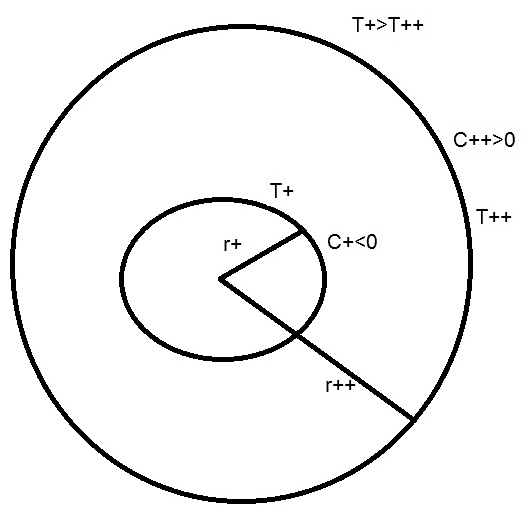
Why the fact that T+>T++ and C++>0 implies that the cosmological horizon radii increase?, and
Why the fact that T+>T++ and C+<0 implies that the black hole horizon radii shrink?,

I think in a scheme as the figure.
240902
 
Physics news on Phys.org
PeteSampras said:
Why the fact that T+>T++ and C++>0 implies that the cosmological horizon radii increase?

The cosmological horizon radius increases if its temperature increases because C++> 0. That has nothing to do with the relative temperatures of the two horizons.

PeteSampras said:
Why the fact that T+>T++ and C+<0 implies that the black hole horizon radii shrink?

The black hole's horizon radius shrinks if its temperature increases because C+<0. That has nothing to do with the relative temperature of the two horizons.

The only role that T+>T++ plays in the logic is to make heat flow from the black hole to the cosmological horizon. It plays no role in determining how the radius of each horizon changes.
 
PeterDonis said:
The cosmological horizon radius increases if its temperature increases because C++> 0.

PeterDonis said:
The black hole's horizon radius shrinks if its temperature increases because C+<0.

To expand on this a bit: we have a situation in which T+ > T++, which means heat flows from the black hole to the cosmological horizon. That means the heat flow into the cosmological horizon, which I'll call Q++, is positive. Then the fact that C++ is also positive means that T++ increases.

Also, the heat flow into the black hole, which I'll call Q+, is negative, because heat is flowing out of the black hole. Then the fact that C+ is also negative means that T+ increases.
 

Similar threads

  • · Replies 4 ·
Replies
4
Views
2K
  • · Replies 20 ·
Replies
20
Views
3K
  • · Replies 17 ·
Replies
17
Views
4K
  • · Replies 9 ·
Replies
9
Views
2K
  • · Replies 9 ·
Replies
9
Views
2K
  • · Replies 3 ·
Replies
3
Views
4K
  • · Replies 23 ·
Replies
23
Views
3K
  • · Replies 26 ·
Replies
26
Views
5K
  • · Replies 4 ·
Replies
4
Views
2K
  • · Replies 16 ·
Replies
16
Views
2K