The Residue Theorem To Evaluate Integrals

5 replies · 3K views · last reply
joypav
Messages
149
Reaction score
0
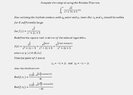
View attachment 7330

I have no idea if this is in the right direction. I know I am going to need the summation of the residues to use the theorem. I found the residues using the limit, but do I need to change these using the euler formula?

We are supposed to be working problems at home and I am getting a bit lost as the semester goes on. I would really appreciate some help or a push in the right direction!
 
Attachments
  • Handwritten-style typed working computing the improper integral from 0 to infinity of sqrt(x) over x^2 + 2x + 5 dx by the residue theorem, with f(z) = z^(1/2)/(z^2 + 2z + 5), poles z1 = -1 + 2i and z2 = -1 - 2i, and residues written as sqrt(-1+2i)/(4i) and sqrt(-1-2i)/(-4i).
    9ve7wm.jpg
    15.1 KB · Views: 226
Square roots are multi-valued, so you have to choose a branch $\log z$ first. Also, you need to choose a contour for which the residue theorem can be applied. Consider using a keyhole contour.
 
Okay, yeah. Something more like this? Lacking details of course, but is this the idea?
View attachment 7336
Then I will have four integrals to compute, set equal to 2(pi)i*sum of the residues.
 
Attachments
  • Handwritten-style typeset derivation applying the Residue Theorem to the integral from 0 to infinity of sqrt(x)/(x^2+2x+5) dx, redefining the square root via logarithm, listing poles z1 = -1+2i and z2 = -1-2i, and giving residues for each pole.
    drbml4.jpg
    26.4 KB · Views: 164
It looks right so far. Now show that the integral of $f$ becomes negligible over certain parts of the contour.
 
For completion, the integral evaluates to

$$\boxed{\frac{\pi}{2\sqrt{2}}\sqrt{\sqrt{5}-1}}$$