The Sense of Restoring Force in Vibrations

Click For Summary
SUMMARY

The discussion centers on the concept of restoring force in mechanical vibrations, specifically addressing the relationship between force, displacement, and velocity. Participants clarify that the restoring force acts opposite to displacement rather than velocity, emphasizing that negative acceleration can lead to an increase in speed if the velocity is negative. Misinterpretations of these terms are highlighted, particularly regarding the phrase "decreasing velocity," which lacks clarity. The source material referenced is "Engineering Mechanics" by Joseph E. Shelley.

PREREQUISITES
  • Understanding of mechanical vibrations
  • Familiarity with Newton's laws of motion
  • Knowledge of acceleration and velocity concepts
  • Basic principles of restoring forces in physics
NEXT STEPS
  • Study the concept of restoring forces in mechanical systems
  • Learn about the relationship between displacement and force in oscillatory motion
  • Investigate the implications of negative acceleration in different contexts
  • Review the terminology used in "Engineering Mechanics" by Joseph E. Shelley
USEFUL FOR

Physics students, mechanical engineers, and anyone interested in the principles of vibrations and forces in mechanical systems will benefit from this discussion.

mech-eng
Messages
825
Reaction score
13
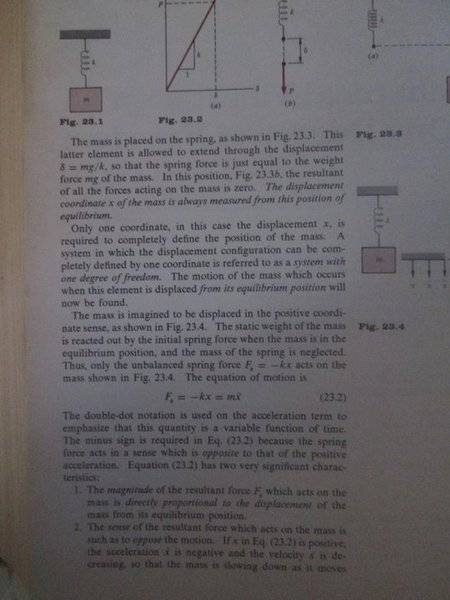
I would like to ask about the sense of the restoring force in mechanical vibrations.
IMG_1473.JPG


Comment 2 says that resultant force is opposite the motion but I have some hesitations about it because let's think the situation that mass is moving back upward to its equilibrium position. In this case the sense of the force is to its equilibrium point and acceleration is also to its equilibrium point. Because when the mass moves downward and when the velocity of mass come to zero because of the spring force, this time mass will start to move in the sense of the spring force.

Would you like to explain it?

Source: Engineering Mechanics by Joseph E. Shelley

Thank you.
 
Physics news on Phys.org
You are correct. The sense of the force is opposite to the displacement, not opposite to the velocity. I assume that "motion" means velocity, as usual.
 
Dale said:
You are correct. The sense of the force is opposite to the displacement, not opposite to the velocity. I assume that "motion" means velocity, as usual.
Agreed. This is poorly worded, IMHO, on the part of the author.

The phrase (also in Comment 2) that a negative acceleration means a decreasing velocity, therefore the mass is slowing down, is just wrong. If the velocity happens to be negative, a negative acceleration would mean the mass is speeding up. (The phrase "decreasing velocity" seems ambiguous: does it mean a decreasing magnitude, or a change toward more negative values? The author seems to have confused these two meanings.)
 

Similar threads

  • · Replies 9 ·
Replies
9
Views
3K
  • · Replies 6 ·
Replies
6
Views
3K
  • · Replies 19 ·
Replies
19
Views
3K
  • · Replies 10 ·
Replies
10
Views
2K
  • · Replies 24 ·
Replies
24
Views
2K
  • · Replies 13 ·
Replies
13
Views
2K
  • · Replies 1 ·
Replies
1
Views
3K
  • · Replies 17 ·
Replies
17
Views
2K
  • · Replies 11 ·
Replies
11
Views
2K
  • · Replies 21 ·
Replies
21
Views
2K