The T dS equations and Sackur-Tetrode equation

  • Thread starter Thread starter mathman44
  • Start date Start date
Click For Summary

Homework Help Overview

The discussion revolves around the "TdS" equations and the Sackur-Tetrode equation, focusing on a specific part of a homework problem related to thermodynamic processes, particularly isothermal processes.

Discussion Character

  • Exploratory, Assumption checking, Conceptual clarification

Approaches and Questions Raised

  • Participants explore the relationship between entropy change and the TdS equation, questioning the validity of assuming that ΔS equals dS. There is an attempt to relate pressure and volume changes in the context of isothermal processes.

Discussion Status

Some participants have offered guidance on how to approach the problem, suggesting the need to consider limits and the proper application of expressions for entropy. Multiple interpretations of the equations and their implications are being explored.

Contextual Notes

There is mention of specific conditions for the process being analyzed, such as isothermal conditions and the need to handle limits carefully in the context of the equations discussed.

mathman44
Messages
204
Reaction score
0
The "T dS" equations and Sackur-Tetrode equation

Homework Statement


This is a bit of a dumb question (I hope)
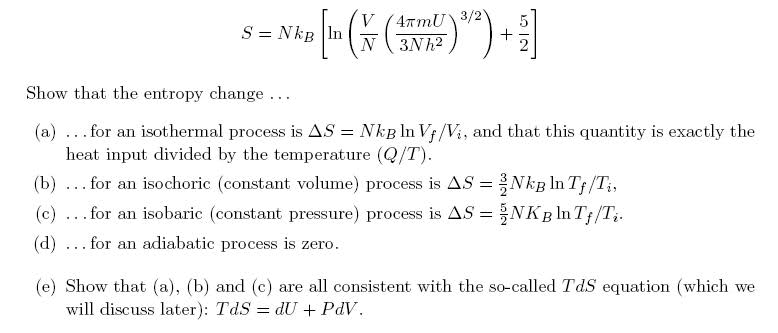
69eufp.jpg


I'm having trouble with part (e).

The Attempt at a Solution


to show it for (a), dS is given, so T\times{NK_bln{\frac{V_f}{V_i}} = P\times{dV} since dU = 0 for isothermal process. P can be written as \frac{NK_bT}{V}, but this is clearly not equal to what I got in part A... although it would be if I integrated the right side (?)
 
Physics news on Phys.org


The TdS equation has TdS on the left hand side, you have an expression for \Delta S of a process with a macroscopic change. Do you know that
d(\ln{x})=\frac{d(\ln{x})}{dx}dx =\frac{dx}{x}
?


Was I wrong to assume that \Delta{S} = dS?


Yes, if you use Vf and Vi on the left hand side, you need to use them on the right hand side and take the limit
\lim_{V_{f}\rightarrow V_{i}}
on both sides and show that the ratio of the left hand side to the right hand side approaches 1, but it's much easier to just use the relation I mentioned.
 

Similar threads

Replies
1
Views
3K
Replies
5
Views
2K
  • · Replies 10 ·
Replies
10
Views
2K
Replies
3
Views
6K
  • · Replies 1 ·
Replies
1
Views
2K
  • · Replies 4 ·
Replies
4
Views
2K
Replies
5
Views
4K
Replies
2
Views
7K
Replies
5
Views
2K
  • · Replies 9 ·
Replies
9
Views
3K