The voltage of the 2uf capacitor will be the sum of the two source voltages.

  • Thread starter Thread starter dreamz25
  • Start date Start date
  • Tags Tags
    Capacitors Topic
Click For Summary
SUMMARY

The voltage across a 2µF capacitor in a circuit with two voltage sources is determined by the sum of the source voltages. In steady-state conditions, the direction of current flow is dictated by the polarity of the dominant voltage source. For transient analysis, it is crucial to apply current conventions and consider initial conditions, as the voltage across the capacitor will change rapidly without resistance in the circuit. Understanding Kirchhoff's Voltage Law (KVL) is essential for calculating potential differences in such arrangements.

PREREQUISITES
  • Understanding of Kirchhoff's Voltage Law (KVL)
  • Knowledge of capacitor behavior in electrical circuits
  • Familiarity with steady-state and transient analysis
  • Basic concepts of voltage sources and current flow
NEXT STEPS
  • Study Kirchhoff's Voltage Law (KVL) applications in capacitor circuits
  • Learn about transient response in RC circuits
  • Explore the effects of resistance on capacitor charging and discharging
  • Investigate the behavior of capacitors in series and parallel configurations
USEFUL FOR

Electrical engineering students, circuit designers, and anyone looking to deepen their understanding of capacitor behavior in various circuit configurations.

dreamz25
Messages
26
Reaction score
0
the topic "capacitors"

Hi everyone!
while i was working out questions on the topic "capacitors", got stuck somewhere...
and my problem is

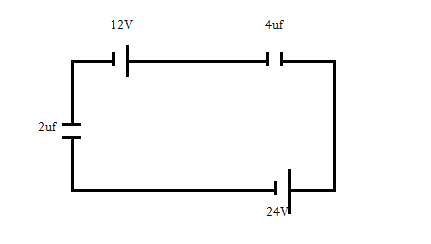
Suppose the arrangement is like ...
cell.png


So two questions are points of my confusion...

(1) what will be the direction of flow of current?
(2) and how to find the potential difference between the 2uf capacitor?

My work
I actually tried a lot to work this question out but failed..
main problems were,
* How to put the charges on each capacitor ? ,
* How can there be a potential difference across 2uf capacitor as both of its plates are connected to the -ve plates of the cells.

actually for the first time i have come across the system involving two cells and with such an arrangement.

So please guide me...
I don't want the soln.. but just want to get my concept clear...
simply guide me... how to proceed...?

would be thankful...!
 
Physics news on Phys.org


Is this question in context of steady state, transient response, or both?

If it is steady state, then question (1) is a trick question (kind of). Question (2) can be found by writing in the - and + terminals of each component at their nodes, with the voltage drop across that component. Use KVL to find the voltage across the unknown nodes. The answer is very simple.

If its transient, then you must use current convention that current flows from + to - voltage and also be aware of initial conditions, which makes me think the question is for steady-state only. Question (2) would be a trick question since there is no resistance, and so the voltage would be changing at an infinite rate.


dreamz25 said:
(1) what will be the direction of flow of current?
(2) and how to find the potential difference between the 2uf capacitor?
The larger voltage source dominates (this is equivalent to saying the polarity of the sum of the voltage sources) and this sets the charging current direction.

There is an inrush of current into the uncharged capacitors until the sum of their voltages = the net source voltage. (In practice, there will also be some resistance in the loop, and this will limit the amplitude of the inrush of current to a value less than infinite.)
 

Similar threads

Replies
2
Views
1K
  • · Replies 14 ·
Replies
14
Views
2K
Replies
20
Views
2K
Replies
4
Views
2K
Replies
9
Views
3K
  • · Replies 5 ·
Replies
5
Views
2K
Replies
5
Views
1K
Replies
2
Views
1K
  • · Replies 8 ·
Replies
8
Views
2K
  • · Replies 8 ·
Replies
8
Views
2K