Thermodynamics Polytropic Process Compressor

Click For Summary

Discussion Overview

The discussion revolves around the thermodynamic behavior of a compressor operating under a polytropic process, specifically addressing the heat transfer characteristics during compression. Participants explore the implications of the polytropic index (n) on heat absorption and rejection, as well as the physical mechanisms behind these processes.

Discussion Character

  • Exploratory
  • Technical explanation
  • Debate/contested

Main Points Raised

  • One participant expresses confusion about how a compressor can absorb heat from the environment during a polytropic process, traditionally associating compression with heat release.
  • Another participant suggests that when a gas is compressed above its critical temperature, its temperature increases due to the energy input, questioning where this energy goes.
  • Some participants propose that if the surrounding temperature is higher than the refrigerant's temperature, heat transfer could occur into the refrigerant.
  • A participant notes that energy is transferred to a system through work or heat transfer, indicating that the positive heat transfer (Q) suggests heat is added to the system due to a temperature difference.
  • One participant acknowledges their misunderstanding about compression and heat release after receiving clarification, indicating a shift in their perspective.

Areas of Agreement / Disagreement

Participants do not reach a consensus on the physical mechanisms of heat transfer during compression, with multiple competing views regarding the role of temperature differences and the implications of the polytropic index.

Contextual Notes

Some assumptions regarding the conditions of the surrounding environment and the specific characteristics of the refrigerant are not fully explored, leaving potential gaps in understanding the heat transfer dynamics.

raniero
Messages
39
Reaction score
0
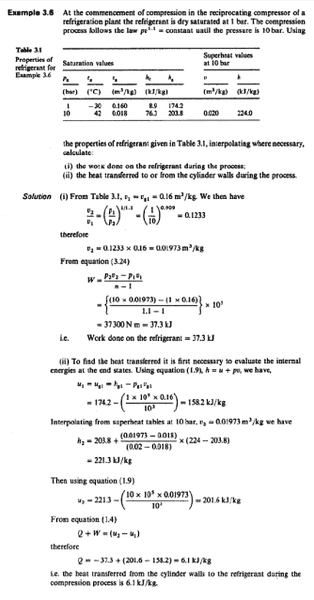
I was revising for my course exam and encountered a question in my book (Applied Thermodynamics for Engineering Technologists, p 66 example 3.3) which stated that a compressor follows a polytropic process to compress air; I understood the calculation process which resulted in heat being transferred to the refrigerant. The problem is that I cannot understand how physically a compressor would be absorbing heat from the environment. I always thought that any type of compression would give off heat.

Theoretically I know that for a polytropic process if n=γ the process is adiabatic, if n is smaller than γ heat is given off and if n is bigger than γ heat is received into the working gas (), but I would like to know how this is physically possible.

The question I talked about above is the one in the image below.
32zhwfa.png


Thanks in advance.
 
Engineering news on Phys.org
It never went cross my eyes that n has anything to do with heat absorption and heat rejection. Simple is that, when a gas is compressed above its critical temp, its temperature increases. You are giving energy in the form of electricity which is converted into mechanical energy by a piston or impeller,this increases kinetic energy of the fluid.where would this energy go? It would increase its temp.
 
According to the above problem, may be the surrounding temperature is above refrigerant‘s temperature.which caused heat transfer.
 
:-)
Thanks
 
engnr_arsalan said:
According to the above problem, may be the surrounding temperature is above refrigerant‘s temperature.which caused heat transfer.

Maybe that is true, but I'm not sure about it. Thanks :)
 
Energy is transferred to a system either by work or by heat transfer,in above problem they have already found out the portion of energy tranfered by work,rest is heat transfer,which is obviously due to temperature difference.since Q is positive,it means heat is added to the system,thus surrounding/casing temp was greater then refrigerant temp.
 
engnr_arsalan said:
Energy is transferred to a system either by work or by heat transfer,in above problem they have already found out the portion of energy tranfered by work,rest is heat transfer,which is obviously due to temperature difference.since Q is positive,it means heat is added to the system,thus surrounding/casing temp was greater then refrigerant temp.

Oh, okay I understood the idea now. Seems so simple after the explanation, I was blind folded by the fact that a compression always releases heat. Thanks for your input :)
 

Similar threads

  • · Replies 3 ·
Replies
3
Views
11K
  • · Replies 14 ·
Replies
14
Views
2K
  • · Replies 6 ·
Replies
6
Views
32K
  • · Replies 4 ·
Replies
4
Views
6K
  • · Replies 8 ·
Replies
8
Views
6K
  • · Replies 1 ·
Replies
1
Views
2K
Replies
49
Views
4K
  • · Replies 2 ·
Replies
2
Views
4K
  • · Replies 20 ·
Replies
20
Views
3K
Replies
21
Views
10K