Thevinin Question (electrical Crts)

  • Thread starter Thread starter seto6
  • Start date Start date
Click For Summary
SUMMARY

The discussion focuses on calculating the Thevenin equivalent circuit for a load, specifically determining the Thevenin voltage and resistance. The Thevenin resistance was established at 4k ohms, and the Thevenin voltage was calculated to be 8 volts. The maximum power transfer occurs when the load resistance equals the Thevenin resistance, yielding a theoretical maximum power of 16mW. However, a discrepancy arose as another participant calculated the maximum power to be 4mW, attributed to an incorrect method of calculating power using the Thevenin voltage instead of the voltage drop across the load resistance.

PREREQUISITES
  • Thevenin's Theorem
  • Basic circuit analysis techniques
  • Understanding of voltage and resistance relationships
  • Power calculation formulas in electrical circuits
NEXT STEPS
  • Study Thevenin's Theorem applications in circuit simplification
  • Learn how to calculate power transfer in resistive circuits
  • Explore voltage division in series circuits
  • Investigate common mistakes in power calculations in electrical engineering
USEFUL FOR

Electrical engineering students, circuit designers, and anyone involved in analyzing or simplifying electrical circuits using Thevenin's Theorem.

seto6
Messages
248
Reaction score
0
ok, i want to find a thevinin equvilent so i can replace the circuit at the load with the thevinin equivalent.

so i would end up with a voltage thevinin, thevinin resistance and the load.

now i found the thevinin resistance to be 4k ohm.

now i found the voltage at the load, thus thevinin voltage to be 8 volts.

the max power through the load is when the load is equal to thevinin resistance which is 4k ohm. i calculated the max power transferred to be 16mW, but they got 4mW...where did i go wrong.
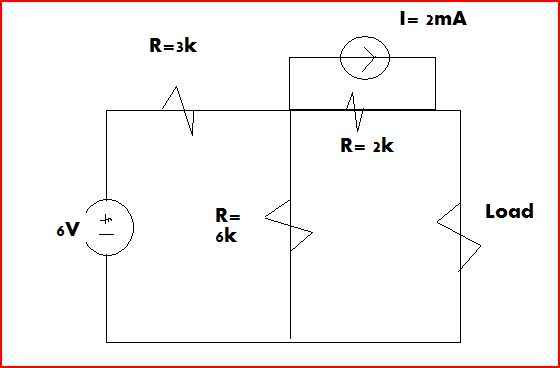
hsjs7n.jpg
 
Physics news on Phys.org
You got everything correct except the power. What exactly did you do to calculate the power?
 
You probably used the Thevenin voltage squared divided by the resistance to calculate the power.You should use the voltage drop across the resistance instead, which should be noted to be half the supply voltage, since the two resistances are equal (Rl = Rth) so the voltage drop across each one should be the same.
Or maybe you just made a mistake with the numbers.
 

Similar threads

  • · Replies 12 ·
Replies
12
Views
2K
  • · Replies 1 ·
Replies
1
Views
2K
  • · Replies 8 ·
Replies
8
Views
3K
  • · Replies 4 ·
Replies
4
Views
2K
  • · Replies 8 ·
Replies
8
Views
8K
Replies
2
Views
2K
Replies
15
Views
2K
  • · Replies 3 ·
Replies
3
Views
2K
  • · Replies 2 ·
Replies
2
Views
2K
  • · Replies 18 ·
Replies
18
Views
3K