Thin heartshaped wire - Calculate the magnetic field at the origin

Click For Summary

Homework Help Overview

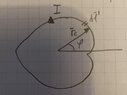
The discussion revolves around calculating the magnetic field at the origin due to a thin wire shaped like a heart, which carries a current. The problem involves applying Biot-Savart's law in a context where the wire's geometry is defined by a specific equation relating to polar coordinates.

Discussion Character

  • Exploratory, Conceptual clarification, Mathematical reasoning, Problem interpretation, Assumption checking

Approaches and Questions Raised

  • Participants explore the application of Biot-Savart's law, questioning the correct expression for the differential length element (dl) in relation to the wire's shape. There is discussion about the use of primed and unprimed variables, and whether the line element should be treated as having multiple components. Some participants suggest using Cartesian coordinates for clarity.

Discussion Status

The discussion is ongoing, with participants providing feedback on each other's mathematical expressions and clarifying the use of variables. There is no explicit consensus, but several participants are guiding the original poster towards a clearer understanding of the geometry involved and the correct application of the law.

Contextual Notes

Participants note potential confusion arising from the wire's geometry and the implications of using different coordinate systems. There are references to the need for diagrams to illustrate vector relationships, and some participants express uncertainty about the assumptions being made regarding the wire's shape and its effect on the calculations.

JoelKTH
Messages
29
Reaction score
1
Homework Statement
A thin wire that carries the current I is bent in a heart-shaped curve according to the equation r_c=r_0 e^k|phi| for |phi|<= pi, where r_c is the distance from origo to a point on the curve. Calculate the magnetic flow B in origo.
Relevant Equations
Biot Savarts Law
Hi,

So I know I am to use Biot Savarts law dB= (my_0/4pi)* (I dl x (r-r')/|r-r'|^3 where r=0 because its in origo and r'=r'_c(r'_hat).
This makes (r-r')= -r'_c(r'_hat) and |r-r'|^3= r_c^3.

From previous questions, I have defined dl' as the infinitesimal displacement of r'(phi) when phi' is increasing with dphi along the curve.
Usually its dl'/dphi = r_hat --> dl= r_hat dphi and then I use Biot Savarts law. However I get wrong result here.
My professor tells me to use dl=r_c' dphi' phi_hat + dr'_c r_hat_c.
Why is this intuitively correct? I am having some problem wrapping my head around this. How can I derive it from the dl' expression? Or know if there are any other shapes that do not only depend on phi.

//
 

Attachments
  • IMG_4583.jpg
    IMG_4583.jpg
    29.9 KB · Views: 137
Physics news on Phys.org
JoelKTH said:
Homework Statement:: A thin wire that carries the current I is bent in a heart-shaped curve according to the equation r_c=r_0 e^k|phi| for |phi|<= pi, where r_c is the distance from origo to a point on the curve. Calculate the magnetic flow B in origo.
Relevant Equations:: Biot Savarts Law

Biot Savarts law dB= (my_0/4pi)* (I dl x (r-r')/|r-r'|^3
I think you have mismatched parens in that last equation in the quote, but it's hard to tell without LaTeX.

It would help a lot if you could start posting your math equations using LaTeX -- please see the "LaTeX Guide" at the lower left of the Edit window.

Also, I'm having trouble following where you are taking the cross product of ## \vec I(\phi)## and ## \vec r(\phi) ## -- am I missing that somewhere in your text equations? The angle of the vector cross-product looks to be a pretty complicated function of ##\phi## ...
 
Last edited:
  • Like
Likes   Reactions: MatinSAR
Hi @JoelKTH. I'd like to add to what @berkeman and @haruspex have said.

Your use of primed and unprimed variables is confusing. For example, it is not clear what you mean by dl and dl’. I suspect there is only one line element length to consider, not two. A diagram showing the various vectors and angles might help.

JoelKTH said:
My professor tells me to use dl=r_c' dphi' phi_hat + dr'_c r_hat_c.
Why is this intuitively correct?
It looks like your professor is telling you to treat the ( vector) line element (dl) as the sum of 2 components: one component in the 'phi-hat' direction and the other component is in the 'r_hat_c' direction. But without a proper diagram showing the vectors and angles, it's hard to know if that's correct.
 
  • Like
Likes   Reactions: MatinSAR
Thanks for your reply @Steve4Physics @berkeman and @haruspex . I rewrote it now. I hope its more clear.
JoelKTH said:
Homework Statement:: A thin wire that carries the current I is bent in a heart-shaped curve according to the equation r_c=r_0 e^k|\varphi| for |\varphi|\le \pi, where r_c is the distance from origo to a point on the curve. Calculate the magnetic flow B in origo.
Relevant Equations:: Biot Savarts Law

Hi,

So I know I am to useBiot Savart's law $$ \mathbf{d B} = \mu_0 \frac{4 \pi I \mathbf{dl \times (r - r')}}{|\mathbf{r - r'}|^3} $$where $$\mathbf{r} = \mathbf{0}$$ because it is in the origin and $$\mathbf{r'} = r'_c \hat{\mathbf{r'}}$$ This makes $$(\mathbf{r - r'}) = -r'_c \hat{\mathbf{r'}}$$ and $$|\mathbf{r - r'}|^3 = r_c^3$$.

JoelKTH said:
From previous questions, I have defined $$\mathbf{dl'}$$ as the infinitesimal displacement of $$\mathbf{r'(\varphi)}$$ when $$\varphi'$$ is increasing with $$d\varphi$$ along the curve. $$\varphi : 0 \rightarrow 2\pi$$ Usually, it is $$\frac{\mathbf{dl'}}{d\varphi} = \hat{\mathbf{r}} \Rightarrow \mathbf{dl'} = \hat{\mathbf{r}} d\varphi$$ and then I use Biot Savart's law. However, I get the wrong result here.

JoelKTH said:
My professor tells me to use $$\mathbf{dl'} = r_c' \hat{\mathbf{\varphi'}} d\varphi' + dr'_c \hat{\mathbf{r'_c}}$$. Why is this intuitively correct? I am having some difficulty understanding this. How can I derive it from the $$\mathbf{dl'}$$ expression? Or are there any other shapes that do not only depend on $$\varphi$$?

//
 
Last edited:
  • Like
Likes   Reactions: berkeman
Steve4Physics said:
Hi @JoelKTH. I'd like to add to what @berkeman and @haruspex have said.

Your use of primed and unprimed variables is confusing. For example, it is not clear what you mean by dl and dl’. I suspect there is only one line element length to consider, not two. A diagram showing the various vectors and angles might help.
It's only dl’. Not sure what you mean by a diagram of showing the various vectors and angles. It might be a bit confusing as @haruspex also let me know. Hopefully the edited version is more straight forward.
Steve4Physics said:
It looks like your professor is telling you to treat the ( vector) line element (dl) as the sum of 2 components: one component in the 'phi-hat' direction and the other component is in the 'r_hat_c' direction. But without a proper diagram showing the vectors and angles, it's hard to know if that's correct.
Yes, I think due to the symmetry of the wire
 
I would like to add that there is a tip in the solution to go to kartesian coordinates.
$$\frac{d \mathbf{r'_c}}{d\varphi'} = \frac{d}{d\varphi'} (\mathbf{\hat{x}} \cos{\varphi'} + \mathbf{\hat{y}} \sin{\varphi'}) = -\mathbf{\hat{x}} \sin{\varphi'} + \mathbf{\hat{y}} \cos{\varphi'} = \mathbf{\hat{\varphi'}}$$
$$d\mathbf{l'} = \left(\mathbf{\hat{r_c}} \frac{d \mathbf{r'_c}}{d\varphi'} + \mathbf{r'_c} \frac{d \mathbf{\hat{r_c}}}{d\varphi'}\right)d\varphi'$$

Does this make more sense than using $$\mathbf{dl'} = r_c' \hat{\mathbf{\varphi'}} d\varphi' + dr'_c \hat{\mathbf{r'_c}}$$
?
 
I assume you were trying to fix the LaTeX. You need to bracket it with double hash signs (#, but two together) or double $ signs. Also, no boldface or italics inside the LaTeX except by using LaTeX controls.

As I wrote in post #3, I have no idea where you get ##\vec {dl}=\hat r d\phi## from. That makes no sense to me. As @Steve4Physics noted in post #4, your professor's version looks to be based on writing the length element vector as the sum of a radial component and a tangential component, ##\vec{dl}=dr.\hat r+r.d\phi.\hat \phi##, which is clearly correct.
 
  • Like
Likes   Reactions: MatinSAR
@JoelKTH, in Post #5 you wrote:
##\mathbf{d B} = \mu_0 \frac{4 \pi I \mathbf{dl \times (r - r')}}{|\mathbf{r - r'}|^3}##
but the ##4\pi## should be in the denominator.

Note that to find the field at the origin you can use simpler equations:
##\mathbf {d B} = \frac {\mu_0 I}{4 \pi} \frac {\mathbf{dl} \times \mathbf r}{|\mathbf{r^3}|}## where ##r = r_0 e^{k|\phi|}##, ##-\pi \le \phi \lt \pi##.
Then you don't need to use variables which are primed or subscripted with ‘c’ - which reduces headaches.
 
  • Like
Likes   Reactions: JoelKTH and MatinSAR
  • #10
haruspex said:
I assume you were trying to fix the LaTeX. You need to bracket it with double hash signs (#, but two together) or double $ signs. Also, no boldface or italics inside the LaTeX except by using LaTeX controls.

As I wrote in post #3, I have no idea where you get ##\vec {dl}=\hat r d\phi## from. That makes no sense to me. As @Steve4Physics noted in post #4, your professor's version looks to be based on writing the length element vector as the sum of a radial component and a tangential component, ##\vec{dl}=dr.\hat r+r.d\phi.\hat \phi##, which is clearly correct.
Thanks for your reply. Yes the ##\vec {dl}=\hat r d\phi## is wrong. Instead it normally should be: ##\vec {dl}=\hat \varphi d\varphi##. Due to cylindrical symmetry(no heart shape) ##\vec {dl}=\hat r d\phi##.

But now its heart-shaped. I suppose it makes more sense that if the radius is not constant, an infinitesimal movement around the wire should then also be dependent on the radius. Which most likely is the ##r.d\phi.\hat \phi## part. I think this is where I am confused and perhaps its more a question of vector calculus than physics.

After studying my Mathematics Handbook of 600 pages that contains vector component relationship, I see the the patter. Thanks for your help
 
  • #11
JoelKTH said:
it normally should be: ##\vec {dl}=\hat \varphi d\varphi##.
No, that can't be right either; it's dimensionally wrong. You have a length on the left but not on the right.
For constant radius it would be: ##\vec {dl}=r\hat \varphi d\varphi##.
Since the radius changes too, there is also the vector due to the radius change: ##\hat r.dr##.
Hence, in general, ##\vec {dl}=\hat \varphi r.d\varphi+\hat rdr##.
If ##r=r_0e^{k\varphi}##, can you express ##dr## in terms of ##d\varphi##?
 
  • #12
haruspex said:
No, that can't be right either; it's dimensionally wrong. You have a length on the left but not on the right.
For constant radius it would be: ##\vec {dl}=r\hat \varphi d\varphi##.
Since the radius changes too, there is also the vector due to the radius change: ##\hat r.dr##.
Hence, in general, ##\vec {dl}=\hat \varphi r.d\varphi+\hat rdr##.
If ##r=r_0e^{k\varphi}##, can you express ##dr## in terms of ##d\varphi##?
Yes, you are correct. I ment what you wrote but I was a bit too quick here in Latex.
Not sure what you mean by expressing ##dr## in terms of ##d\varphi##?

I have ##\vec {dl}=\hat \varphi r.d\varphi+\hat rdr##. I know that $$d\mathbf{l'} = \left(\mathbf{\hat{r_c}} \frac{d \mathbf{r'_c}}{d\varphi'} + \mathbf{r'_c} \frac{d \mathbf{\hat{r_c}}}{d\varphi'}\right)d\varphi'$$
Therefor, I derive each respective part. The first part I go to cartesian coordinates to simplify to ##\varphi## direction
 
  • #13
JoelKTH said:
Not sure what you mean by expressing ##dr## in terms of ##d\varphi##?

Differentiate ##r=r_0e^{k\varphi}##.
 
  • #14
I have an issue with the function ##r=r_0 e^{k|\phi |} ## representing a closed electrical circuit. As the angle increases the value of ##r## increases exponentially and doesn't close a circuit. The picture you drew appears to be a cardioid whose equation is,
$$
r=2a(1-\cos(\phi))
$$
 
  • #15
Fred Wright said:
I have an issue with the function ##r=r_0 e^{k|\phi |} ## representing a closed electrical circuit. As the angle increases the value of ##r## increases exponentially and doesn't close a circuit.
Try ##-\pi<\phi<\pi##, as stated in post #1.
 
  • #16
haruspex said:
Differentiate ##r=r_0e^{k\varphi}##.
##r=r_0ke^{k\varphi}##
 
  • #17
JoelKTH said:
##r=r_0ke^{k\varphi}##
No, that's incorrect differentiation. You have to pick what it is you are differentiating with respect to and do it consistently both sides.
If I differentiate wrt phi: ##\frac{dr}{d\phi}=r_0ke^{k\varphi}##, which I can rewrite as ##dr=r_0ke^{k\varphi}d\phi##.
You are now in a position to find ##\vec dl## in terms of ##\phi, d\phi## and the unit vectors.
 
  • #18
haruspex said:
No, that's incorrect differentiation. You have to pick what it is you are differentiating with respect to and do it consistently both sides.
If I differentiate wrt phi: ##\frac{dr}{d\phi}=r_0ke^{k\varphi}##, which I can rewrite as ##dr=r_0ke^{k\varphi}d\phi##.
You are now in a position to find ##\vec dl## in terms of ##\phi, d\phi## and the unit vectors.
Yes you are correct. Here is my calculation:

##d\mathbf{l}' = d\mathbf{r} = (r_c)\hat{\mathbf{d}}r_c' + (\varphi)\hat{\mathbf{r}}_c' d\varphi'##

Then, ##dr/d\varphi = \hat{\mathbf{r}}_c \frac{dr_c'}{d\varphi} + \hat{\boldsymbol{\varphi}} \frac{r_c' d\varphi'}{d\varphi'}##

Since ##r_c = r_0 e^{k|\varphi|}##, we have ##\frac{d r_c'}{d\varphi'} = r_0 k e^{k|\varphi|} = r_c k##

By transferring to cartesian coordinates we get ##\frac{dr_c'}{d\varphi} = \frac{d}{d\varphi} ( \hat{\mathbf{x}} \cos\varphi' + \hat{\mathbf{y}} \sin\varphi') = \hat{\boldsymbol{\varphi}}##

This means that ##\mathrm{d}\mathbf{l}'=(r_c\hat{\mathbf{d}}r_c'/d\varphi+\varphi\hat{\mathbf{r}}_c'/d\varphi')d\varphi'=(r_c\hat{\mathbf{r}}_ckr_c'+r_c'\varphi\hat{\boldsymbol{\varphi}})##
 
Last edited:
  • #19
JoelKTH said:
Yes you are correct. Here is my calculation:

##d\mathbf{l}' = d\mathbf{r} = (r_c)\hat{\mathbf{d}}r_c' + (\varphi)\hat{\mathbf{r}}_c' d\varphi'##

Then, ##dr/d\varphi = \hat{\mathbf{r}}_c \frac{dr_c'}{d\varphi} + \hat{\boldsymbol{\varphi}} \frac{r_c' d\varphi'}{d\varphi'}##

Since ##r_c = r_0 e^{k|\varphi|}##, we have ##\frac{d r_c'}{d\varphi'} = r_0 k e^{k|\varphi|} = r_c k##

By transferring to cartesian coordinates we get ##\frac{dr_c'}{d\varphi} = \frac{d}{d\varphi} ( \hat{\mathbf{x}} \cos\varphi' + \hat{\mathbf{y}} \sin\varphi') = \hat{\boldsymbol{\varphi}}##

This means that ##\mathrm{d}\mathbf{l}'=(r_c\hat{\mathbf{d}}r_c'/d\varphi+\varphi\hat{\mathbf{r}}_c'/d\varphi')d\varphi'=(r_c\hat{\mathbf{r}}_ckr_c'+r_c'\varphi\hat{\boldsymbol{\varphi}})##
Why do you insist on using all these primes (‘) in your notation? Don't you get fed up typing them? I don't see what the c subscript gains either.
To avoid blunders, we should consider ##\phi>0## and ##\phi<0## separately.
We have for positive ##\phi##:
##r=r_0e^{k\phi}##
##dr=kr_0e^{k\phi}d\phi##
##d\vec l= \hat\phi r.d\phi+\hat rdr##
Can you combine those to eliminate r, i.e. to obtain ##d\vec l## as a function of the two unit vectors and ##r_0, k, \phi, d\phi## only?
Similarly, write ##\vec r## in those terms and compute ##d\vec l\times\vec r##.
 

Similar threads

  • · Replies 15 ·
Replies
15
Views
2K
Replies
4
Views
2K
Replies
6
Views
3K
Replies
3
Views
3K
  • · Replies 14 ·
Replies
14
Views
2K
  • · Replies 12 ·
Replies
12
Views
1K
  • · Replies 15 ·
Replies
15
Views
3K
  • · Replies 9 ·
Replies
9
Views
2K
Replies
2
Views
1K
  • · Replies 6 ·
Replies
6
Views
884