Math Amateur
Gold Member
MHB
- 3,920
- 48
I am reading "The Basics of Abstract Algebra" by Paul E. Bland ... ...
I am currently focused on Chapter 3: Sets with Two Binary Operations: Rings ... ...
I need help with Bland's proof of the Third Isomorphism Theorem for rings ...
Bland's Third Isomorphism Theorem for rings and its proof read as follows:
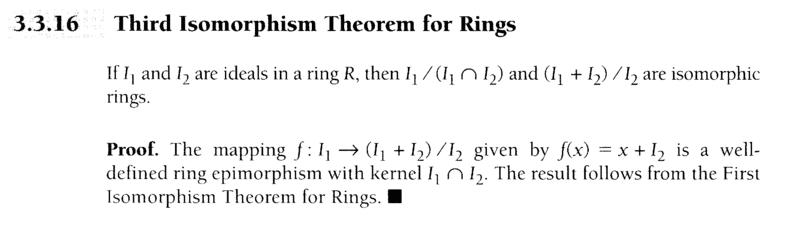 In the above proof by Bland we read the following:
" ... ... The mapping ##f \ : \ I_1 \rightarrow ( I_1 + I_2 ) / I_2## given by ##f(x) = x + I_2## is a well-defined ring epimorphism with kernel ##I_1 \cap I_2##. ... ... "I cannot see how f can be an epimorphism as it does not seem to be onto ##( I_1 + I_2 ) / I_2## ... ...
My reasoning (which I strongly suspect is faulty) is as follows:... ... The domain of ##f## is ##I_1##, so ##x \in I_1## ...
Now there exists elements ##y \in I_1 + I_2## such that ##y \in I_2 \ \ ( y = 0 + y## where ##0 \in I_1, y \in I_2)##
For such y there is a coset in ##( I_1 + I_2 ) / I_2## of the form ##y + I_2## that is not in the range of ##f## ...
... so ##f## is not an epimorphism ...
It seems certain to me that my reasoning is wrong somewhere ... can someone please point out the error(s) in my analysis above ...
Peter
I am currently focused on Chapter 3: Sets with Two Binary Operations: Rings ... ...
I need help with Bland's proof of the Third Isomorphism Theorem for rings ...
Bland's Third Isomorphism Theorem for rings and its proof read as follows:
" ... ... The mapping ##f \ : \ I_1 \rightarrow ( I_1 + I_2 ) / I_2## given by ##f(x) = x + I_2## is a well-defined ring epimorphism with kernel ##I_1 \cap I_2##. ... ... "I cannot see how f can be an epimorphism as it does not seem to be onto ##( I_1 + I_2 ) / I_2## ... ...
My reasoning (which I strongly suspect is faulty) is as follows:... ... The domain of ##f## is ##I_1##, so ##x \in I_1## ...
Now there exists elements ##y \in I_1 + I_2## such that ##y \in I_2 \ \ ( y = 0 + y## where ##0 \in I_1, y \in I_2)##
For such y there is a coset in ##( I_1 + I_2 ) / I_2## of the form ##y + I_2## that is not in the range of ##f## ...
... so ##f## is not an epimorphism ...
It seems certain to me that my reasoning is wrong somewhere ... can someone please point out the error(s) in my analysis above ...
Peter
