dylanreynolds1
- 2
- 2
Hello all, I have a question that's been bothering me the last few days and wasn't sure where to turn.
Recall the original Special Relativity thought experiment: A spaceship travels at constant velocity v, moving in the positive x direction. An observer on the spaceship emits a photon directly upwards, from the floor of his ship to the ceiling, and measures the time, call it T. To a stationary observer watching the ship fly by, the beam of light will travel in a diagonal path. If we denote the time measured by the stationary observer t, then when the ship has traveled a distance v*t, the stationary observer will see the light travel a distance c*t. This situation can be modeled with a right triangle;
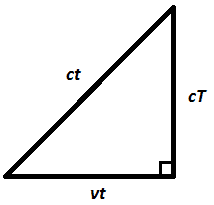
If we use Pythagoras we can solve for the ratio of T/t and get the usual Lorentz Factor.
Now the question that has been bothering me: Imagine the same situation, however now we have two ships, each traveling in the same direction but with different speeds. Call the slower ship v1 and the faster ship v2. In the same time t, as measured by a stationary observer, the slower ship will travel a distance v1*t, and the faster ship will travel a distance v2*t. If each ship emits a photon at the same time, the stationary observer will see two beams of light, with the one coming from the faster ship making a smaller angle. We can model this with a pair of triangles;
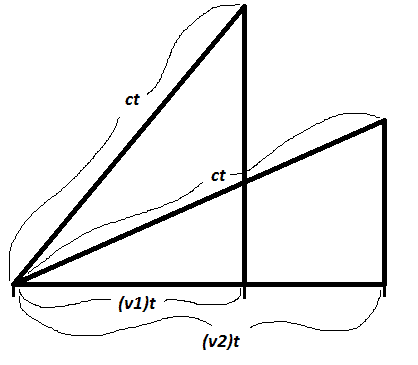
From this diagram it appears that the photons, as measured by everyone involved, travel different distances in the vertical direction.
Since the ships are identical, does this mean the photon on the second ship does not make it to the ceiling at the same time the first one does? How would this discrepancy be resolved if the two moving observers were watching each other? Since there is no length contraction in the vertical direction I would expect the two photons to reach the top in the same amount of time. Does this mean an observer on one ship would see the photon of the other ship traveling slower?
Maybe I'm missing something, any thoughts are much appreciated.
Recall the original Special Relativity thought experiment: A spaceship travels at constant velocity v, moving in the positive x direction. An observer on the spaceship emits a photon directly upwards, from the floor of his ship to the ceiling, and measures the time, call it T. To a stationary observer watching the ship fly by, the beam of light will travel in a diagonal path. If we denote the time measured by the stationary observer t, then when the ship has traveled a distance v*t, the stationary observer will see the light travel a distance c*t. This situation can be modeled with a right triangle;
If we use Pythagoras we can solve for the ratio of T/t and get the usual Lorentz Factor.
Now the question that has been bothering me: Imagine the same situation, however now we have two ships, each traveling in the same direction but with different speeds. Call the slower ship v1 and the faster ship v2. In the same time t, as measured by a stationary observer, the slower ship will travel a distance v1*t, and the faster ship will travel a distance v2*t. If each ship emits a photon at the same time, the stationary observer will see two beams of light, with the one coming from the faster ship making a smaller angle. We can model this with a pair of triangles;
From this diagram it appears that the photons, as measured by everyone involved, travel different distances in the vertical direction.
Since the ships are identical, does this mean the photon on the second ship does not make it to the ceiling at the same time the first one does? How would this discrepancy be resolved if the two moving observers were watching each other? Since there is no length contraction in the vertical direction I would expect the two photons to reach the top in the same amount of time. Does this mean an observer on one ship would see the photon of the other ship traveling slower?
Maybe I'm missing something, any thoughts are much appreciated.