Thread Pressure - Thread Stripping

Click For Summary
SUMMARY

This discussion focuses on the critical factors influencing thread engagement and the prevention of thread stripping in mechanical applications. Specifically, it highlights that for 3 1/4-8UN-2A threads with a shear strength of 44.5 KSI, a minimum engagement length of 2.68 inches is necessary to avoid failure. The conversation also emphasizes the importance of understanding the ratio of shear strength to tensile strength, which varies by material, and how this affects the design and safety of threaded connections. Participants express concerns about using shorter engagement lengths and the potential consequences of thread failure.

PREREQUISITES
  • Understanding of thread engagement mechanics
  • Knowledge of shear strength and tensile strength ratios
  • Familiarity with mechanical engineering formulas
  • Basic principles of material science
NEXT STEPS
  • Research the impact of thread engagement length on shear strength in mechanical design
  • Explore the relationship between tensile strength and shear strength for various materials
  • Learn about the calculation of safety factors in threaded connections
  • Investigate the use of engineering calculators for thread stripping analysis
USEFUL FOR

Mechanical engineers, design engineers, and anyone involved in the analysis and design of threaded connections in mechanical systems.

cmarentes89
Messages
4
Reaction score
1
TL;DR
At what forces and thread engagement will my threads shear or strip.
Hello all,

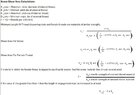
So I've attached two images, one is the spread-sheet that I'm working on and the other is an image of the formulas that I'm using. I'm a bit confused on how length of engagement works for those formulas. So for 3 1/4-8UN-2A threads, with a shear strength of 44.5 KSI, the minimum length of engagement should be about 2.68 inches. From that, I understand that my engagement length should be 2.68 inches to avoid any thread stripping and/or shearing. But what if I use 1.00 inches of thread engagement engagement? The formulas shows that it would not strip when I compare the forces required and actual to strip the threads.... My ultimate goal is to determine a shear safety of factor and the minimum length of engagement at any applied pressure.
 

Attachments

  • 2.JPG
    2.JPG
    42 KB · Views: 190
  • 1.JPG
    1.JPG
    63 KB · Views: 131
Engineering news on Phys.org
cmarentes89 said:
From that, I understand that my engagement length should be 2.68 inches to avoid any thread stripping and/or shearing. But what if I use 1.00 inches of thread engagement?
Then, on some occasion the thread may strip, and you would, if you survived, be questioned by the coroner.

The formulas have a tolerance allowance for imperfections.

The length of the nut, or engagement, determines the area of thread in pressure contact and in shear. The tensile strength of the threaded portion of the bolt, must be balanced against the shear strength of the thread.

The formulas appear to be not specific to the material.
The ratio of shear strength to tensile strength in the material used, will be an important parameter.
 
  • Like
Likes   Reactions: berkeman
Baluncore said:
Then, on some occasion the thread may strip, and you would, if you survived, be questioned by the coroner.

The formulas have a tolerance allowance for imperfections.

The length of the nut, or engagement, determines the area of thread in pressure contact and in shear. The tensile strength of the threaded portion of the bolt, must be balanced against the shear strength of the thread.

The formulas appear to be not specific to the material.
The ratio of shear strength to tensile strength in the material used, will be an important parameter.
Would definitely would never try it in real life lol.

I see, but in a ratio comparison, wont my shear strength to tensile strength always be the same? 1/2 of the tensile strength?
 
  • Informative
  • Like
Likes   Reactions: DeBangis21 and berkeman
Baluncore said:
Not always, shear strength of steel is usually between 60% and 70% of tensile strength, other materials may differ.
Cast iron may range from 0.55 to 1.25 .
https://www.engineersedge.com/materials/material_tensile_shear_and_yield_strength_15798.htm
Thank you so much for the data, it will be very helpful. So I guess my question is, I'm I looking at the wrong formulas for what I'm trying to accomplish?

I figured my material shear strength multiplied by my shear area would have give me my actual force on threads. Then compare that to my actual loading pressure multiplied by my shear area again would give me a factor of safety based on shear. But in this method, all I would have to compare is my material shear strength to my actual loading pressure.... which eliminates the shear area, so this doesn't seem right.
 

Similar threads

Replies
3
Views
2K
  • · Replies 6 ·
Replies
6
Views
2K
  • · Replies 9 ·
Replies
9
Views
4K
  • · Replies 16 ·
Replies
16
Views
3K
Replies
1
Views
2K
Replies
15
Views
37K
  • · Replies 5 ·
Replies
5
Views
14K
Replies
3
Views
18K
Replies
8
Views
4K
  • · Replies 2 ·
Replies
2
Views
2K