Three charges/electric field problem

  • Thread starter Thread starter FlipStyle1308
  • Start date Start date
  • Tags Tags
    Field
Click For Summary
SUMMARY

The discussion revolves around calculating the electric field generated by three point charges: q1 = +4.07 μC, q2 = +4.07 μC, and q3 = -4.07 μC, positioned at the vertices of an equilateral triangle with a side length of d = 2.29 cm. Participants clarify the use of the formula E = k(|q|/r²) to find the electric field at specific midpoints between the charges. The importance of vector addition for the resultant electric field is emphasized, particularly in determining the x and y components of the electric fields due to each charge.

PREREQUISITES
  • Understanding of Coulomb's Law and electric fields
  • Familiarity with vector addition and components
  • Knowledge of the geometry of equilateral triangles
  • Proficiency in using the formula E = k(|q|/r²)
NEXT STEPS
  • Study the concept of electric fields due to multiple point charges
  • Learn how to calculate vector components in two dimensions
  • Explore the effects of charge signs on electric field direction
  • Practice problems involving electric fields in equilateral triangle configurations
USEFUL FOR

Students and educators in physics, particularly those focusing on electromagnetism, as well as anyone solving problems related to electric fields and point charges.

FlipStyle1308
Messages
264
Reaction score
0
Here is the problem which I need to solve:

The following picture shows a system consisting of three charges, q1 = +4.07 μC, q2 = +4.07 μC, and q3 = -4.07 μC, at the vertices of an equilateral triangle of side d = 2.29 cm. Find the magnitude of the electric field at a point halfway between the charges q1 and q2. Also find the magnitude of the electric field at the point halfway between the charges q2 and q3.
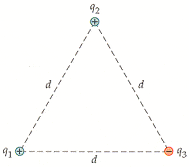
19-32.gif


I am not too sure on how to solve this, so a little help would be good. Nothing is listed in my textbook about how to approach this. I was thinking of using the distance formula from mat, but I don't know how to incorporate the charges into the problem.
 
Physics news on Phys.org
Please show your own work. You must at least know some equations you think are related to this problem?
 
For the first part of the problem, I used F21 = (k lq1l lq2l)/r^2, and got 2.8397 x 10^26N. How do I change this to get my answer into N/C?

Or was I supposed to use E= k(lql/r^2)? If so, how do I solve with this equation?
 
Last edited:
FlipStyle1308 said:
Or was I supposed to use E= k(lql/r^2)? If so, how do I solve with this equation?
That's correct. Well, almost. That's the magnitude of the elctric field due to one charge q. The question asks you to find the field due to three charges. So you solve them vectorially, and then find the magnitude of the resultant.
 
Is this the correct equation:
elefie2.gif
 
Still, that's just the magnitude. Go the 'Multiple Point Charges' section in the link I provided.
 
Okay, so I use
epoint3.gif
. I still do not know how to incorporate the problem into the equation.
 
  • #10
I do know how to calculate components along axes, but I don't know how to incorporate the sides of the equilateral triangle into the problem. Since the distance between two points is given (one side of the equilateral triangle), shouldn't that mean I don't have to find x and y components?
 
  • #11
FlipStyle1308 said:
Since the distance between two points is given (one side of the equilateral triangle), shouldn't that mean I don't have to find x and y components?
I'm not sure I understand what you're saying. The question asks for the field at the midpoints of the line q1q2 and q1q3. These points are not the at same distance away from all the charges.
 
  • #12
Okay, I know, but I'm just confused on how to set this up. Would you be able to give me a starting equation (with values), and then I can try to work my way from there?
 
  • #13
E_1_x = k\frac{q_1}{(d/2)^2}\cos60
E_1_y = k\frac{q_1}{(d/2)^2}\sin60<br />

For the first problem, those are the components of the field due to the first charge, q1. Do keep in mind that signs of the charges play an important role.
 
  • #14
Okay, thanks. So I found E1x = 139,544,631.1N/C and E1y = 241,698,391N/C, so E1net = 279,087,799.8N/C. Is this correct? What about for E2?
 
Last edited:
  • #15
You don't find E1net. Add the x components of all the fields (with the sign), and then y components, separately. This will give you components of the resultant field. Then find the magnitude. For reference, have a look at the diagrams in that link.

What about for E2?
You've got to find it out. :)
 
  • #16
I kinda worked ahead while waiting for your response, and I realized I don't need E1net. For E2x should my answer be the same as E1y and my answer for E2y should be the same as E1x?
 
  • #17
Nope. What do you think would happen to the field at a point midway between two equal charges?
 
  • #18
Would it balance out to zero?
 
  • #19
Exactly. Now, what does that tell you about E2's components?
 
  • #20
E2x = -E1y and E2y = -E1x? Is that right? Do I need to calculate anything for E3?
 
  • #21
FlipStyle1308 said:
E2x = -E1y and E2y = -E1x? Is that right?
No. That wouldn't add up to a zero vector, would it?
Do I need to calculate anything for E3?
Yes, for the first problem, the resultant field is the same as the field due to E3 alone.

Btw, I've got a big download ahead of me now, and browsing will slow down. I'm sure the others will be able help you in case you have any questions. Try doing the second problem on the same principles. Good luck.
 
  • #22
Okay, thanks for your help! Is anyone able to help me find E3 (x and y components)? I pretty much just need the equation set up for E3, and then I'll be able to solve the whole problem (I hope).
 
Last edited:

Similar threads

Replies
17
Views
2K
  • · Replies 1 ·
Replies
1
Views
4K
  • · Replies 3 ·
Replies
3
Views
4K
Replies
2
Views
1K
  • · Replies 7 ·
Replies
7
Views
10K
  • · Replies 14 ·
Replies
14
Views
2K
  • · Replies 2 ·
Replies
2
Views
1K
  • · Replies 1 ·
Replies
1
Views
1K
  • · Replies 1 ·
Replies
1
Views
3K
  • · Replies 8 ·
Replies
8
Views
3K