Three Circle Problem

  • Context: Undergrad 
  • Thread starter Thread starter bob012345
  • Start date Start date
bob012345
Gold Member
Messages
2,325
Reaction score
1,042
TL;DR
The problem is to determine if the intersection area of the three circles is less than or greater than one quarter the area of one circle.
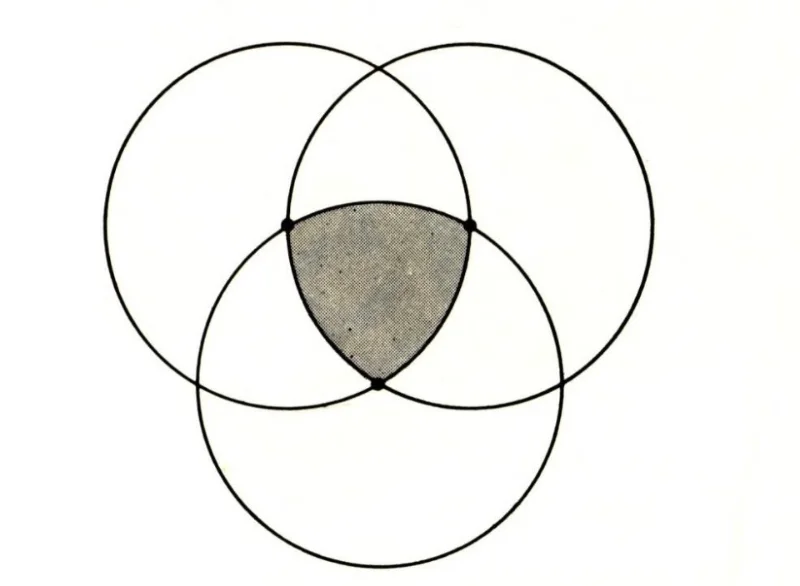
Three identical circles intersect in such a way that each intersects the centers of the other two as in the figure. The problem is to determine if the shaded area is less than or greater than one quarter the area of one circle. Of course one can calculate the answer but the exercise is to show it by more subtle arguments if one can. This is adapted from a book by Martin Gardner. Enjoy!
IMG_4871.webp
 
Last edited:
  • Like
Likes   Reactions: Lnewqban
Mathematics news on Phys.org
I still need to compare ##\sqrt 3## and ## \pi /2##. Not even calculation like this?
 
Hill said:
I still need to compare ##\sqrt 3## and ## \pi /2##. Not even calculation like this?
You don’t need numbers but of course you can calculate things if you want.
 
InShot_20260203_224849721.webp
I've divided the shaded region into an equilateral triangle of area ##A_T## and three segments of area ##a## each. Each circle has area ##A_\circ##.

Observe that the triangle plus one segment is a 60° sector of a circle. Hence $$\begin{equation}\frac{A_\circ}6=A_T+a\end{equation}$$

The area of the shaded region is obviously ##A_T+3a##. So the statement "the shaded area is more than a quarter circle" can be written
$$\begin{equation}\frac{A_\circ}4<A_T+3a\end{equation}$$Using (1) to eliminate ##A_T## we get$$\begin{eqnarray}\frac{A_\circ}4&<&\frac{A_\circ}6+2a\\A_\circ&<&24a\end{eqnarray}$$

I can't draw this accurately on my phone. Draw a circle and inscribe a hexagon, then draw diameters to split the hexagon into six equilateral triangles. Draw circles so that every one of the straight lines has a 60° segment sitting on it. The result looks like this:
InShot_20260203_231822142.webp

(Adapted from Wikipedia). Notice that each green region is two back-to-back segments of area ##a## and there are twelve such regions, non-overlapping, and there is (red) space left over in the circle.

Thus it is not true that ##A_\circ<24a##, and hence the shaded area is less than one quarter of the circle.
 
  • Like
Likes   Reactions: bob012345

Similar threads

  • · Replies 2 ·
Replies
2
Views
2K
  • · Replies 3 ·
Replies
3
Views
3K
  • · Replies 23 ·
Replies
23
Views
3K
  • · Replies 2 ·
Replies
2
Views
2K
  • · Replies 4 ·
Replies
4
Views
3K
  • · Replies 1 ·
Replies
1
Views
1K
  • · Replies 3 ·
Replies
3
Views
2K
  • · Replies 4 ·
Replies
4
Views
2K
Replies
17
Views
3K
  • · Replies 6 ·
Replies
6
Views
2K