Three Phase Wye Delta Transformer Feeding Single Phase Load

Click For Summary

Discussion Overview

The discussion revolves around the behavior of a three-phase wye-delta transformer feeding a single-phase load. Participants explore the distribution of current in the delta winding when a single-phase load is connected between two lines, examining discrepancies between hand calculations and simulation results from Multisim.

Discussion Character

  • Technical explanation
  • Debate/contested
  • Mathematical reasoning

Main Points Raised

  • One participant calculates that winding A will carry 50A while windings B and C (in series) will also carry 50A, suggesting an even split of current.
  • Another participant notes that Multisim shows winding A carrying 66A and windings B and C carrying 33A, questioning the accuracy of the hand calculations.
  • Some participants suggest that the discrepancy may arise from not accounting for phase differences in the currents, proposing that currents should be treated as vectors with 120-degree angles.
  • One participant mentions the complexity of the circuit, indicating that it is overdefined with three voltage sources and that the voltage of the delta secondary is unspecified.
  • Another participant points out that there are two voltage sources across a single load, implying that one source has double the impedance of the other, which could affect current distribution.
  • A later reply argues that Multisim's approach is incorrect, suggesting that it uses a different equation than what was expected for the current distribution.

Areas of Agreement / Disagreement

Participants express differing views on the accuracy of hand calculations versus simulation results, with no consensus on which method provides the correct current distribution. The discussion remains unresolved regarding the correct interpretation of the circuit behavior.

Contextual Notes

Participants acknowledge the complexity of the circuit analysis, including the need to consider phase differences and the implications of having multiple voltage sources. There are unresolved assumptions regarding the voltage levels and the floating nature of the delta secondary.

BuzzBar
Messages
3
Reaction score
2
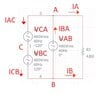
Three wye-delta (120:480) is feeding single phase load as per diagram. How will current be distributed in the delta winding when single phase is connected between line A and B ?

When I solve by hand I get different results when simulating in Multisim.
Hand calculation - Winding A will be in parallel with winding B&C (which are in series and B+C=-A). This will cause the current to be split evenly between windings A (50A) and B&C (50A).

However when I use Multisim currents are winding A (66A) and B&C(33A).
Which calculation is correct? I don't understand how Multsim is solving winding A to carry double the current in winding B&C,

Capture1.JPG


Capture2.JPG
 
Last edited by a moderator:
Physics news on Phys.org
Welcome to PF.

Is this for schoolwork? If so, I can move it to the schoolwork forums for you. Also, can you clarify on your diagram which are "line" A/B/C and "winding" A/B/C? Thanks.
 
I haven't actually tried to solve this yet, IDK, maybe later. But I suspect that you might be adding up the currents algebraically, without regard to their phase difference. In fact, they will add like vectors with 120o angles. The problem is well defined with that "phasor" provision. Frankly, it's just a book keeping exercise of KVL/KCL with out of phase sinusoids.

Please let us know what confuses you about the analysis by hand. Write out the equations of the voltages and currents in the secondary circuit (I know, it is a PITA, that's why I haven't done it for you, yet, LOL). Sorry if I'm not giving you credit for knowing about vectors/phasors in circuits. Often there is a bit of guessing required about the OP's background knowledge.
 
berkeman said:
Welcome to PF.

Is this for schoolwork? If so, I can move it to the schoolwork forums for you. Also, can you clarify on your diagram which are "line" A/B/C and "winding" A/B/C? Thanks.
Hi, yes its is for school. I added line and winding currents designation to the diagram.

Capture1.JPG
 
Last edited by a moderator:
  • Like
Likes   Reactions: berkeman
DaveE said:
I haven't actually tried to solve this yet, IDK, maybe later. But I suspect that you might be adding up the currents algebraically, without regard to their phase difference. In fact, they will add like vectors with 120o angles. The problem is well defined with that "phasor" provision. Frankly, it's just a book keeping exercise of KVL/KCL with out of phase sinusoids.

Please let us know what confuses you about the analysis by hand. Write out the equations of the voltages and currents in the secondary circuit (I know, it is a PITA, that's why I haven't done it for you, yet, LOL). Sorry if I'm not giving you credit for knowing about vectors/phasors in circuits. Often there is a bit of guessing required about the OP's background knowledge.
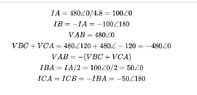
Hi, I rearranged the delta circuit and treat each winding as as voltage source. I use VAB for reference and consider it to be at angle 0. When I add VBC and VCA as vector sum I get them to be equal to -VAB. So from this I have two equal voltage sources, so current should be dived equally between two voltage source branches,
 

Attachments

  • Capture2.JPG
    Capture2.JPG
    17.1 KB · Views: 68
  • Capture3.JPG
    Capture3.JPG
    21.6 KB · Views: 77
  • Like
Likes   Reactions: Gavran
The circuit is overdefined by having three voltage sources, with a closed delta that must sum to zero. Something must give.

The voltage of the delta secondary, relative to ground is floating, unspecified.
 
You have two voltage sources across a single load. One has double the source impedance of the other unless otherwise defined. It should be clear after stating that assumption.
 
It is obvious that Multisim has used the equation ## I_{AC}+I_{CB}+ I_{BA} = 0A ## instead of ## I_{BA} = \frac{I_{A}}{2} ## has been used by @BuzzBar.
The system is unbalanced and in my opinion the Multisim approach is wrong.
 

Similar threads

  • · Replies 8 ·
Replies
8
Views
2K
Replies
1
Views
2K
  • · Replies 2 ·
Replies
2
Views
2K
  • · Replies 2 ·
Replies
2
Views
6K
Replies
3
Views
3K
  • · Replies 1 ·
Replies
1
Views
2K
  • · Replies 4 ·
Replies
4
Views
2K
Replies
23
Views
6K
  • · Replies 3 ·
Replies
3
Views
3K
  • · Replies 6 ·
Replies
6
Views
2K