Thrust angle calculation for off-centerline airplane engine

Click For Summary
SUMMARY

The discussion focuses on calculating the thrust angle for an off-centerline airplane engine, specifically for an RC seaplane with the engine mounted 16 inches behind and 4 inches above the center of gravity (CG), generating 5 lbs of thrust. The equation used to balance the moments is (TsinA)y=(TcosA)x, which simplifies to 4sinA=cosA. The solution involves using the trigonometric identity tan(A) = sin(A)/cos(A), leading to the conclusion that the motor angle A is approximately 14 degrees.

PREREQUISITES
  • Understanding of basic trigonometry, including sine, cosine, and tangent functions.
  • Familiarity with the concepts of center of gravity (CG) and thrust in aerodynamics.
  • Ability to graph functions and interpret their intersections.
  • Knowledge of algebraic manipulation to solve equations.
NEXT STEPS
  • Study the application of trigonometric identities in physics problems.
  • Learn about the dynamics of RC aircraft and how thrust affects flight stability.
  • Explore graphing techniques for solving equations involving trigonometric functions.
  • Investigate the effects of engine placement on aircraft performance and control.
USEFUL FOR

Aerospace engineers, RC aircraft hobbyists, and anyone involved in the design and optimization of model airplanes will benefit from this discussion.

aerohead_18
Messages
33
Reaction score
4
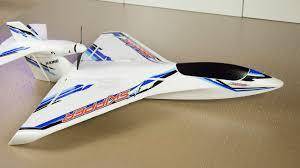
This isn't for any particular project or assignment, but I've tried solving this in the past and haven't figured it out. Say you have an RC seaplane, like the one pictured, with the engine mounted well above and aft the CG. You're going to need to angle it down a little to counteract the pitch-down moment produced by the thrust acting above the CG.
imgres.jpg


Here's what I have so far.
Let's say the motor is 16" behind the CG and 4" above it, and it's generating 5lbs of thrust. To balance the moments, you would set it up like:

(TsinA)y=(TcosA)x

where T=thrust, A=motor angle from x-axis, y=position behind the CG, and x=position above the CG. Plugging in the values:

(5sinA)16=(5cosA)4
...which reduces to:
4sinA=cosA

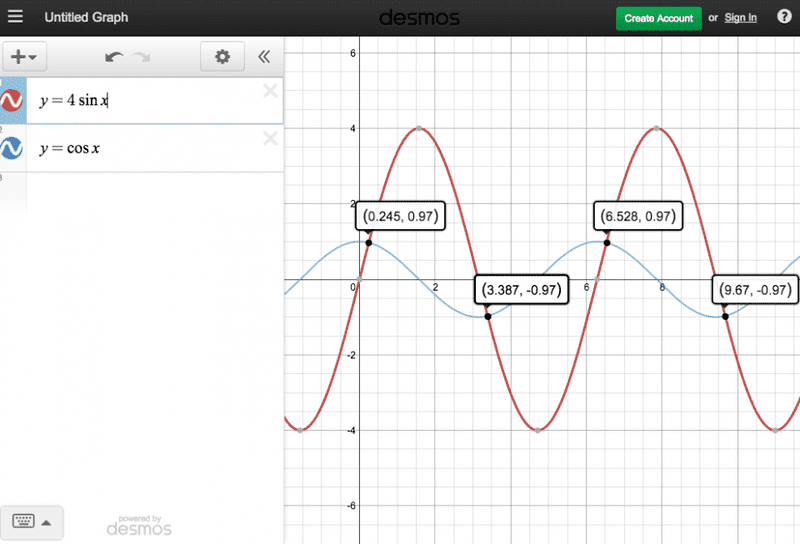
As far as I know there isn't any way to solve that algebraically. The only way I could think of to solve for A might be graphing the functions f(x)=4sinA and g(x)=cosA and maybe use one of the solutions to find the angle where the two thrust components are equal. Below are the two functions graphed and some of their solutions.
Screen Shot 2016-05-12 at 8.57.24 PM.png


So, assuming I'm on the right track, where do I go from here? I initially thought the x-value of each solution would be a possible motor angle, but if you plug that back into the equation above the two sides aren't equal. So how on Earth would I do this?
 
Physics news on Phys.org
aerohead_18 said:
This isn't for any particular project or assignment, but I've tried solving this in the past and haven't figured it out. Say you have an RC seaplane, like the one pictured, with the engine mounted well above and aft the CG. You're going to need to angle it down a little to counteract the pitch-down moment produced by the thrust acting above the CG.

View attachment 100647

Here's what I have so far.
Let's say the motor is 16" behind the CG and 4" above it, and it's generating 5lbs of thrust. To balance the moments, you would set it up like:

(TsinA)y=(TcosA)x

where T=thrust, A=motor angle from x-axis, y=position behind the CG, and x=position above the CG. Plugging in the values:

(5sinA)16=(5cosA)4
...which reduces to:
4sinA=cosA

As far as I know there isn't any way to solve that algebraically. The only way I could think of to solve for A might be graphing the functions f(x)=4sinA and g(x)=cosA and maybe use one of the solutions to find the angle where the two thrust components are equal. Below are the two functions graphed and some of their solutions.

View attachment 100645

So, assuming I'm on the right track, where do I go from here? I initially thought the x-value of each solution would be a possible motor angle, but if you plug that back into the equation above the two sides aren't equal. So how on Earth would I do this?
As long as you have the same angle A on both sides of the equation, carry the trigonometry forward a little bit:

4 sin (A) = cos (A)

##\frac{sin (A)}{cos (A)} = tan (A) = \frac{1}{4}##

##tan^{-1} (A) = A = tan^{-1} (\frac{1}{4}) ≈ 14° ##

where tan-1 is the arctangent function.
 
  • Like
Likes   Reactions: aerohead_18
Okay, that makes sense. Forgot about the sin(A)/cos(A)=tan(A) rule. How did you know that tanA=1/4?
 
aerohead_18 said:
Okay, that makes sense. Forgot about the sin(A)/cos(A)=tan(A) rule. How did you know that tanA=1/4?
You do the algebra on both sides of the equation.

You divide both sides of the equation by cos (A) to get tan (A) on the LHS, which leaves 1 on the RHS.
You then divide both sides of the equation to get just tan (A) on the LHS, which means the RHS is now 1/4.

So, tan (A) = 1/4
 
  • Like
Likes   Reactions: aerohead_18
SteamKing said:
You do the algebra on both sides of the equation.

You divide both sides of the equation by cos (A) to get tan (A) on the LHS, which leaves 1 on the RHS.
You then divide both sides of the equation to get just tan (A) on the LHS, which means the RHS is now 1/4.

So, tan (A) = 1/4
Got it. Thanks!
 

Similar threads

Replies
4
Views
15K
  • · Replies 1 ·
Replies
1
Views
2K
  • · Replies 4 ·
Replies
4
Views
9K
Replies
1
Views
2K
  • · Replies 9 ·
Replies
9
Views
2K
  • · Replies 2 ·
Replies
2
Views
4K
Replies
5
Views
2K
Replies
6
Views
11K
  • · Replies 5 ·
Replies
5
Views
5K
Replies
3
Views
3K