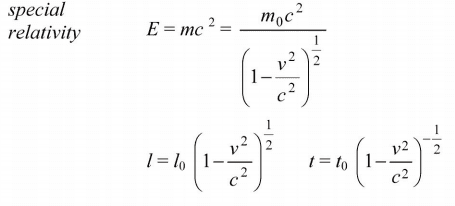
By following
@Nugatory 's suggestion, you'll eventually end up with this identity involving hyperbolic trigonometric functions
##\cosh\theta=\frac{1}{\sqrt{1-\tanh^2\theta}}## [in some form, whether you recognize it or not.]
The following might be a little over level-B... but it might be worth it.
Geometrically, time-dilation arises from a dot-product in spacetime
(since one is projecting the other observer's segment [a hypotenuse] onto the measuring observer's leg--this involves a hyperbolic-cosine).
Since physicists prefer velocity (instead of rapidity-angle) where ##(v/c)=\tanh\theta##, one uses the above identity to write hyperbolic-cosine in terms of hyperbolic-tangent. Thus we see factors like ##\frac{1}{\sqrt{1-(v/c)^2}}.##
Some possibly helpful analogies...
The Euclidean analogue ##\cos\theta=\frac{1}{\sqrt{1+\tan^2\theta}}## would be used to replace ##\cos\theta## with an expression involving a slope ##m##: ##\frac{1}{\sqrt{1+m^2}}.##
The Galilean [i.e. non-relativistic] analogue is ##\rm{cosg\ }\theta=1## (called a Galilean-cosine, as suggested by the mathematician IM Yaglom)... which could represent the Galilean limit of the expression in Special Relativity. Note there is no dependence on velocity here.