Time dilation for a simple problem — Light propagating inside a moving bus

Click For Summary

Homework Help Overview

The discussion revolves around the concept of time dilation and light propagation within a moving bus, exploring the perspectives of both an observer inside the bus and an external observer. Participants are analyzing the implications of special relativity, particularly the Lorentz transformation and length contraction.

Discussion Character

  • Exploratory, Conceptual clarification, Mathematical reasoning, Assumption checking

Approaches and Questions Raised

  • Participants discuss the assumptions made regarding distances measured by different observers, specifically the distances ##d_0## and ##d_1##. There are attempts to apply the Lorentz transformation to relate these distances and times. Some participants question the validity of using a "stick" analogy to illustrate the problem, while others suggest that the original poster may have neglected length contraction in their reasoning.

Discussion Status

The discussion is active, with participants providing insights and questioning each other's assumptions. Some guidance has been offered regarding the application of the Lorentz transformation and the implications of length contraction. There is an acknowledgment of confusion surrounding the setup of the problem, and participants are collaboratively exploring the correct relationships between the variables involved.

Contextual Notes

Participants note that the original poster's assumptions about the distances may not account for relativistic effects, leading to confusion. There is a mention of the need to consider length contraction when analyzing distances in different frames of reference.

name
Messages
9
Reaction score
1
Homework Statement
Calculate the time it takes for the light to travel a straight line distance d1 in a bus moving at a constant velocity V as observed by an external observer.
Relevant Equations
N/A derived below.
So I drew the problem and tried to derive t1 for an external observer by making the following assumptions.
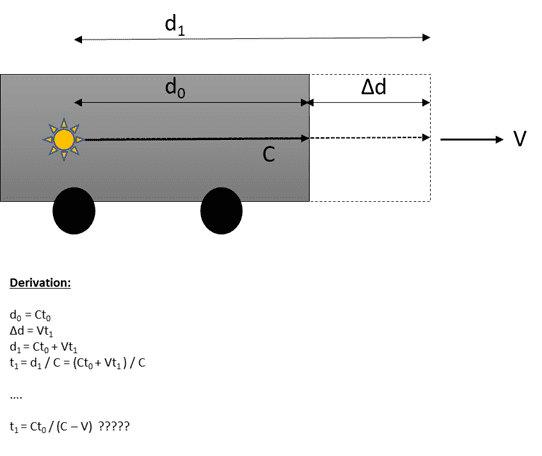
  1. Inside observer sees light travel a distance of d0 meters in t0 seconds at a speed of c m/s.
  2. Bus moved Δd meters in t1 seconds at V m/s.
  3. Outside observer sees light travel a distance of d1 meters in t1 seconds at a speed of c m/s.
1626443291455.png

I know this is incorrect but I don't see where the error is?

Thank You
 
Last edited by a moderator:
Physics news on Phys.org
The distance ##d_0## is the distance between the light source and the right end of the bus according to the observer inside the bus. What is this distance according to the external observer?
 
  • Like
Likes   Reactions: name
A simple way of solving a problem like this is by direct application of the Lorentz Transformation.

Event 1: t' = t = x' =x =0

Event 2: ##x'=d_1##, ##t'=\frac{d_1}{c}##, ##\ x = ? ##, ##t = ?##
 
  • Like
Likes   Reactions: name
TSny said:
The distance ##d_0## is the distance between the light source and the right end of the bus according to the observer inside the bus. What is this distance according to the external observer?
I have it as ##d_1## as per my assumptions which is the sum of ##d_0## and ##Δd##. Is that incorrect?
Chestermiller said:
A simple way of solving a problem like this is by direct application of the Lorentz Transformation.

Event 1: t' = t = x' =x =0

Event 2: ##x'=d_1##, ##t'=\frac{d_1}{c}##, ##\ x = ? ##, ##t = ?##

If ##x## the distance according to the external observer, then that would be ##d_1 = ct_0 + Vt_1##, no?
 
Last edited:
What does the Lorentz transformation give for this?
 
name said:
I have it as ##d_1## as per my assumptions which is the sum of ##d_0## and ##Δd##. Is that incorrect?
This is not quite correct. You defined ##d_0## as the distance between the light source and the front of the bus as measured by someone inside the bus. However, ##d_1## is a distance measured by the external observer. At any instant of time according to the external observer, the distance between the light source and the front of the bus is not ##d_0##.

Imagine that there is a stick inside of the bus that moves with the bus. The stick extends between the light source and the front of the bus. For observers inside the bus, the stick is at rest and is measured to have a length ##d_0##. For the external observer, the stick is in motion. What is the length of the stick according to the external observer?
 
  • Like
Likes   Reactions: name
$$t=\gamma(t'+V\frac{x'}{c^2})$$
$$x=\gamma(x'+Vt')$$
 
  • Like
Likes   Reactions: name
TSny said:
Imagine that there is a stick inside of the bus that moves with the bus. The stick extends between the light source and the front of the bus. For observers inside the bus, the stick is at rest and is measured to have a length ##d_0##. For the external observer, the stick is in motion. What is the length of the stick according to the external observer?
I don't think that this "stick" approach is going to work, because one event occurs at x' = 0 at t' = 0, and the second event occurs at x' = ##d_1## at time t' = ##d_1/c##.
 
Chestermiller said:
I don't think that this "stick" approach is going to work, because one event occurs at x' = 0 at t' = 0, and the second event occurs at x' = ##d_1## at time t' = ##d_1/c##.
I find that both approaches yield the same answer. Using the Lorentz transformation equations makes it easy. I wanted to show the OP where they made their mistake.
 
  • Like
Likes   Reactions: PhDeezNutz
  • #10
TSny said:
I find that both approaches yield the same answer. Using the Lorentz transformation equations makes it easy. I wanted to show the OP where they made their mistake.
I'd be interested in seeing your answer. Private communication?
 
  • Like
Likes   Reactions: PhDeezNutz
  • #11
Thank you guys, I really appreciate the time both of you have taken to respond.

Just a bit of background on this question and why I was confused. I started by trying to derive time dilation equation by drawing the typical example of a bus moving at a constant speed V with the light source starting from the bottom and propagating vertically instead of horizontally as my initial example in this thread.

Using simple trig, I was able to derive the time an external observer would observe (see attached)
$$t = \gamma * t_0$$.

While I was aware of the Lorenz Transformation, no where in my derivation did I really have to "think" about it.

I thought I could do the same with the light source propagating in the x direction this time. It's obviously trickier than I thought as it seems like I was also neglecting length contraction, so my assumption of total distance being equal to d0 + Δd was completely wrong.
 

Attachments

  • time dilation .jpg
    time dilation .jpg
    21.6 KB · Views: 152
  • Like
Likes   Reactions: PeroK
  • #12
Here's a question. If there is length contraction in the direction of motion, how can you rule out length contraction in a direction at right-angles to the motion?
 
  • #13
name said:
I thought I could do the same with the light source propagating in the x direction this time. It's obviously trickier than I thought as it seems like I was also neglecting length contraction, so my assumption of total distance being equal to d0 + Δd was completely wrong.
The only mistake you made when you set up ##d_1 = d_0 + \Delta d## was that you didn't take into account that the distance ##d_0## is Lorentz contracted to ##d_0/\gamma## in the ground frame. So, you should of written $$d_1 = \frac{d_0}{\gamma} + \Delta d$$ Then make your substitutions ##d_1 = ct_1##, ##d_0 = ct_0##, and ##\Delta d = vt_1##. What do you get when you solve for ##t_1## in terms of ##t_0##?
 

Similar threads

  • · Replies 8 ·
Replies
8
Views
2K
  • · Replies 21 ·
Replies
21
Views
2K
  • · Replies 12 ·
Replies
12
Views
3K
  • · Replies 20 ·
Replies
20
Views
1K
  • · Replies 2 ·
Replies
2
Views
1K
  • · Replies 18 ·
Replies
18
Views
2K
Replies
10
Views
3K
  • · Replies 4 ·
Replies
4
Views
2K
  • · Replies 38 ·
2
Replies
38
Views
4K
  • · Replies 3 ·
Replies
3
Views
3K