Time Dilation Model & Wave Interference: Newbie Questions Answered

Click For Summary
SUMMARY

The discussion clarifies the concepts of time dilation models and wave interference, specifically addressing the confusion regarding light ray behavior in two different models. In the first model, a short pulse of light does not produce interference as the upward and downward rays do not cross. However, in the second model, a continuous beam of light can create interference when the overlapping regions of the beam are considered. The discussion emphasizes the importance of visualizing the light paths accurately to understand interference phenomena.

PREREQUISITES
  • Understanding of basic wave mechanics
  • Familiarity with light propagation concepts
  • Knowledge of interference patterns in optics
  • Ability to interpret diagrams related to light behavior
NEXT STEPS
  • Research "Wave Interference in Optics" for deeper insights into light behavior
  • Study "Pulse vs. Continuous Wave Light" to differentiate between light types
  • Explore "Interference Patterns in Physics" to understand practical applications
  • Learn about "Diagrammatic Representations of Light Paths" for better visualization techniques
USEFUL FOR

Students of physics, optical engineers, and anyone interested in understanding the principles of wave interference and light propagation in various models.

Eshu
Messages
2
Reaction score
0
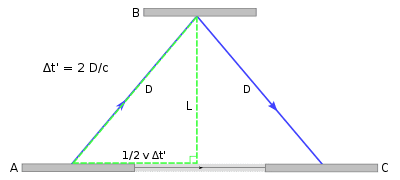
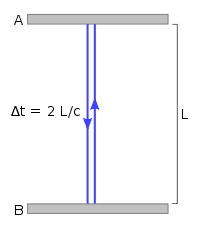
I have some newbie kind of confusion The model in question is taken from wikipedia:
200px-Time-dilation-001.svg.png


and

400px-Time-dilation-002.svg.png


If, in the first model, the light ray is reflected back to its source, could there be some kind of detectable interference at the midpoint (where the blue arrows are)? If the answer is yes, would this happen in the second model, since from the outside perspective, at the midpoint the light ray does not appear to be reflected back on itself.

Thanks for any help!
 
Physics news on Phys.org
Both diagrams are showing the path of a single short pulse, not a beam. So there is no interference in either case because at any point there is only light going up or light going down or (most of the time) nothing.

You could have a continuous beam of light bouncing back and forth and the first diagram would be valid and you would indeed get interference anywhere the beam crosses itself. However, the second diagram would need some modification. Instead of a thin line you would have a very fat line, so fat that the tail end of the upward traveling beam overlapped the front of the downward traveling beam, and you would get interference in the overlap region. You would also need to draw both mirrors all the time, as a pair of long horizontal lines, since there would always be light bouncing off them, instead of just showing them a couple of times.

Hope that makes sense.

Edit: Here's a sketch of what I mean - for a very short pulse you get the top diagram. If you stand at the bottom mirror, you'll only see flashes of light every time the pulse reaches the bottom, and since the upward going rays (in red) never cross the downward going rays you get no interference. However, if you have a long pulse, as in the bottom diagram, then the red rays and the blue rays (representing evenly spaced points along the beam) do overlap and you do get interference.
long pulses.png
 
Last edited:
  • Like
Likes   Reactions: Nugatory and Dale
Thanks for answering. That makes sense.
 

Similar threads

  • · Replies 58 ·
2
Replies
58
Views
5K
  • · Replies 15 ·
Replies
15
Views
3K
  • · Replies 18 ·
Replies
18
Views
2K
  • · Replies 9 ·
Replies
9
Views
2K
  • · Replies 16 ·
Replies
16
Views
2K
  • · Replies 18 ·
Replies
18
Views
3K
  • · Replies 2 ·
Replies
2
Views
2K
  • · Replies 11 ·
Replies
11
Views
2K
  • · Replies 34 ·
2
Replies
34
Views
2K
  • · Replies 4 ·
Replies
4
Views
2K