Time evolution of a rotating dipolar magnetic field

Click For Summary

Homework Help Overview

The discussion revolves around the interpretation of a rotating dipolar magnetic field, specifically focusing on the behavior of magnetic field lines generated by a magnetic moment that is tilted and rotating. The original poster describes the mathematical representation of the magnetic field and expresses confusion regarding the global rotation of the field lines in the presence of electromagnetic radiation.

Discussion Character

  • Conceptual clarification, Assumption checking, Problem interpretation

Approaches and Questions Raised

  • Participants explore the nature of the magnetic field lines, questioning whether they rotate rigidly despite the presence of radiation. The original poster presents a mathematical proof supporting their claim but expresses uncertainty about the implications of this result.

Discussion Status

The discussion is ongoing, with participants sharing insights and raising questions about the interpretation of the results. Some participants express surprise at the findings, while others seek further clarification on the implications of the rigid rotation of the magnetic field lines.

Contextual Notes

There are references to specific angles and configurations of the magnetic dipole, as well as the inclusion of radiation in the analysis. The original poster mentions the use of Mathematica for numerical evaluations and provides links to visual representations of the magnetic field lines.

Barnak
Messages
62
Reaction score
0
I'm having some interpretation problems with a rotating dipolar magnetic field, so I need your opinion (I apologise for my bad English).

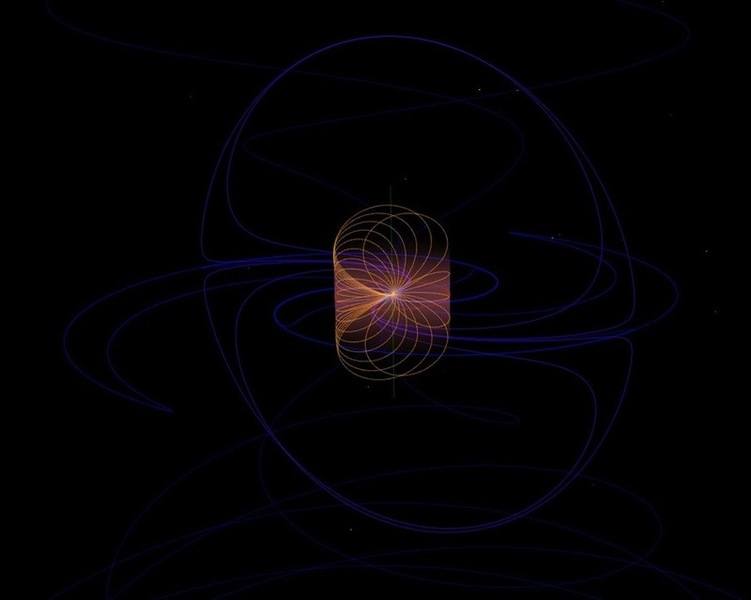
Let there be a magnetic moment "mu" tilted relative to the rotation axis (the "z" axis), with an inclination angle "alpha". The magnetic moment is steadily rotating with the angular velocity "w". It then generates a time dependent magnetic field with radiation (see Jackson, section 9.3). I already have all the magnetic field components and was able to draw the field lines, at t = 0 (see the picture below, for the case alpha = 90°). The yellow curves are the "last closed" magnetic field lines, inside the "light cylinder" defined by R_L = c/w. The blue curves are some radiation lines. All the curves shown represents the total magnetic field (including near, intermediate and far fields). The red circle is just a reference equator. The total magnetic field has the following mathematical form (the vectorial notation is implied) :

B(t, x, alpha) = F(x) sin(alpha) cos(wt) + G(x) sin(alpha) sin(wt) + H(x) cos(alpha),

with F, G and H three complicated vectors dependent of the space location only (and "w/c", of course). Apparently, the field is simply LOCALLY rotating, but it isn't clear that this should also imply that the field lines are ALL GLOBALLY rotating without any deformation. The numerical evaluation, using Mathematica, seems to indicate that they do rotate like a rigid body, despite the presence of EM radiation flowing out ! This is very surprising to me, and I was expecting some complicated time evolution with lines deformations, a bit like a fluid or an organic shape. So is it possible that, in the special case of a rotating magnetic dipole, the total magnetic field lines are simply rotating like a rigid body, even with the presence of EM waves flowing out ?
radiation3.jpg
 
Last edited:
Physics news on Phys.org
Here's an "experimental proof" (from Mathematica) that the lines do rotates like a rigid body. However, I simply don't understand that a magnetic field line can "precesse" like this, especially since this is from the alpha = 90°[/color] case.

http://nho.ohn.free.fr/celestia/Cham/Divers/Rotation.mp4 (tiny mp4 movie)

Here's another example (alpha = 90° again) :

http://nho.ohn.free.fr/celestia/Cham/Divers/Dipole2.mp4 (tiny mp4 movie)

Here's a better movie (AVI format) :

http://nho.ohn.free.fr/celestia/Cham/Divers/fieldRotation.avi

I'm yet unable to give a complete mathematical proof that the field lines do rotate like a rigid body, even in the presence of waves flowing out.

Here's a one page PDF document showing all the equations (just forget the first few lines, since this is "work in progress") :

http://nho.ohn.free.fr/celestia/Cham/Divers/DipoleRotation

Nobody care to comment ?
 
Last edited by a moderator:
I found the complete formal and rigorous proof I was looking for. It was really a non-trivial matter. The principle of my proof is actually very simple, but the details are a bit laborious. The idea of the proof is this :

If it's true that the total magnetic field simply rotates like a rigid body, then the following vectorial equation should be satisfied, for any point :

B(r, t) == R(wt) B(r', 0)

where R(wt) is a time dependent rotation matrix applied to the initial magnetic field (t = 0) EVALUATED at the previous position : r' = R(-wt) r (inverse rotation). This algebraic equation is a constraint on the time evolution of the field (rigid rotation). The field vector is LOCALLY rotated AND parallel transported (translation) to another point.

Now, in the simpler case of alpha = 90°, the field has the following form (see equation 9 in the PDF document I gave in my previous message) :

B(r, t) = F(r) cos(wt) + G(r) sin(wt).

It isn't obvious at all that this is a rigid evolution of the field, since the vectors F and G are complicated expressions (equations 10 and 11). However, they do obey the algebraic constraint above ! (the algebra is pretty laborious, but I verified that F(r) cos(wt) + G(r) sin(wt) == R(wt) F(r') ). Now, the generalisation to alpha != 90° is almost trivial. It's easy to verify that H(r) is actually invariant under the rotation :

R(wt) H(r') == H(r).

So, using the previous result from the case alpha = 90°, we get (see again equation 9) :

B(r, t) = { F(r) cos(wt) + G(r) sin(wt) } sin(alpha) + H(r) cos(alpha) == R(wt) { F(r') sin(alpha) + H(r') cos(alpha) }

Marvelous, isn't ? The result, however, is physically very surprising since there's still radiation flowing in that field !
 
It's definitely very non-intuitive to me! Thanks for sharing (haven't read the last post yet, but will do so later).
 
Below is a picture of some of the magnetic field lines produced by the rotating dipole. The purple curves are of radiation nature. However, I'm having a strong difficutly with the interpretation and I need some judgments on the solution.

I recall that the field I'm drawing is an exact solution to Maxwell's equations associated to a rotating magnetic dipole. This field is really rotating like a rigid body. I have a complete proof of that. This isn't a conceptual problem in itself, since the dipole is steadily rotating while sitting at the center (there's a kind of symmetry here). The problem appears when I draw the magnetic field lines. For a long tube of field lines starting at the polar caps (or even for a single line starting at the exact center of the polar caps), I get this tilted conical shape as shown on the first picture below. This cone is RIGIDLY rotating around the rotation axis (green vertical line). Since that cone is tilted, the field lines are evolving in an unexpected way (unacceptable to me). The central part IS okay, as seen in Celestia. While the cone rotates, you can really feel the radiation flowing out from the polar caps (central part on the first picture), but the evolution of the large parts doesn't make any sense to me ! How can the far away field rotate like this ? I was expecting something like what is shown on the second picture below (rough sketch). I can only see two ways out of this "problem" :

1- the analytical solution is wrong in some way, but I don't believe it is. I just can't see how it may be wrong. I need a judgment on this.

2- The solution is right and I only have a problem of interpretation with this "wrong" evolution. Maybe there really is a tilted magnetic cone which DO rotates like this, but then this is truly amazing.

How is special relativity supposed to enter the solution, for the pure rotating magnetic dipole ? As far as I can tell, the solution I have is an exact analytical solution of Maxwell equation, and since the radiation is included, special relativity is already in the solution, isn't ?

Please, give me your thought on this.

First picture : magnetic field lines (radiation in purple) RIGIDLY rotating around the green axis, according to exact solution of Maxwell's equs :
rotation-false.jpg


Second picture : expected evolution of field. Rigid rotation of an aligned conical pattern of radiation :
rotation-real.jpg
 
Last edited:
reference

If you have access at your local library or through some institution you could check out this reference

http://www.springerlink.com/content/u7vr8g3kq4042717/

this is from the journal astrophysics. A rotating magnetic dipole is used as a model for a pulsar.
 
Sorry, but this doesn't help much.
 

Similar threads

  • · Replies 1 ·
Replies
1
Views
1K
  • · Replies 5 ·
Replies
5
Views
1K
  • · Replies 5 ·
Replies
5
Views
2K
  • · Replies 5 ·
Replies
5
Views
4K
  • · Replies 1 ·
Replies
1
Views
4K
Replies
1
Views
2K
Replies
11
Views
3K
  • · Replies 5 ·
Replies
5
Views
16K
  • · Replies 19 ·
Replies
19
Views
3K
Replies
16
Views
2K