gnits
- 137
- 46
- Homework Statement
- To find the ratio of forces around a right triangle
- Relevant Equations
- Equate moments of couples
Could I please ask for help with the following:
ABC is a right-angled triangle in which AB = 4a; BC = 3a. Forces of magnitudes P, Q and R act along the directed sides AB, BC and CA respectively. Find the ratios P:Q:R if their resultant is a couple.
Book answer is 4 : 3 : 5
Here's my diagram:
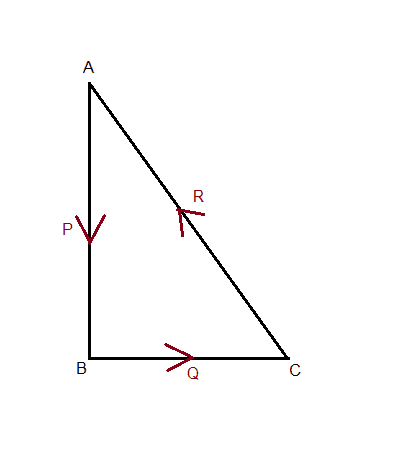
Here's my working:
tan ACB = 4/3 and so the cos of ACB is 3/5 and the sin of ACB is 4/5
As we are given that the resultant is a couple we can equate moments about A, B and C respectively, giving:
4aQ = 4R/5 * 3a = 3aP
Which gives:
20Q = 12R = 15P
so P : Q : R = 15 : 20 : 12
Not the book answer,
thanks for pointing to my error,
Mitch.
ABC is a right-angled triangle in which AB = 4a; BC = 3a. Forces of magnitudes P, Q and R act along the directed sides AB, BC and CA respectively. Find the ratios P:Q:R if their resultant is a couple.
Book answer is 4 : 3 : 5
Here's my diagram:
Here's my working:
tan ACB = 4/3 and so the cos of ACB is 3/5 and the sin of ACB is 4/5
As we are given that the resultant is a couple we can equate moments about A, B and C respectively, giving:
4aQ = 4R/5 * 3a = 3aP
Which gives:
20Q = 12R = 15P
so P : Q : R = 15 : 20 : 12
Not the book answer,
thanks for pointing to my error,
Mitch.