Finding net gravitational attractions in a triangle

Click For Summary
SUMMARY

The discussion centers on calculating net gravitational attractions in a triangular configuration using Newton's law of universal gravitation, specifically the formula Fg=Gm_1m_2/r^2. A user calculated the gravitational force between two masses and derived a force of 1.067*10^-10 N, but encountered an error in their final calculations, leading to an incorrect result of 2.13*10^-10 N. The error was attributed to mishandling scientific notation in the calculations, which significantly impacted the outcome.

PREREQUISITES
  • Understanding of Newton's law of universal gravitation
  • Familiarity with scientific notation and its application in calculations
  • Basic knowledge of vector components in physics
  • Ability to solve problems involving forces in two dimensions
NEXT STEPS
  • Review the principles of Newton's law of universal gravitation
  • Practice calculations involving scientific notation and unit conversions
  • Learn about vector addition and resolving forces in two dimensions
  • Explore gravitational force problems in triangular configurations
USEFUL FOR

Students studying physics, particularly those focusing on gravitational forces and vector analysis, as well as educators seeking to clarify common calculation errors in gravitational problems.

AfronPie
1. The problem is attached in a picture. I've done it five times and keep getting it wrong. The correct answer is also displayed in the picture. Thank you for any help.

2. Fg=Gm_1m_2/r^2


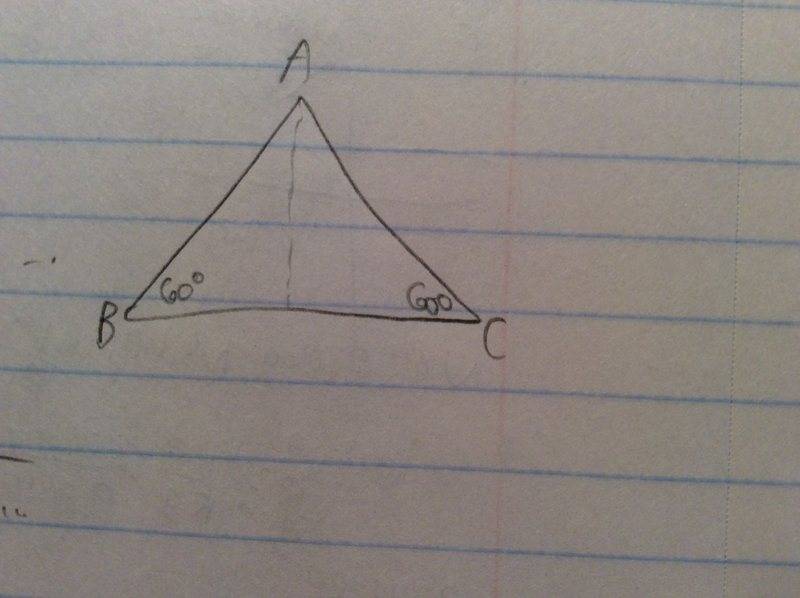
3. I calculated Fg between AB and BC (they are equal). So Fg=(6.67*10^-11)(4)(4)/(.10)^2=1.067*10^-10. Then I drew a triangle (also attached). I labeled the point in between B and C the center of my axis. So when I calculated the sum of the forces in the x direction I got 0. In the y direction the sum of the forces is 2*1.067*10^-10*sin60. I did that and got 2.13*10^-10. Why isn't that the right answer?
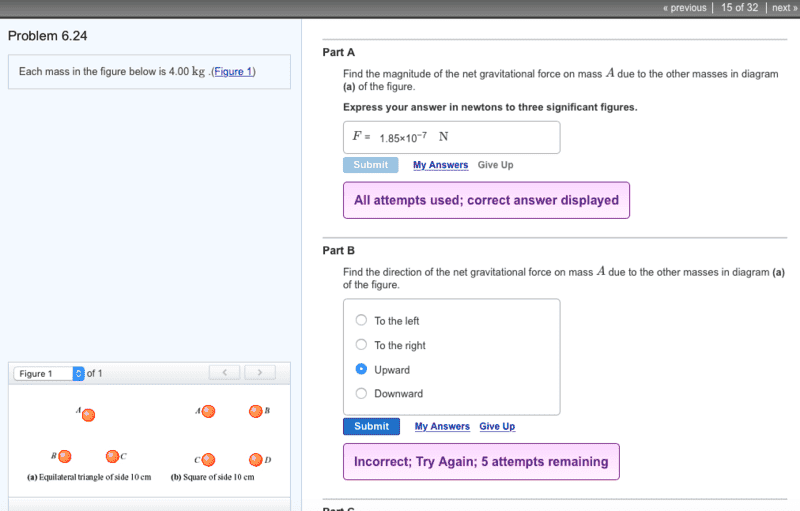
hlepmeg-d.png
IMG_0315.JPG
 
Physics news on Phys.org
Hello AfronPie,

Welcome to Physics Forums!

AfronPie said:
1. The problem is attached in a picture. I've done it five times and keep getting it wrong. The correct answer is also displayed in the picture. Thank you for any help.

2. Fg=Gm_1m_2/r^2


3. I calculated Fg between AB and BC (they are equal). So Fg=(6.67*10^-11)(4)(4)/(.10)^2=1.067*10^-10. Then I drew a triangle (also attached). I labeled the point in between B and C the center of my axis. So when I calculated the sum of the forces in the x direction I got 0. In the y direction the sum of the forces is 2*1.067*10^-10*sin60. I did that and got 2.13*10^-10. Why isn't that the right answer?
Recheck your calculation of the force between two of the masses (your Fg). The value you're getting is too small, so check how you're handling the scientific notation exponents.
 
  • Like
Likes   Reactions: AfronPie
gneill said:
Hello AfronPie,

Welcome to Physics Forums!Recheck your calculation of the force between two of the masses (your Fg). The value you're getting is too small, so check how you're handling the scientific notation exponents.
Thank you very very much. I did the whole thing right but that one mistake messed it up completely.
 

Similar threads

Replies
4
Views
2K
  • · Replies 8 ·
Replies
8
Views
2K
Replies
31
Views
2K
  • · Replies 2 ·
Replies
2
Views
2K
  • · Replies 9 ·
Replies
9
Views
2K
  • · Replies 4 ·
Replies
4
Views
2K
  • · Replies 6 ·
Replies
6
Views
2K
Replies
8
Views
1K
  • · Replies 8 ·
Replies
8
Views
2K
  • · Replies 1 ·
Replies
1
Views
5K