To find the relative velocities of linear and circular motion

Click For Summary
SUMMARY

The discussion focuses on finding the relative velocities of linear and circular motion, specifically deriving the velocity \( v \) in terms of \( u \). The midpoint velocity \( V_m \) is calculated as \( (u/2) i + (u/2) j \), while the particle's position vector \( r_p \) is expressed as \( \cos(wt) i + \sin(wt) j \). The error identified in the calculations was the assumption that the maximum value occurs when \( \cos(wt) = 0 \) and \( \sin(wt) = 1 \); the correct maximum is actually \( \sqrt{2} \). This correction leads to the accurate formulation of \( v = u - u/\sqrt{2} \).

PREREQUISITES
  • Understanding of linear and circular motion dynamics
  • Familiarity with vector calculus and differentiation
  • Knowledge of angular velocity and its relationship to linear velocity
  • Proficiency in trigonometric identities and their applications in physics
NEXT STEPS
  • Study the relationship between angular velocity and linear velocity in circular motion
  • Learn about vector differentiation in the context of motion analysis
  • Explore trigonometric maximization techniques in physics problems
  • Investigate the implications of relative velocity in different motion scenarios
USEFUL FOR

Students and educators in physics, particularly those focusing on mechanics, as well as anyone involved in solving complex motion problems involving linear and circular dynamics.

gnits
Messages
137
Reaction score
46
Homework Statement
To find relative velocities
Relevant Equations
d=st
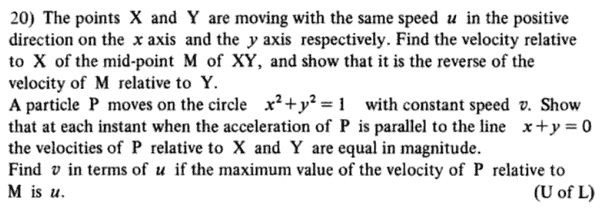
Could I please ask for help regarding the final part of the following question:
ls.PNG

It is the very last part, to find v in terms of u.

So I have that the velocity of the midpoint of XY is:

V_m = (u/2) i + (u/2) j

I let the position vector of P be:

r_p = cos(wt) i + sin(wt) j

(w = angular velocity = v because v = rw and r = 1. So I am assuming that the particle is at (1,0) when t = 0)

Differentiating this gives the velocity of P as:

V_p = -w sin(wt) i + w cos(wt) j

And so the velocity of P relative to M is:

V_p - V_m = V_pm = (-w sin(wt) - u/2) i + (w cos(wt) - u/2) j

and so, the modulus of V_pm is given by:

|V_pm|^2 = w^2 (sin(wt))^2 + uw sin(wt) + u^2/4 + w^2 (cos(wt))^2 - uw cos(wt) + u^2/4

Which simplifies to:

|V_pm|^2 = w^2 + u^2/2 + uw (sin(wt) - cos(wt) )

This will be maximal when cos(wt) = 0 and sin(wt) = 1

Simplifying and substituting v for w, and replacing |V_pm| with u leads to:

v^2 + u^2/2 + uv = u^2

This does not lead to the provided answer of v = u - u/sqrt(2)

Thanks for any help,
Mitch.
 
Physics news on Phys.org
gnits said:
Homework Statement:: To find relative velocities
Relevant Equations:: d=st

Could I please ask for help regarding the final part of the following question:

View attachment 264411

Which simplifies to:

|V_pm|^2 = w^2 + u^2/2 + uw (sin(wt) - cos(wt) )

This will be maximal when cos(wt) = 0 and sin(wt) = 1

This is the mistake.
 
PeroK said:
This is the mistake.
Thanks for your reply, it helped me see my error.
I was indeed wrong to say that the max value will occur when cos(wt) = 0 and sin(wt) = 1
As I have the sum of three terms and the first two are positive, I will need to maximize the last term.
I wrongly stated this max as 1 but it is in fact sqrt(2)
This leads to the correct answer
Thanks again.
 
Last edited:
The book claims the answer is that all the magnitudes are the same because "the gravitational force on the penguin is the same". I'm having trouble understanding this. I thought the buoyant force was equal to the weight of the fluid displaced. Weight depends on mass which depends on density. Therefore, due to the differing densities the buoyant force will be different in each case? Is this incorrect?

Similar threads

Replies
1
Views
808
  • · Replies 1 ·
Replies
1
Views
1K
  • · Replies 3 ·
Replies
3
Views
2K
  • · Replies 10 ·
Replies
10
Views
2K
  • · Replies 11 ·
Replies
11
Views
2K
  • · Replies 7 ·
Replies
7
Views
2K
Replies
11
Views
3K
Replies
27
Views
4K
  • · Replies 3 ·
Replies
3
Views
2K
Replies
5
Views
2K