Torque in one end of a rod in free space

Click For Summary

Discussion Overview

The discussion revolves around the dynamics of a rod subjected to torque at one end while in free space, with no external forces acting on it. Participants explore the implications of this scenario on the motion of the center of mass (COM) and the angular acceleration of the rod.

Discussion Character

  • Exploratory
  • Debate/contested
  • Technical explanation

Main Points Raised

  • Some participants question how the rod behaves under the influence of torque alone, considering the absence of external forces.
  • There is a discussion about whether a torque can exist without a net force and how this affects the acceleration of the COM.
  • Some argue that if only torque is applied, the forces implied by it cancel out, resulting in no acceleration of the COM.
  • Others suggest that torque can still lead to angular acceleration, calculated using the moment of inertia, but debate whether this acceleration occurs around the end of the rod or the COM.
  • Participants express confusion about the relationship between torque and forces, particularly in scenarios like robotic arms where torque is applied at joints.
  • Some assert that a torque can exist with zero net external force if forces are applied at different points but with equal magnitude.

Areas of Agreement / Disagreement

Participants do not reach consensus on whether torque can exist without a net force or how the dynamics of the rod should be interpreted in this context. Multiple competing views remain regarding the implications of torque on the motion of the rod.

Contextual Notes

Participants highlight the need for clarity on the definitions of torque and net force, as well as the conditions under which they apply. There are unresolved questions about the relationship between torque and the motion of the COM and angular acceleration.

Mechanics89
Messages
7
Reaction score
0
Hello.

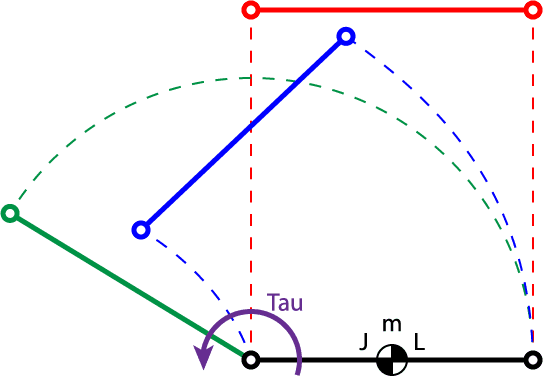
I'm having trouble with determining the dynamics of a rod, when one of the ends has a torque applied to it. I've illustrated it in the figure below:
20jkdq9.jpg


There are no external forces except of the torque - so no gravity, drag etc. Also, the rod is assumed rigid. How will it behave? Green, blue or red? And why?

Legend:
Tau (τ): Torque
m: Mass
J: Moment of inertia
L: Length
 
Physics news on Phys.org
What is the net force on the rod? How is the center of mass going to move based on this?
 
@Orodruin: I was thinking what there will be a force on the center of mass as the torque would imply this due to Tau = a x F?
 
Mechanics89 said:
@Orodruin: I was thinking what there will be a force on the center of mass as the torque would imply this due to Tau = a x F?
You have to make up your mind, if there is just a external torque, or also external net force. If there is just a torque, then all forces "implied" by it cancel, and the COM won't accelerate.
 
A.T. said:
You have to make up your mind, if there is just a external torque, or also external net force. If there is just a torque, then all forces "implied" by it cancel, and the COM won't accelerate.

But why would the torque cancel out? The example should be thought of as no external net force is applied. Can it be explained by the following sketch, where the torque couples cancel out?:

mtou2t.jpg


I'm trying to determine the acceleration of the COM along with the angular acceleration around the COM.
 
Mechanics89 said:
But why would the torque cancel out?
The torque doesn't cancel, but the forces do. There is a torque, but no net force. No net force implies no acceleration of the COM.
 
Doc Al said:
The torque doesn't cancel, but the forces do. There is a torque, but no net force. No net force implies no acceleration of the COM.

Okay, thanks. But the torque will imply an angular acceleration? Calculated by Tau = (I_COM + m * (L/2)^2) * Alpha? And will this angular acceleration be around the end or the COM?
 
Mechanics89 said:
And will this angular acceleration be around the end or the COM?
If the COM cannot accelerate, can the rod rotate around the end?
 
A.T. said:
If the COM cannot accelerate, can the rod rotate around the end?

Nope - so will the acceleration be:

d2x = 0;
d2y = 0;
d2Phi = Tau / I_COM;

or:

d2x = 0;
d2y = 0;
d2Phi = Tau / (I_COM + m * (L/2)^2);

Or an I completely off track here? :)
 
  • #10
Hello,
I am unable to understand your figure. You have depicted that a torque acts about the 'end point' to the left however there is NO external force. A torque without the presence of forces imply the formation of a 'couple' in order to cancel out the forces. If that is the case, i cannot understand where the Couple forces must have been applied to produce a torque around the end point as depicted in the figure ! The way i see it, there must have been a force on the rod to produce a torque as shown.
 
  • #11
Mechanics89 said:
Nope - so will the acceleration be:

d2x = 0;
d2y = 0;
d2Phi = Tau / I_COM;

or:

d2x = 0;
d2y = 0;
d2Phi = Tau / (I_COM + m * (L/2)^2);

Or an I completely off track here? :)

There is a way relating the torque around one point with the torque around another point if you know the force acting on the object and its point of application. What does that relation tell you in the case the total external force is zero?
 
  • #12
Orodruin said:
There is a way relating the torque around one point with the torque around another point if you know the force acting on the object and its point of application. What does that relation tell you in the case the total external force is zero?

That there is no torque as the total external net force is zero? :)
 
  • #13
pranav_bhrdwj said:
Hello,
I am unable to understand your figure. You have depicted that a torque acts about the 'end point' to the left however there is NO external force. A torque without the presence of forces imply the formation of a 'couple' in order to cancel out the forces. If that is the case, i cannot understand where the Couple forces must have been applied to produce a torque around the end point as depicted in the figure ! The way i see it, there must have been a force on the rod to produce a torque as shown.

Okay, thanks for the answer. But for instance: assume a robotic arm with a single joint between two "bones". When the robotic joint is actuated, isn't there only a torque imposed in the joint, thus causing the arm to move? Or will the arm only be able to move, if a "muscle" is connected a small distance from the joint, thus making a nonzero total net force?
 
  • #14
You can have a torque with total external force zero, you just need forces with different points of application but with the same magnitude.

However, when you have zero net force, the torque is the same regardless of which point you are considering (exercise: prove this!). Your problem is therefore equivalent to no net force and the same torque around the CoM.
 

Similar threads

  • · Replies 2 ·
Replies
2
Views
2K
  • · Replies 2 ·
Replies
2
Views
2K
  • · Replies 3 ·
Replies
3
Views
3K
  • · Replies 3 ·
Replies
3
Views
2K
  • · Replies 5 ·
Replies
5
Views
5K
  • · Replies 4 ·
Replies
4
Views
2K
  • · Replies 3 ·
Replies
3
Views
5K
Replies
8
Views
3K
  • · Replies 13 ·
Replies
13
Views
7K
  • · Replies 3 ·
Replies
3
Views
3K