Torque question in Deltoid muscle

  • Thread starter Thread starter dcmf
  • Start date Start date
  • Tags Tags
    Muscle Torque
Click For Summary
SUMMARY

The discussion centers on calculating torque in the Deltoid muscle, specifically using the torque equation T=FlSinθ with an emphasis on the angle's measurement in radians. Participants identified calculation errors leading to discrepancies in results, with one participant correcting their initial torque calculation from 17 N to approximately 986.25 N. The mention of a 3-second timeframe was deemed irrelevant to the torque calculation, serving only as a distraction. The importance of accurately drawing a free body diagram (FBD) was highlighted to clarify the forces involved.

PREREQUISITES
  • Understanding of torque calculations using T=FlSinθ
  • Familiarity with free body diagrams (FBD) in physics
  • Knowledge of significant figures in scientific calculations
  • Ability to convert degrees to radians for trigonometric functions
NEXT STEPS
  • Review the principles of torque and its applications in biomechanics
  • Learn how to accurately draw and analyze free body diagrams
  • Study the significance of significant figures in physics calculations
  • Practice converting angles from degrees to radians for trigonometric equations
USEFUL FOR

Students and professionals in biomechanics, physics educators, and anyone involved in the analysis of muscle forces and torque calculations.

dcmf
Messages
16
Reaction score
5
Homework Statement
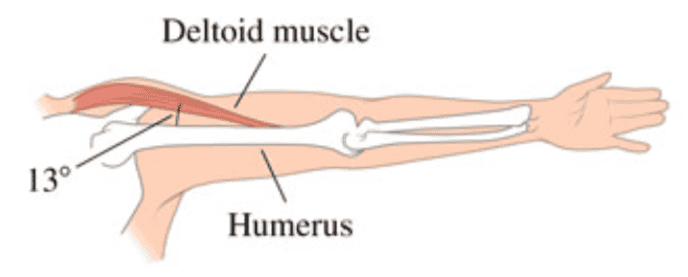
A woman lifts a 3.6-kg barbell in each hand with her arm in a horizontal position at the side of her body and holds it there for 3 s (see the figure below). What force does the deltoid muscle in her shoulder exert on the humerus bone while holding the barbell? The deltoid attaches 13 cm from the shoulder joint and makes a 13 degree angle with the humerus. The barbell in her hand is 0.55 m from the shoulder joint, and the center of mass of her 4.0-kg arm is 0.24 m from the joint.
Relevant Equations
Tnet, T=Flsinθ, Fg=mg
Here's a picture the question provided.
1710606356284.png


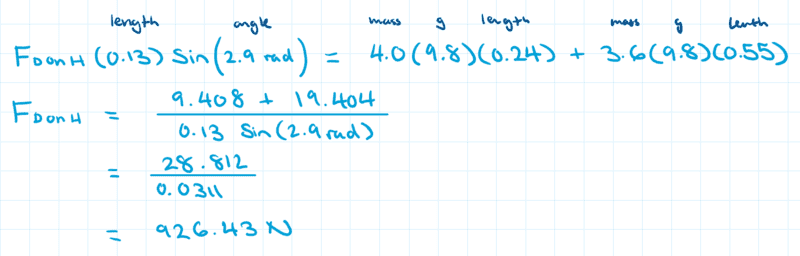
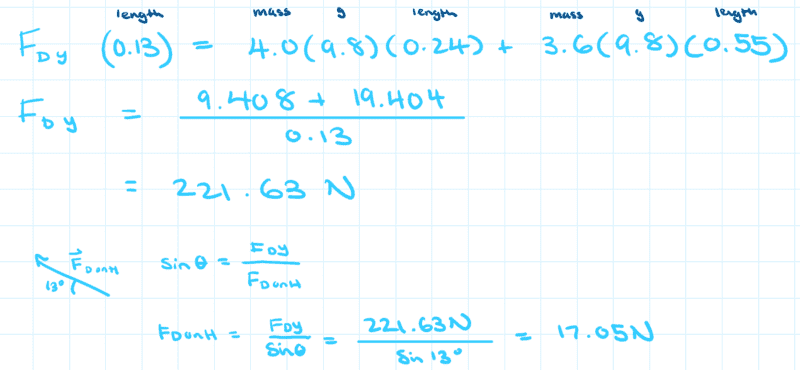
I tried solving this question two ways (assuming the axis of rotation is at the shoulder joint) and am getting wildly different answers.
1710606423436.png

1710606439578.png


Some potential reasons there's a discrepancy:
- I'm not super confident about my use of the torque equation (T=FlSinθ), especially the angle part, which I think needs radians as an input
- Question mentioned something about 3 seconds but I never used that in any of my calculations and this is a one-part question so its not as if it could be used later on

Thanks in advance!
 
Physics news on Phys.org
##\sin(13^\circ) < 1## so you cannot possibly have done the math right in the first attempt as dividing something by a positive number < 1 cannot possibly give a smaller number.
 
If you draw a free body diagram, it would be evident how far from reality that first result of 17 N is, considering that the barbell weights 35 N.
 
Thanks for the input.
Orodruin said:
##\sin(13^\circ) < 1## so you cannot possibly have done the math right in the first attempt as dividing something by a positive number < 1 cannot possibly give a smaller number.

You're absolutely correct, there was a calculation error there but that results in about 985.2N, but I think the answer needs about 2 significant figures so there's still (at least what seems to me) a discrepancy between the two values.

Also is 3s really not being used at all in the question? Just a red herring?
 
Lnewqban said:
If you draw a free body diagram, it would be evident how far from reality that first result of 17 N is, considering that the barbell weights 35 N.
1710610590357.png

I had a really poorly done sketch so I omitted it 😳 The numbers didn't look right to me either though. But I just have terrible intuition with math and it didn't click that dividing by a decimal should result in a bigger number :')
Thank you
 

Attachments

  • 1710610492007.png
    1710610492007.png
    11.5 KB · Views: 88
dcmf said:
View attachment 341914
I had a really poorly done sketch so I omitted it 😳 The numbers didn't look right to me either though. But I just have terrible intuition with math and it didn't click that dividing by a decimal should result in a bigger number :')
Thank you
Your FBD for summation of moments is correct.
The greater the deviation of the line of action of the muscle from the vertical, the greater the actual force respect to the vertical component (which you have properly calculated).
My calculation of the actual muscle effort gives 986.25 N.
 
dcmf said:
You're absolutely correct, there was a calculation error there but that results in about 985.2N, but I think the answer needs about 2 significant figures so there's still (at least what seems to me) a discrepancy between the two values.
Your 2.9 radians is far too imprecise to represent 167°. It is closer to 166°, which makes a big difference in the sine (0.225 vs 0.239).

dcmf said:
Also is 3s really not being used at all in the question? Just a red herring?
For computing the static force in equilibrium, yes, it is a red herring.
 
dcmf said:
View attachment 341914
I had a really poorly done sketch so I omitted it 😳 The numbers didn't look right to me either though. But I just have terrible intuition with math and it didn't click that dividing by a decimal should result in a bigger number :')

I know it’s not necessary for the computation of ##T##, but a FBD should include the reaction forces at the shoulder joint too.
 

Similar threads

Replies
6
Views
15K
  • · Replies 4 ·
Replies
4
Views
3K
Replies
2
Views
1K
  • · Replies 12 ·
Replies
12
Views
4K
  • · Replies 18 ·
Replies
18
Views
5K
  • · Replies 3 ·
Replies
3
Views
2K
  • · Replies 1 ·
Replies
1
Views
3K
  • · Replies 14 ·
Replies
14
Views
1K
  • · Replies 2 ·
Replies
2
Views
4K
  • · Replies 5 ·
Replies
5
Views
14K