Torus - Singh, Example 2.2.5 - Baffled by certain aspects

  • Context: Graduate 
  • Thread starter Thread starter Math Amateur
  • Start date Start date
  • Tags Tags
    Example Torus
Click For Summary

Discussion Overview

The discussion revolves around the treatment of the torus in Example 2.2.5 from Tej Bahadur Singh's "Elements of Topology." Participants express confusion regarding the definitions and choices made in the example, particularly concerning the placement of circles C_1 and C_2 and their implications in the context of topology.

Discussion Character

  • Exploratory
  • Debate/contested
  • Technical explanation

Main Points Raised

  • Peter questions why C_1 is defined at height z = 1 and suggests that defining it at z = 0 might be more natural when rotating C_2 around the z-axis.
  • Some participants assert that both C_1 and C_2 are circles in R^3, implying that their product is embedded in R^6.
  • There is a discussion about the possibility of defining C_1 at z = -1, which would correspond to the bottom of the torus, indicating that there are alternative definitions that could be considered.
  • Clarifications are sought regarding whether C_1 and C_2 are indeed the same circle, with participants confirming this point.

Areas of Agreement / Disagreement

Participants express differing views on the placement of C_1 and the implications of its definition. While some agree that C_1 could be defined differently, there is no consensus on the necessity or implications of such a change.

Contextual Notes

The discussion highlights the ambiguity in the definitions used in Singh's example and the potential for multiple interpretations regarding the placement of circles in the torus structure.

Math Amateur
Gold Member
MHB
Messages
3,920
Reaction score
48
I am baffled by some aspects of the torus ... I hope someone can help ...

I am puzzled by some aspects of Singh's treatment of the torus in Example 2.2.5 ( Tej Bahadur Singh: Elements of Topology, CRC Press, 2013) ... ...

Singh's Example 2.2.5 reads as follows:
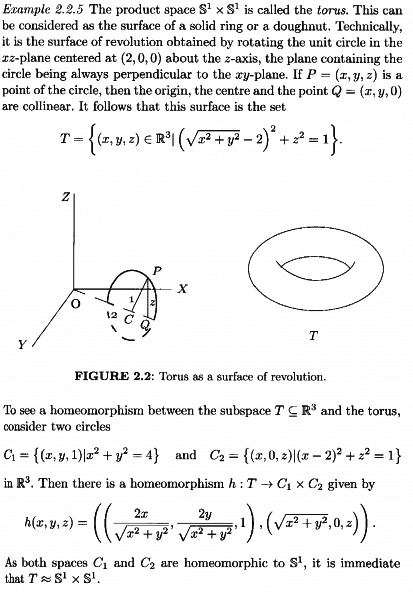
?temp_hash=1d6597f8eee43d0cd15ffc346eef67d4.png


My questions related to the above example of Singh's are as follows:Question 1

C_1 as defined above seems to me to be a circle at 'height' z = 1, around the z-axis ... why (for what reason?) did Singh choose C_1 to be at 'height' z = 1?

Why not choose C_1 as \{ (x,y, 0) \ | \ x^2 + y^2 = 4 \}?

Such a choice seems more natural if you are rotating C_2 around the z-axis, since C_1 is at level z = 0 ... ...Question 2

h \ : \ T \rightarrow C_1 \times C_2

maps (x,y,z) onto two three dimensional points in Euclidean 3-space and so essentially maps (x,y,z) into Euclidean 6-space ... ..

... BUT ...

T is homeomorphic to S^1 \times S^1 which is embedded in Euclidean 4-space ... ... how can this be ...


I hope someone can clarify the above issues/questions ...

Peter
 

Attachments

  • Singh - Example 2.2.5.png
    Singh - Example 2.2.5.png
    43.2 KB · Views: 755
Last edited:
Physics news on Phys.org
Question 2: C1 and C2 are both circles in R^3 so the product is embedded in R^6.

Question 1. The top of the torus,T, is a circle at height of 1 above the xy-plane. and has radius 2
The circle C2 is the same circle.
 
Last edited:
Math Amateur said:
I am baffled by some aspects of the torus ... I hope someone can help ...

I am puzzled by some aspects of Singh's treatment of the torus in Example 2.2.5 ( Tej Bahadur Singh: Elements of Topology, CRC Press, 2013) ... ...

Singh's Example 2.2.5 reads as follows:

?temp_hash=1d6597f8eee43d0cd15ffc346eef67d4.png


My questions related to the above example of Singh's are as follows:Question 1

C_1 as defined above seems to me to be a circle at 'height' z = 1, around the z-axis ... why (for what reason?) did Singh choose C_1 to be at 'height' z = 1?

Why not choose C_1 as \{ (x,y, 0) \ | \ x^2 + y^2 = 4 \}?

Such a choice seems more natural if you are rotating C_2 around the z-axis, since C_1 is at level z = 0 ... ...Question 2

h \ : \ T \rightarrow C_1 \times C_2

maps (x,y,z) onto two three dimensional points in Euclidean 3-space and so essentially maps (x,y,z) into Euclidean 6-space ... ..

... BUT ...

T is homeomorphic to S^1 \times S^1 which is embedded in Euclidean 4-space ... ... how can this be ...


I hope someone can clarify the above issues/questions ...

Peter
lavinia said:
Question 2: C1 and C2 are both circles in R^3 so the product is embedded in R^6.

Question 1. The top of the torus,T, is a circle at height of 1 above the xy-plane. and has radius 2
The circle C2 is the same circle.
Thanks so much for your help Lavinia ... ...

... ... BUT ... for Question 1 ... do you mean "The circle C1 is the same circle"and ... if it is supposed to be C_1, then could Singh have alternatively, defined C_1 as

C_1 as \{ (x,y, -1) \ | \ x^2 + y^2 = 4 \} ...

as this seems to define the bottom of the torus ...

Hope you can help further ... ...

Peter
 
Math Amateur said:
Thanks so much for your help Lavinia ... ...

... ... BUT ... for Question 1 ... do you mean "The circle C1 is the same circle"and ... if it is supposed to be C_1, then could Singh have alternatively, defined C_1 as

C_1 as \{ (x,y, -1) \ | \ x^2 + y^2 = 4 \} ...

as this seems to define the bottom of the torus ...

Hope you can help further ... ...

Peter
yes he could have defined C_1 as the bottom of the torus.
 
Thanks Lavinia ... Appreciate the help ...

Just quickly ... In your answer to question 1, did you mean: The Circle C1 is the same circle?

Peter
 
Math Amateur said:
Thanks Lavinia ... Appreciate the help ...

Just quickly ... In your answer to question 1, did you mean: The Circle C1 is the same circle?

Peter
yes. sorry
 
Thanks again Lavinia ... most helpful ...

Peter
 

Similar threads

  • · Replies 2 ·
Replies
2
Views
3K
  • · Replies 2 ·
Replies
2
Views
2K
  • · Replies 2 ·
Replies
2
Views
2K
  • · Replies 4 ·
Replies
4
Views
3K
  • · Replies 2 ·
Replies
2
Views
2K
  • · Replies 5 ·
Replies
5
Views
2K
  • · Replies 2 ·
Replies
2
Views
2K
  • · Replies 13 ·
Replies
13
Views
2K
  • · Replies 0 ·
Replies
0
Views
1K
  • · Replies 6 ·
Replies
6
Views
3K