Toy Problem to Understand Products of Inertia?

  • Thread starter Thread starter Swamp Thing
  • Start date Start date
  • Tags Tags
    Inertia
Click For Summary
The discussion focuses on understanding the physical meaning of the off-diagonal elements of the inertia tensor, specifically the products of inertia. A non-zero product of inertia indicates that an object cannot rotate about a specific axis without external torque, linking to the concept of dynamic balancing. The conversation explores the need for a toy problem to illustrate these concepts, particularly how non-cancelling terms in the inertia matrix relate to external torque requirements during rotation. The example of a tilted disk on a massless shaft is used to visualize the need for restraining torque when rotating about a non-principal axis. Ultimately, the dialogue emphasizes the importance of principal axes in simplifying the inertia tensor and understanding rotational dynamics.
Swamp Thing
Insights Author
Messages
1,045
Reaction score
775
I am a bit new to the concept of the Inertia Tensor. One question that comes to mind is, what is the physical meaning of the off-diagonals i.e. the products of inertia?

I read this post : https://www.physicsforums.com/threads/physical-meaning-of-product-of-inertia.401927/post-2711721
and I find it quite helpful.

D H said:
Products of inertia certainly do have physical meaning. Suppose the Ixy for some object is non-zero. That means that the object cannot perform a pure x-axis rotation without some external torque. (The same also pertains to a pure y-axis rotation.)

This seems to connect with the idea of dynamic balancing, i.e. an object is dynamically balanced IFF the rotation axis lines up with a set of axes for which the inertia tensor is diagonal. (Have I got that right?)

But I'd like to see a toy problem that exemplifies this in a simple way, and in particular, I'd like to know how it ties in with the following formula:
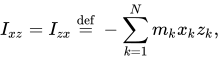
30fff787f23ac8abca8661c94f6bc6b99cba7d1a

which is from Wikipedia https://en.wikipedia.org/wiki/Moment_of_inertia#Inertia_tensor

If there are some ##m_k x_k z_k## terms that don't all cancel out, how does that call for an external torque to maintain the rotation axis?
 
Last edited:
  • Like
Likes Dale
Physics news on Phys.org
Imagined a massless shaft supported on two bearings. Between the two bearings, there is mounted a massive disk, but the disk is tilted, so that the angle between the disk axis of symmetry and the shaft axis is not zero.

When the shaft is rotated, rotating bearing reaction will rotate because this is a non-principal axis rotation of the massive disk
 
Thanks. Your example helps to visualize a situation where you need to exert a restraining torque in order to hold the rotation axis in place.

However, it's not directly clear to me that this model will have those non-cancelling ##m_k x_k y_k## type terms -- so this model isn't enough of a "toy" for me to understand :smile:.
 
For every rigid body, there exists a coordinate system in which the inertia matrix is diagonal. Such a coordinate system is called a Principal Axis System. An axis of symmetry is always a principal axis.

If you start with a principal coordinate system and make a rotation to a non-principal system, the off-diagonal terms will always appear. When the body is required (forced) to rotate about a non-principal axis, the constraint forces are required.

For the example given of the massive disk obliquely mounted on a massless shaft, it is pretty obvious what the principal axes of the disk are (the shaft has no mass). The central axis defining the disk and any pair of perpendiculars in the disk are the principal axes. The required rotation axis is not one of these, so it is non-principal.
 
  • Like
Likes vanhees71
I built a device designed to brake angular velocity which seems to work based on below, i used a flexible shaft that could bow up and down so i could visually see what was happening for the prototypes. If you spin two wheels in opposite directions each with a magnitude of angular momentum L on a rigid shaft (equal magnitude opposite directions), then rotate the shaft at 90 degrees to the momentum vectors at constant angular velocity omega, then the resulting torques oppose each other...

Similar threads

  • · Replies 3 ·
Replies
3
Views
2K
  • · Replies 11 ·
Replies
11
Views
11K
  • · Replies 1 ·
Replies
1
Views
4K
  • · Replies 1 ·
Replies
1
Views
2K
  • · Replies 1 ·
Replies
1
Views
2K
Replies
2
Views
4K
  • · Replies 2 ·
Replies
2
Views
3K
  • · Replies 67 ·
3
Replies
67
Views
10K
Replies
5
Views
6K
  • · Replies 16 ·
Replies
16
Views
93K