Questions Regarding the Inertia Tensor

Join the discussion
Ask a follow-up here, or get your own question answered by working scientists, mathematicians and engineers — people, not an autocomplete.
Real named experts · corrections over time · the nuance an AI answer skips
3 replies · 2K views
sams
Gold Member
Messages
84
Reaction score
2
In Chapter 11: Dynamics of Rigid Bodies, in the Classical Dynamics of Particles and Systems book by Thornton and Marion, Fifth Edition, pages 415-418, Section 11.3 - Inertia Tensor, I have three questions regarding the Inertia Tensor:

1.The authors made the following statement: "neither V nor ω is characteristic of the αth particle."

1.PNG

What do the authors mean by the above statement and how did they take V.ω outside the relation?

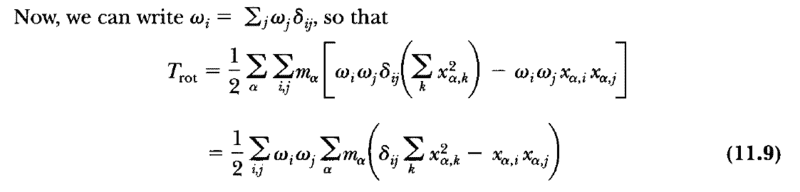
2. Kronecker delta function

2.PNG

3.PNG


Shouldn't the second term in the square brackets or in the parenthesis of Equation (11.9) also contain the Kronecker delta function?

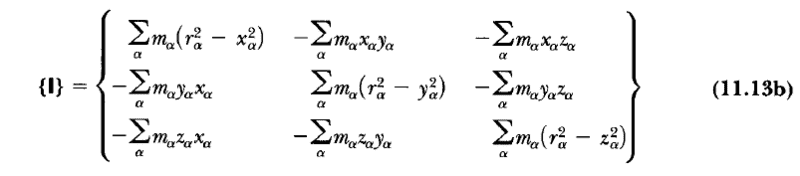
3. Physical Interpretation of the diagonals and off-diagonals of the Inertia Tensor
4.PNG


According to the authors, the diagonal terms are called the moments of inertia and the off-diagonal terms are called the products of inertia. What are the physical interpretations of the diagonal and the off-diagonal terms? What is the difference between them?

Thank you so much for your help.
 

Attachments

  • 1.PNG
    1.PNG
    13.6 KB · Views: 554
  • 2.PNG
    2.PNG
    6.2 KB · Views: 509
  • 3.PNG
    3.PNG
    8 KB · Views: 592
  • 4.PNG
    4.PNG
    7.6 KB · Views: 425
  • 4.PNG
    4.PNG
    7.6 KB · Views: 524
Last edited:
on Phys.org
sams said:
What do the authors mean by the above statement and how did they take V.ω outside the relation?
They mean that all particles have the same V and the same ω, so they can be taken out of the summation, due to the distributive property of the cross product.

sams said:
Shouldn't the second term in the square brackets or in the parenthesis of Equation (11.9) also contain the Kronecker delta function?
No, since the second term comes from a double sum over the components of ω and x. The Kronecker delta is introduced to transform the single sum into a double sum, so that both terms can be written together as a double sum.

sams said:
According to the authors, the diagonal terms are called the moments of inertia and the off-diagonal terms are called the products of inertia. What are the physical interpretations of the diagonal and the off-diagonal terms? What is the difference between them?
There is an orthogonal system of coordinates in which the tensor of inertia is diagonal. In that case, the moments of inertia obtained are aligned with the coordinate axes and they are called the principal moments of inertia. They represent the "natural" way in which the body can rotate. Any rotation can be written as a superposition of rotations around the principal moments of inertia.
 
  • Like
Likes   Reactions: sams
DrClaude said:
No, since the second term comes from a double sum over the components of ω and x. The Kronecker delta is introduced to transform the single sum into a double sum, so that both terms can be written together as a double sum.
5.PNG

Equation (11.8) is obtained from Equation (11.7). How did the second term come with a double sum and not the first term as well?
 

Attachments

  • 5.PNG
    5.PNG
    1.4 KB · Views: 467
sams said:
How did the second term come with a double sum and not the first term as well?
Because you are squaring a dot product. The dot product will give you a sum of three terms, and when you square it you get a product of two sums.

I suggest you write it out. It takes only a couple of lines, and it is just simple vector algebra. All will then become clear.