Trajectory of a photon in a moving box

  • Context: High School 
  • Thread starter Thread starter flexible_time
  • Start date Start date
  • Tags Tags
    Box Photon Trajectory
Click For Summary

Discussion Overview

The discussion revolves around the trajectory of a photon emitted from a moving cylinder with mirrors, examining how its path is perceived in different reference frames. Participants explore the implications of special relativity on the behavior of light in relation to moving observers, considering both theoretical and conceptual aspects of light propagation and measurement.

Discussion Character

  • Exploratory
  • Technical explanation
  • Conceptual clarification
  • Debate/contested

Main Points Raised

  • Some participants propose that when a photon is emitted from a stationary cylinder, its trajectory is straightforward in a stationary frame, but becomes complex when the cylinder is in motion.
  • Others argue that the trajectory of the photon will appear diagonal to an observer in a stationary frame due to the motion of the cylinder, leading to a non-zero x position at detection time.
  • A later reply questions the implications of the speed of light being constant and how that interacts with the perceived motion of the cylinder, suggesting that the light's path cannot gain additional velocity in the x direction without exceeding the speed of light.
  • Some participants draw analogies to a ball bouncing on a moving ship to illustrate how different observers perceive the same event differently, emphasizing the relativity of motion.
  • There are discussions about the nature of photons, with some participants suggesting that thinking in terms of "light signals" rather than photons may clarify the issue, as photons do not follow classical paths.
  • One participant expresses frustration over the concept that the x component of the light's velocity could be non-zero in a stationary frame, arguing that the initial conditions imply it should remain zero.
  • Another participant counters this by explaining that the moving source alters the angle of emission, leading to different perceived trajectories in different frames.

Areas of Agreement / Disagreement

Participants do not reach a consensus on the trajectory of the photon in the moving frame. There are competing views on how the motion of the cylinder affects the perceived path of the photon, and the discussion remains unresolved regarding the implications of special relativity on this scenario.

Contextual Notes

Limitations include the dependence on the definitions of reference frames and the assumptions about the behavior of light in different contexts. The discussion highlights the complexities of relativistic effects without resolving the mathematical details involved.

flexible_time
Messages
29
Reaction score
0
I have a basic question about the trajectory of a photon.
ayVveoX.png


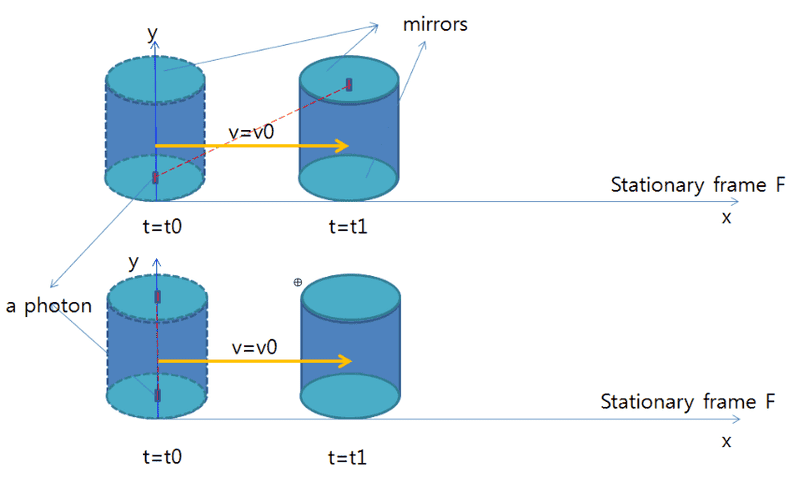
As can be seen in the figure above, let's suppose there is a stationary frame F and a cylinder sealed with two sided mirror is located at the origin of F. Then let's consider two cases; First is the velocity of cylinder is 0 with regard to F and second is constant v=v0. For the first case, at initial time t=t0, single photon is emitted from the center of bottom mirror to the positive y direction with velocity c so that the x position of the photon is not changed. Because of zero velocity of cylinder, the photon will bounce off from side to side forever so the trajectory of the photon will be like the red dotted line at bottom of the figure. So far so good.

Here comes my question concerning the second case v=v0. If the velocity of cylinder with regard to F is non-zero v0 and travel from x=0 to x=v0*(t1-t0), then what will the trajectory of the photon look like? the diagonal path or path parallel y-axis of F? Is the x position of the photon 0 or v0*(t1-t0) at t=t1? Which one is correct?

According to the link here, the answer seems to be x=v0*(t1-t0) when measured in frame F. Do I understand correctly? If so, I doubt where does x changes come from although the photon is emitted to a perpendicular direction to the x axis?
 
Physics news on Phys.org
flexible_time said:
f so, I doubt where does x changes come from although the photon is emitted to a perpendicular direction to the x axis?
This is the same problem as bouncing a ball up and down on the deck of a ship. An observer on the ship sees the ball moving straight up and down with no horizontal component while an observer on the dock watching the ship move slowly by sees the ball following the slantwise path with some velocity in the x-direction. (We can do it the other way as well: the dockside guy bounces a ball straight up and down on the dock; ship guy, believing himself to be at rest while the dock slips slowly backwards will see the ball following a slanting path).

The path of the ball through space is the same whether viewed by dock guy or ship guy - the ball moves through the same points in space either way. The apparent horizontal velocity is introduced by the arbitray choice we've made about what's moving horizontally and what's not.

(As an aside: You should get in the habit of thinking "flash of light" or "light pulse" or "light signal" instead of "photon". Photons aren't what you think they are, and there's no such thing as a photon traveling on a path like you're describing. Fortunately this doesn't change anything in this problem - the question makes just as much sense with a flash of light).
 
  • Like
Likes   Reactions: vanhees71
Nugatory said:
The path of the ball through space is the same whether viewed by dock guy or ship guy - the ball moves through the same points in space either way.

Thank you for reply. So does it mean that the flash of light will be detected at x=v0*(t1-t0) at t1 in frame F? My understanding is the speed of light is constant c and since t=t0, the flash of light have already 100% speed of c along y-axis and no room left for velocity for x direction. If the y portion of velocity of light is c when measured in frame F all the time being till reaching top mirror, then it seems to be impossible for light to gain more speed along x-axis because it means moving faster than the speed limit c.
 
flexible_time said:
Thank you for reply. So does it mean that the flash of light will be detected at x=v0*(t1-t0) at t1 in frame F? My understanding is the speed of light is constant c and since t=t0, the flash of light have already 100% speed of c along y-axis and no room left for velocity for x direction. If the y portion of velocity of light is c when measured in frame F all the time being till reaching top mirror, then it seems to be impossible for light to gain more speed along x-axis because it means moving faster than the speed limit c.
Both observers must agree that the speed of light is ##c##. Both observers can calculate the distance the flash of light must cover to get from one mirror to the other, and they will come up with different results (if the two mirrors are separated by one meter in the y direction, the distance is ##\sqrt{1+\Delta{x}^2}## and ##\Delta{x}## is zero for the observer at rest relative to the box, non-zero for the observer moving relative to the box).

But if the speed is the same and the distance traveled is different, then the travel time must be different... and we've just discovered relativistic time dilation! This two-mirror device you are studying is actually an idealized clock (it's often called a "light clock", and you will find many threads discussing it here). We can say that one tick of the clock corresponds to one mirror-to-mirror passage; if we place the mirrors one light-second apart our clock will even nicely tick once every second. But as the analysis above shows, the clock that is moving relative to us will tick more slowly than the clock that is at rest relative to us.
 
Nugatory said:
(As an aside: You should get in the habit of thinking "flash of light" or "light pulse" or "light signal" instead of "photon". Photons aren't what you think they are, and there's no such thing as a photon traveling on a path like you're describing.

Can you elaborate on this?
 
pixel said:
Can you elaborate on this?
The photon is a quantum object who's behavior is best described by quantum electrodynamics. It does not travel along a path in the classical sense, it is emitted at some place and time (event A) and can be detected at some other place and time (event B) with some probability. One cannot answer (or even ask) how it gets from A to B or where it is at some intermediate time. That's my limited understanding of it.
 
pixel said:
Can you elaborate on this?
There are many posts on this topic over in the quantum physics subforum. If you have further questions after reading some of them, you should start a thread there.
 
Nugatory said:
(if the two mirrors are separated by one meter in the y direction, the distance is ##\sqrt{1+\Delta{x}^2}## and ##\Delta{x}## is zero for the observer at rest relative to the box, non-zero for the observer moving relative to the box)

I already guessed your answer but the problem for me is that I cannot accept easily that ##\Delta{x}## is non-zero in frame F. Let me explain more my frustration.

There are two events; First is the emission of light at t=t0 and second is the detection at y=h assuming h is the height of box measured in the stationary frame F. At t=t0, light is emitted in the positive y direction with velocity c. This event should be agreed on both frame F(stationary frame) and F'(box frame) but let's stick to the frame F only and forget about box frame. It seems to be obvious to me that the velocity of light is ##0x+cy## at t0 and it is my belief that there is nothing external to change the path of emitted light especially in x direction of frame F. If ##\Delta{x}## is non-zero as you wrote, that means any observer stationary relative to frame F must be able to measure the non-zero velocity of light in x direction but this conclusion seems to be violated with the initial assumption that light is emitted with the velocity ##0x+cy##. So I believe that if the velocity of light is ##0x+cy## at t0 in frame F, then ##\Delta{x}## must be zero in frame F because initial velocity of light in x direction is zero and no external force to change x position of flash of light. What is wrong with my understanding?
 
flexible_time said:
What is wrong with my understanding?
The light source is moving in one frame but not the other. Light leaves a moving source at a different angle than a stationary one, so there's no reason for the x components of the velocity to be the same in both frames. That bit about different angles may sound bizarre at first, but it's actually quite natural: consider the example of the ball bouncing up and down on a moving ship. In one frame the deck isn't moving and the trajectory of the ball is perpendicular to the deck; in the other frame the deck is moving and the trajectory of the ball makes an angle with the deck.

Another way of thinking about it: the flash of light follows the same path through space in both frames. Imagine that the space between the mirrors is full of fine dust. Every grain of dust is at rest relative to one of the observers (so is moving relative to the other). As the light moves through the dust it illuminates each individual grain as it reaches it. Both observers agree about which individual grains are illuminated... But the line we draw through the illuminated grains will be slanting in one frame and vertical in the other because the grains are moving in one frame and not the other.
 

Similar threads

  • · Replies 26 ·
Replies
26
Views
2K
  • · Replies 4 ·
Replies
4
Views
2K
  • · Replies 10 ·
Replies
10
Views
2K
  • · Replies 3 ·
Replies
3
Views
2K
  • · Replies 10 ·
Replies
10
Views
2K
  • · Replies 25 ·
Replies
25
Views
1K
  • · Replies 25 ·
Replies
25
Views
2K
  • · Replies 143 ·
5
Replies
143
Views
9K
  • · Replies 2 ·
Replies
2
Views
2K
  • · Replies 2 ·
Replies
2
Views
1K