Transformation of the neighborhood of a branch point

Click For Summary

Discussion Overview

The discussion focuses on the transformation of the neighborhood of a branch point in the context of Fourier and Laplace transforms, particularly as it relates to control theory and the behavior of multivalued functions. Participants explore the implications of polynomial functions and their zeros on the mapping of the real line in the complex plane.

Discussion Character

  • Exploratory
  • Technical explanation
  • Debate/contested

Main Points Raised

  • One participant expresses confusion about the transformation of the neighborhood of a branch point, suggesting that it may depend on the specific function being considered, particularly contrasting simple n-th roots with the ratio of polynomials.
  • Another participant asserts that any polynomial can be factored into integer powers of its roots, indicating that this factorization leads to branch points of a specific type, although the behavior is only near the polynomial's zeros.
  • A follow-up question seeks clarification on how polynomial factors generate the described branch point patterns, questioning the intuition behind the mapping of the real line.
  • Participants clarify that the zeros of the denominator in a rational function are poles rather than branch points, emphasizing the importance of distinguishing between these concepts.
  • It is noted that if all coefficients of the polynomial are real, non-real zeros will appear in conjugate pairs, affecting the mapping behavior.
  • Concerns are raised about visualizing how zeros map the real line to tangent lines in the range plane, especially when considering multiple factors and their interactions.
  • A request for further explanation or readings on the impact of poles on the function and mapping is made, indicating a desire for deeper understanding.

Areas of Agreement / Disagreement

Participants exhibit a mix of agreement and disagreement regarding the behavior of branch points and poles, with some clarifying distinctions while others seek further understanding. The discussion remains unresolved on several technical aspects, particularly regarding the visualization of mappings and the role of poles.

Contextual Notes

Limitations include the potential for differing interpretations of polynomial behavior, the complexity of mapping in the complex plane, and the need for further exploration of the effects of poles in rational functions.

Eric_H
Hi all,

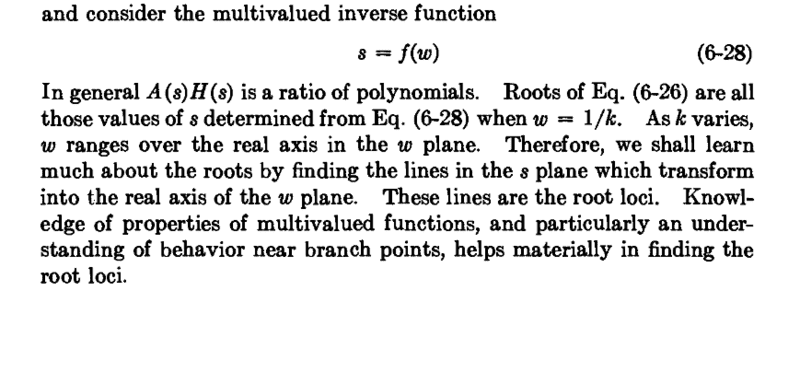
I was trying the understand theory behind Fourier and Laplace Transform (especially in the context of control theory) by reading the book "Complex Variables and the Laplace Transform for Engineers" written by "Wilbur R. LePage".

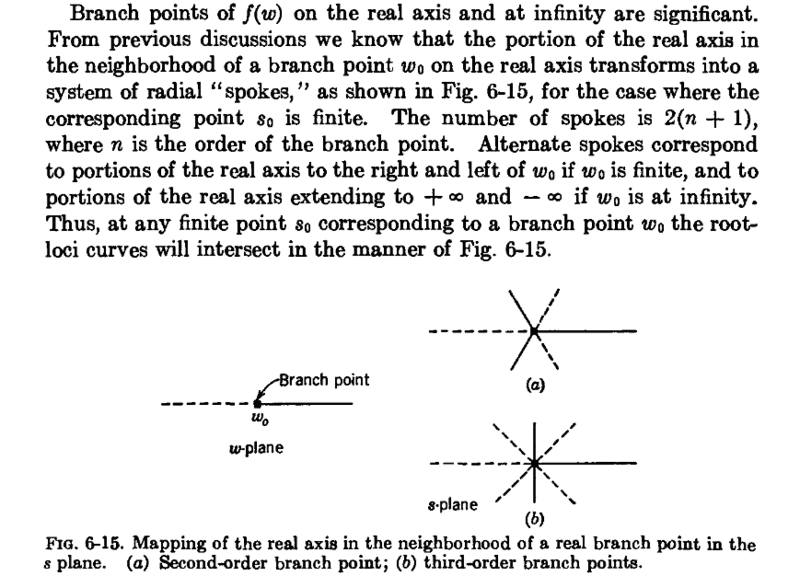
In section 6-10 of the book the author touches on the application of multivalued functions in root locus and said "the portion of the real axis in the neighborhood of a branch point w_o on the real axis transforms into a system of radial 'spokes', as shown in Fig. 6-15."

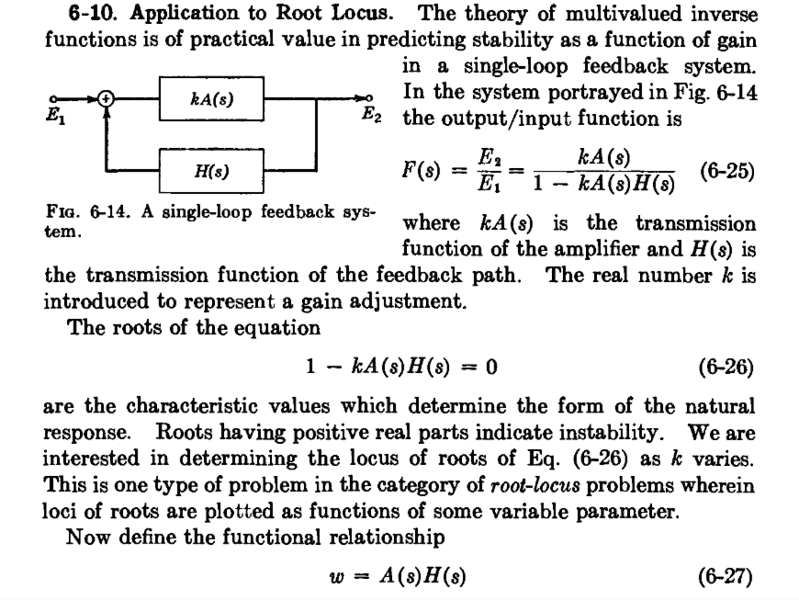
I am confused about the statement as I thought the transformation of the neighborhood of a branch depends on the function we are considering. For instance in the earlier examples in the book, the sq root, cubic root (and in general n-th root I believe) do forms a star / radial 'spokes'. However, in the section 6-10, the function we are converning: w = A(s)H(s) is a ratio of polynomials which I assume may have different behaviour than a simple n-th root?

Any help is appreciated.
001.PNG
002.PNG
003.PNG
 
Physics news on Phys.org
Any polynomial can be factored into a constant times integer powers of (z-ai). More can be said about symmetry when the polynomial has all real coefficients. Although the factorization is different for different polynomials, the factors will always give branch points of the type shown.

PS. The behavior shown is only for a region near to the zero of the polynomial. In general, the "spokes" are curved with tangent lines at the zero point that look like the diagram.
 
  • Like
Likes   Reactions: Eric_H
FactChecker said:
Any polynomial can be factored into a constant times integer powers of (z-ai). More can be said about symmetry when the polynomial has all real coefficients. Although the factorization is different for different polynomials, the factors will always give branch points of the type shown.

PS. The behavior shown is only for a region near to the zero of the polynomial. In general, the "spokes" are curved with tangent lines at the zero point that look like the diagram.
Thanks for your help. Do you mind explaining a bit more on how the factors of a polynomial will always give branch points of the type shown?
It does not look intuitive to me that
$$\Pi(z-a_i)$$
will generate such pattern.

In addition, the function w = A(s)H(s) is a ratio of polynomials, i.e. rational function, so I believe it should have this general form instead:
$$\frac{\Pi(z-a_i)}{\Pi(z-b_i)} $$
and therefore the effect of the denominator have to be taken into account too.
 
The zeros of the denominator are poles rather than branch points. They should be ignored for now, but they are very important for other considerations.
You should also include a constant multiplier as a factor. If all the coefficients are real, the multiplier will be real and any non-real zeros, ai, will come in conjugate pairs. Same for the poles, bi.
If all the ais are distinct, then every zero will map the real line to a single line tangent to the real line at zero on the range plane. If there are n identical ais, then you can consolidate them to a multiplier (z-ak)n. That would give a branch point as described above. There would be n lines through ak exactly evenly directed as described above that are mapped to curves through zero which are tangent to the real line.
 
Last edited:
  • Like
Likes   Reactions: Eric_H
FactChecker said:
The zeros of the denominator are poles rather than branch points. They should be ignored for now, but they are very important for other considerations.
You should also include a constant multiplier as a factor. If all the coefficients are real, the multiplier will be real and any non-real zeros, ai, will come in conjugate pairs. Same for the poles, bi.
If all the ais are distinct, then every zero will map the real line to a single line tangent to the real line at zero on the range plane. If there are n identical ais, then you can consolidate them to a multiplier (z-ak)n. That would give a branch point as described above. There would be n lines through ak exactly evenly directed as described above that are mapped to curves through zero which are tangent to the real line.

Thank you so much for the follow up, but I still cannot visualize why every zero will map the real line to a single line tangent to the real line at zero on the range plane, especially when the factors are multiplied together. The point about conjugate pair are roots is clear and is the result of complex conjugate root theorem. I am also curious about in which way the poles will affect the function / mapping.

Do you mind explaining a bit more about the above points or point me to some readings about them (e.g. some specific chapters of a book)?

Thanks a lot.
 

Similar threads

  • · Replies 1 ·
Replies
1
Views
3K
  • · Replies 17 ·
Replies
17
Views
11K
  • · Replies 5 ·
Replies
5
Views
3K
  • · Replies 1 ·
Replies
1
Views
3K
Replies
24
Views
3K
Replies
1
Views
2K
  • · Replies 2 ·
Replies
2
Views
3K
  • · Replies 2 ·
Replies
2
Views
2K
  • Poll Poll
  • · Replies 5 ·
Replies
5
Views
9K
Replies
2
Views
3K