Engineering Transformer open/short circuit test

Click For Summary
The discussion centers on the confusion regarding the calculation of impedance (Z) and resistance (R) in AC circuits, particularly in transformer testing. Participants clarify that Z represents the total opposition to current flow, incorporating both resistance and reactance, while R is solely the resistance when no reactive components are present. The formulas P/I^2 and V/I yield different values for R and Z due to the presence of reactive elements in AC circuits. The power triangle is referenced to illustrate the relationship between real power, reactive power, and apparent power in AC systems. Understanding these distinctions is crucial for accurate calculations in AC circuit analysis.
Luchekv
Messages
65
Reaction score
1
Hi guys,
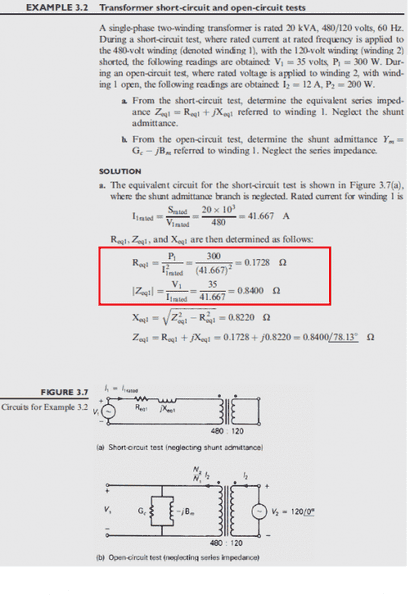
The problem isn't with the question itself its more to do with the fact about how they got Z and R. Just need some clarification.
confused.png

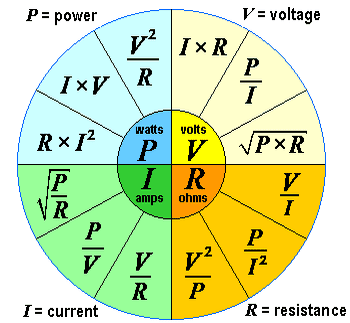
In every other AC power question. I have always worked out impedance with whatever parameters I had be it P/I^2 or V/I. I'm confused as to what the difference here is? Now I'm being thrown off and don't know what I'm calculating in other questions :S
Both of those formulas work out 'R' as can be seen here..so why are they getting two different numbers?
sds.png


Thank you in advance guys
 
Physics news on Phys.org
you have posted ohms law for DC not AC.

is that your confusion?

you know to replace R in your circular crib sheet with

Z = R + (Xl - Xc)j

?
 
I'm confused as to why Z = V/I and not R...but P/I^2 does
 
Luchekv said:
I'm confused as to why Z = V/I and not R...

You confused why Z does not equal R?

Z = V/I is ohms law for AC circuits

Z equals R when there is no reactive component.

Z is the total opposition to current flow defined as I wrote previously.are you happy with complex numbers (both using j notation and polar notation, and swapping between the two)?

Do you know the power triangle
http://sub.allaboutcircuits.com/images/02218.png
 
Last edited:
  • Like
Likes Luchekv
Thats perfect, thank you! and yes I'm good with converting between the two :)
 
Just a note, if you draw a power triangle. You'll notice that the 'real' Power is real (Re) and reactive power (Q) is Imaginary (Im), whereas apparent power (S) is a vector of both.

Considering that resistors only have the real component and no imaginary part, this is why you can apply the DC power equation to the AC circuit for this resistor.
 
  • Like
Likes Luchekv

Similar threads

  • · Replies 7 ·
Replies
7
Views
3K
  • · Replies 5 ·
Replies
5
Views
3K
  • · Replies 4 ·
Replies
4
Views
1K
  • · Replies 20 ·
Replies
20
Views
5K
  • · Replies 12 ·
Replies
12
Views
2K
  • · Replies 2 ·
Replies
2
Views
6K
Replies
19
Views
3K
  • · Replies 2 ·
Replies
2
Views
2K
  • · Replies 5 ·
Replies
5
Views
2K
  • · Replies 1 ·
Replies
1
Views
5K