Translational and Rotational Equilibrium

Click For Summary
SUMMARY

The discussion centers on the concepts of translational and rotational equilibrium in a system involving a rod with suspended masses. When a counterweight is moved from 1cm to 2cm away from the fulcrum, the rod is no longer in rotational equilibrium due to the introduction of net torque. Furthermore, the system is also not in translational equilibrium because the center of mass of the rod accelerates, indicating that the vector sum of forces acting on the system is not zero. This leads to the conclusion that translational equilibrium cannot exist if rotational equilibrium is absent, particularly when the fulcrum is not aligned with the center of mass.

PREREQUISITES
  • Understanding of Newton's laws of motion
  • Familiarity with the concepts of torque and angular acceleration
  • Knowledge of center of mass and its significance in rigid body dynamics
  • Basic grasp of equilibrium conditions in physics
NEXT STEPS
  • Study the conditions for rotational equilibrium in rigid bodies
  • Learn about the relationship between torque and angular acceleration in systems
  • Explore the concept of center of mass and its role in translational motion
  • Investigate examples of systems in translational equilibrium without rotational equilibrium
USEFUL FOR

This discussion is beneficial for physics students, educators, and anyone studying mechanics, particularly those focusing on equilibrium conditions in rigid body dynamics.

mlb2358
Messages
16
Reaction score
0
Hi Everyone,
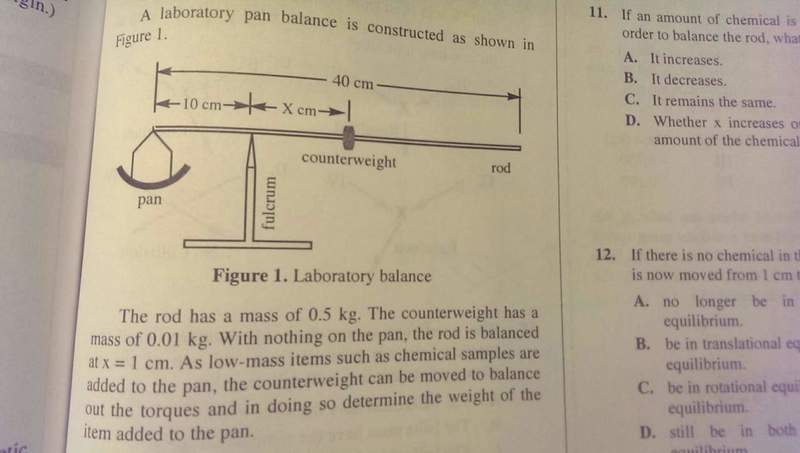
I'm having some trouble with a problem concerning translational and rotational equilibrium. The question involves a balance with various masses suspended from it (see attached image). The question states that the counterweight is moved from 1cm away from the fulcrum to 2cm away from the fulcrum and asks whether or not the rod is still under rotational and translational equilibrium. I understand that it is no longer in rotational equilibrium because there is now a net torque acting on the rod, however the translational equilibrium portion is unclear to me. The answer argues that the masses suspended from the rod no longer exert the same force on the rod because they are now accelerating, thus translational equilibrium is no longer present. I am unclear as to why they are accelerating. I realize that the apparatus will rotate which gives it angular acceleration, but is this enough to conclude that it has linear acceleration as well (alpha =a/r)? If this is the case, how could we ever have have translational equilibrium while not having rotational equilibrium?

I'd appreciate any help, thanks.
uploadfromtaptalk1404728921638.jpg
 
Physics news on Phys.org
mlb2358 said:
Hi Everyone,
I'm having some trouble with a problem concerning translational and rotational equilibrium. The question involves a balance with various masses suspended from it (see attached image). The question states that the counterweight is moved from 1cm away from the fulcrum to 2cm away from the fulcrum and asks whether or not the rod is still under rotational and translational equilibrium. I understand that it is no longer in rotational equilibrium because there is now a net torque acting on the rod, however the translational equilibrium portion is unclear to me. The answer argues that the masses suspended from the rod no longer exert the same force on the rod because they are now accelerating, thus translational equilibrium is no longer present. I am unclear as to why they are accelerating. I realize that the apparatus will rotate which gives it angular acceleration, but is this enough to conclude that it has linear acceleration as well (alpha =a/r)? If this is the case, how could we ever have have translational equilibrium while not having rotational equilibrium?

I'd appreciate any help, thanks. View attachment 71115

Hi mlb2358. Please be sure to employ the posting template when you begin a thread in the Homework sections of Physics Forums. To do otherwise is tempting the wrath of the Mentors who may award infraction points for improperly formatted homework help requests.

The posting guidelines may be found in the pinned thread, "Guidelines for students and helpers", at the top of the thread list.

Re: translational motion. What criterion is used to judge whether a rigid body is undergoing translational motion? What does this criterion say about the motion of the particular rigid body in this case?
 
Last edited:
Does the center of mass of the system accelerate?
 
dauto said:
Does the center of mass of the system accelerate?
The center of mass of the system would be the center of the rod which does accelerate. Does this mean that we can only have translational equilibrium while not having rotational equilibrium when the fulcrum is at the center of mass of the system? Also, the question asks specifically whether the rod is under translational and rotational equilibrium, thus I should only be concerned with the center of mass of the rod and not the system, correct? I realize they are pretty much the same in this case, but I just want to ensure that I understand the concept.

Thanks
 
gneill said:
Hi mlb2358. Please be sure to employ the posting template when you begin a thread in the Homework sections of Physics Forums. To do otherwise is tempting the wrath of the Mentors who may award infraction points for improperly formatted homework help requests.

The posting guidelines may be found in the pinned thread, "Guidelines for students and helpers", at the top of the thread list.

Re: translational motion. What criterion is used to judge whether a rigid body is undergoing translational motion? What does this criterion say about the motion of the particular rigid body in this case?
I apologize for not using the guidelines. I haven't been on this forum in some time and was using a mobile device to post my question.

In response to the question, the requirement is that the vector sum of all of the forces acting on the system should be equal to 0. From dauto's response I guess I should be focusing on the center of mass of the system, which does have a net force applied to it. My question from here is whether translational equilibrium can be present if rotational equilibrium is not present and the fulcrum is not at the center of mass of the system.

Thanks
 
mlb2358 said:
I apologize for not using the guidelines. I haven't been on this forum in some time and was using a mobile device to post my question.
Understood.

In response to the question, the requirement is that the vector sum of all of the forces acting on the system should be equal to 0. From dauto's response I guess I should be focusing on the center of mass of the system, which does have a net force applied to it. My question from here is whether translational equilibrium can be present if rotational equilibrium is not present and the fulcrum is not at the center of mass of the system.

You would do well to consider the motion of the center of mass of the rod as seen from some "stationary" (or inertial) frame of reference. Perhaps for simplicity assume that the fulcrum stand is at rest in this frame of reference along with the center of mass of the rod at its initial position.

The result of unbalanced forces working on a system results in motion. Sketch the motion of the center of mass of the rod for the case where it sits at the fulcrum and when it is offset from the fulcrum. If the center of mass moves in the chosen frame of reference then clearly there is translational motion involved.
 

Similar threads

Replies
6
Views
2K
Replies
14
Views
1K
  • · Replies 5 ·
Replies
5
Views
2K
  • · Replies 31 ·
2
Replies
31
Views
2K
  • · Replies 4 ·
Replies
4
Views
2K
  • · Replies 14 ·
Replies
14
Views
1K
  • · Replies 11 ·
Replies
11
Views
5K
  • · Replies 11 ·
Replies
11
Views
2K
  • · Replies 2 ·
Replies
2
Views
1K
  • · Replies 1 ·
Replies
1
Views
1K