Sekonda
- 201
- 0
Hello again,
I also have another question, somewhat related to my previous, on the topic of the Klein-Gordon equation but treating the mass as a perturbation.
The feynman diagram shows the particular interaction:
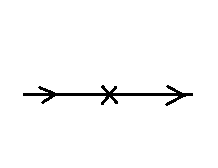
I believe the cross is the point of interaction via the perturbation (the mass), we model the perturbation:
[tex]\delta V=m^2[/tex]
and subsequently use this in the calculation for the transition amplitude, we use plane-wave solutions of the ingoing and outgoing states.
Alike to my previous question, I'm not really sure what this means to model some potential as a mass? Can anyone explain why we do this and maybe exactly what is happening in this particular feynman diagram?
I can try to embelish if needs be, please tell me if there are any inconsistencies or errors I have made in my explanation of my problem!
Thanks,
SK
I also have another question, somewhat related to my previous, on the topic of the Klein-Gordon equation but treating the mass as a perturbation.
The feynman diagram shows the particular interaction:
I believe the cross is the point of interaction via the perturbation (the mass), we model the perturbation:
[tex]\delta V=m^2[/tex]
and subsequently use this in the calculation for the transition amplitude, we use plane-wave solutions of the ingoing and outgoing states.
Alike to my previous question, I'm not really sure what this means to model some potential as a mass? Can anyone explain why we do this and maybe exactly what is happening in this particular feynman diagram?
I can try to embelish if needs be, please tell me if there are any inconsistencies or errors I have made in my explanation of my problem!
Thanks,
SK