Treating multiple objects as the same system

Click For Summary

Homework Help Overview

The discussion revolves around a physics problem involving a box dropped onto a pan connected to two springs. The participants explore concepts of potential energy, kinetic energy, and the treatment of multiple objects as a single system in mechanics.

Discussion Character

  • Exploratory, Conceptual clarification, Assumption checking

Approaches and Questions Raised

  • Participants discuss the potential energy contributions from both the box and the springs, questioning the limits of treating them as a single system. There are inquiries about how to handle kinetic energy when multiple objects are involved and the implications of the pan's negligible mass.

Discussion Status

The conversation is ongoing, with various interpretations of the system's setup being explored. Some participants have provided insights into energy conservation and the interactions between the box, springs, and Earth, while others express confusion about the initial conditions and setup of the problem.

Contextual Notes

There is a noted ambiguity regarding the setup of the pan and springs, with participants questioning whether the springs are arranged horizontally or vertically. Additionally, there is confusion stemming from the original poster's reference to a "brick" instead of a "box," which may affect the clarity of the problem context.

x86
Gold Member
Messages
256
Reaction score
18
Throughout my limited physics career (high school, first year university) I was introduced to concepts such as potential energy, kinetic energy, and work. Naturally, I was taught about potential energy using the whole gravity analogy. A brick at height h has more potential energy than a brick at height 0, provided h>0.

Now one thing really confused me.


1. Homework Statement

A pan of negligible mass is attached to two identical springs of stiffness k = 250 N/m. If a 10kg box is dropped from a height of 0.5m above the pan, determine the maximum vertical displacement d. Initially each spring has a tension of 50 N.

The springs are each 1 m long.

Homework Equations


F=-kx
W = integral of F with respect to dx
potential energy + work + kinetic energy = potential energy + kinetic energy

The Attempt at a Solution


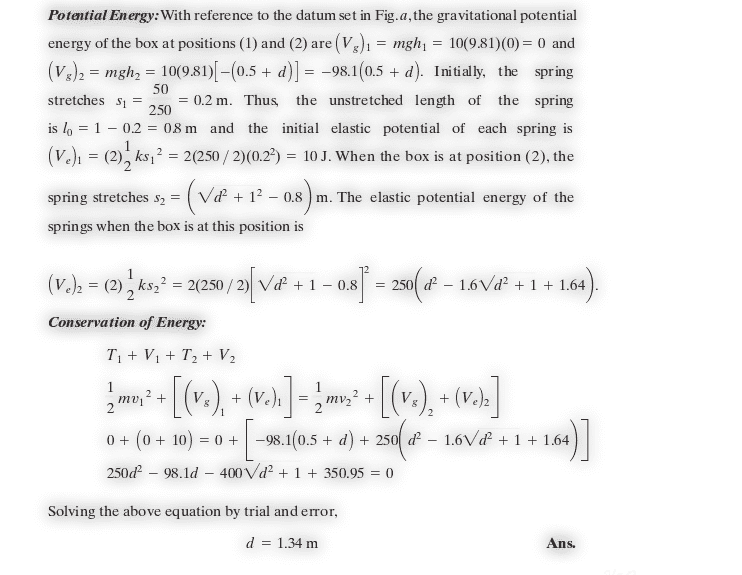
The question is solved by a solution manual online by considering taking the potential energy of the spring, the box, and the earth. The thing is, I originally never learned that we could do this. I learned that we can only take the potential with respect to one object.

Naturally, this confused me. Exactly what are the limits to taking both of these objects as one system? How would we handle kinetic energy (if both the spring and the mass were moving with their own independent velocities)

Here is how it is solved:
Selection_016.png
 
Physics news on Phys.org
Yes, you can consider multiple objects as the same system. The kinetic energies (if any) add, and also add the potential energies of the forces of interaction.
Here the box and Earth interact with the force mg and the potential energy from that interaction is mgh. The springs interact with the box, and the potential energy of interaction between the box and one spring is 0.5k(ΔL)2 where ΔL is the change of length with respect to the relaxed length of the spring.
Assuming no loss of energy, the sum of KE and all PE-s is constant during the motion. At the end, the KE is zero, so the final potential energy is equal to the initial one.
 
Last edited:
  • Like
Likes   Reactions: x86
The box is connected to the Earth via the gravitational force and also via the spring
which exerts a restoring force on it. Due to its position it has potential energy from
from both of these - the spring is pulling it back and so is the earth. In such a system
we find that the mechanical energy is conserved, that is the sum of the potential and kinetic
energy, if no other external froces is acting on it.
 
  • Like
Likes   Reactions: x86
andrevdh said:
The box is connected to the Earth via the gravitational force and also via the spring
which exerts a restoring force on it. Due to its position it has potential energy from
from both of these - the spring is pulling it back and so is the earth. In such a system
we find that the mechanical energy is conserved, that is the sum of the potential and kinetic
energy, if no other external froces is acting on it.

But in the first snapshot, the box isn't touching the spring.
 
x86 said:
But in the first snapshot, the box isn't touching the spring.
The pan has negligible mass, so it does not take away energy. Initially, there energy is equal to the gravitational PE of the brick, as the elastic PE of the spring is zero.
The final energy is the sum of the gravitational energy corresponding to the deepest position of the brick, and the elastic energy of the spring, as the KE is zero.
 
ehild said:
The pan has negligible mass, so it does not take away energy. Initially, there energy is equal to the gravitational PE of the brick, as the elastic PE of the spring is zero.
The final energy is the sum of the gravitational energy corresponding to the deepest position of the brick, and the elastic energy of the spring, as the KE is zero.

The solution says the initial elastic potential energy is 10J. Also, how would the pan take away energy if it had mass?
 
x86 said:
The solution says the initial elastic potential energy is 10J. Also, how would the pan take away energy if it had mass?
Sorry, I forgot that 10 J.
If the pan had mass, the velocity of the spring would change when it collides with the pan. If the collision was perfectly elastic, the brick would rebound and the motion would be quite complicated. But a collision is never really elastic, some of the energy would be lost . So the KE of the pan and brick would be less than the initial PE of the brick.
In the problem, the massless pan just holds the brick , as part of the ideal spring. So you can consider the process that the initial PE of the brick transforms to KE at the pan and that KE transforms to elastic energy.
 
  • Like
Likes   Reactions: x86
This is becoming very confusing.
Now there is talk of a brick too?
How is the pan/springs set up?
Is the pan between two horizontally stretched springs
or one above one below...?
It seems to me that the pan - springs system was set up
by stretching the springs. That is why there is stored
potential energy in the springs.
 
The OP started to write about a brick in the first post... But it is a box in the problem text.
Nothing was said about the set-up. I guess, the pan was connected to two horizontal springs.
 

Similar threads

Replies
17
Views
2K
  • · Replies 58 ·
2
Replies
58
Views
3K
  • · Replies 7 ·
Replies
7
Views
1K
  • · Replies 20 ·
Replies
20
Views
4K
Replies
7
Views
1K
  • · Replies 1 ·
Replies
1
Views
2K
Replies
2
Views
1K
  • · Replies 3 ·
Replies
3
Views
2K
  • · Replies 6 ·
Replies
6
Views
2K
  • · Replies 2 ·
Replies
2
Views
2K